Frozen squirrel poop hints at sights and smells of Ice Age ecosystems
The tiny frozen pellets are storehouses of DNA from the rodents’ diverse diets
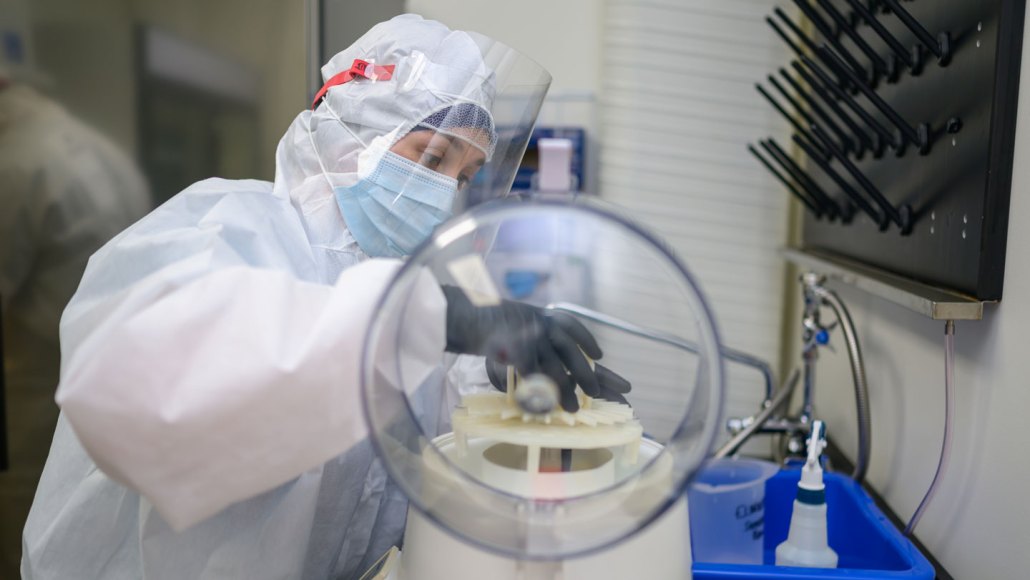
Paleogenomics researcher Danielle Grant, suited up to avoid contaminating ancient poo with any modern genes, loads fecal samples into a centrifuge to extract ancient DNA fragments.
Bennett Whitnell/Hakai Institute
Ancient squirrel poo doesn’t stink. At least not at first.
But that changes when you begin to break down the pellets. Melting them made it clear that they were not mineralized, stony fossils, says biomolecular archaeologist Tyler Murchie of the Hakai Institute in Canada. “There’s no mistaking,” he says. “This is a very poopy-smelling lab.”
The fresh fecal smell is a sign of science. The pellets contain fragments of DNA from the squirrels’ diet that paint a picture of the animals’ ecosystems in new detail, Murchie and his colleagues report June 9 in Nature Communications.
The fecal pellets are some of the many ancient remains found during gold mining operations, Murchie says. As miners melt the permafrost, they expose gold as well as precious bones and mummified remains of ancient creatures.
There are mammoth bones and steppe bison bones, Murchie says, and as work progresses, eventually “you see these large exposures on the valley walls, there’s all these little pockets.” Those holes are the remains of ground squirrel burrows (genus Urocitellus). The burrows are literally frozen in time. “They have little latrine areas and tunnel networks and caches of food,” Murchie says.
Ancient ground squirrels were wonderful paleontology assistants. “They really function as little naturalists or archivists, going on the landscape like pack rats, gathering up all these bits of plant material, seeds, leaves, twigs, etc., bones,” Murchie says. But while scientists had carefully cataloged the contents of the burrows, no one had looked at the frozen poop the squirrels left behind.
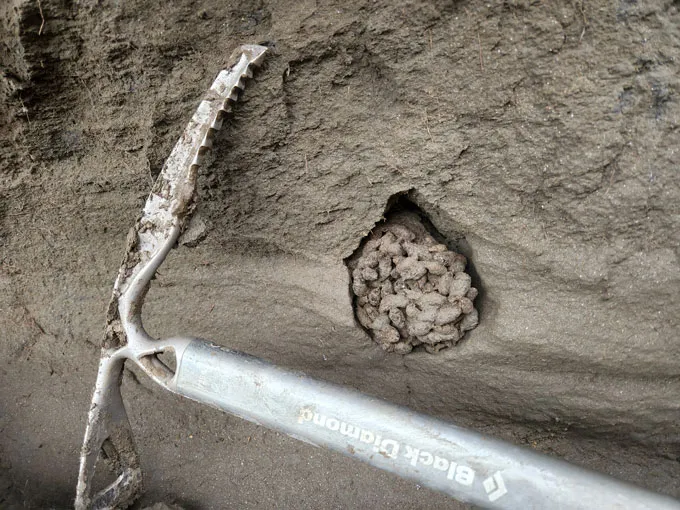
The researchers plugged their noses, thawed the pellets, and extracted DNA from 13 squirrel coprolites from the Yukon. The oldest poop turned out to be nearly 700,000 years old, with others ranging from about 80,000 to 17,000 years old, spanning the Pleistocene epoch.
Scientists usually assume that Pleistocene squirrels were the same squirrels still present in the Yukon today. But “the species we thought these all were doesn’t seem to actually be the species that’s there today,” Murchie says. “There’s been a population turnover of some sort.” The oldest sample, at nearly 700,000 years old, also could be a new species. “It sits in its own evolutionary branch,” he says. “The closest thing to it is squirrels that are in China now.”
The poop held other surprises too. “I thought the DNA would mostly just be the squirrel plus their gut microbiome,” Murchie says. But there were fragments from the squirrels’ diet, too.
Ground squirrels are not picky eaters, and genetic material popped up from grasses, willows, beetles, grasshoppers, woolly mammoths, steppe bison, wolves, ancient horses and many other species.
There were probably not packs of ground squirrels ravenously chasing down mammoths, says Jaquelyn Gill, a paleoecologist at the University of Maine in Orono, who was not involved in the study. Instead, the squirrels were probably scavenging. “It could have been a component of the diet. They could have been chewing on bone for [the] calcium source,” she says.
Rodents today frequently do the same. “I remember watching one on my fence eating a bone,” Murchie says. “It was definitely a different perspective on them after that.” Their omnivorous tendencies allowed Murchie and his colleagues to reconstruct the mitochondrial genomes of 24 animals, 12 from the squirrels themselves, a snowshoe hare used as a control, two bison, three horses and six mammoths.
The other species in the scat offer a detailed picture of the ecosystem, Gill says. “A mammoth bone will tell you a mammoth was here,” she says. “These ground squirrel coprolites are telling you we had a ground squirrel here eating these plants, living among these insects, sharing the landscape.”
And while it’s easy to want to study a mammoth tusk, it’s a little harder to see the promise in poop, she says. “I think you have to have a little bit of imagination and maybe a little humility.”