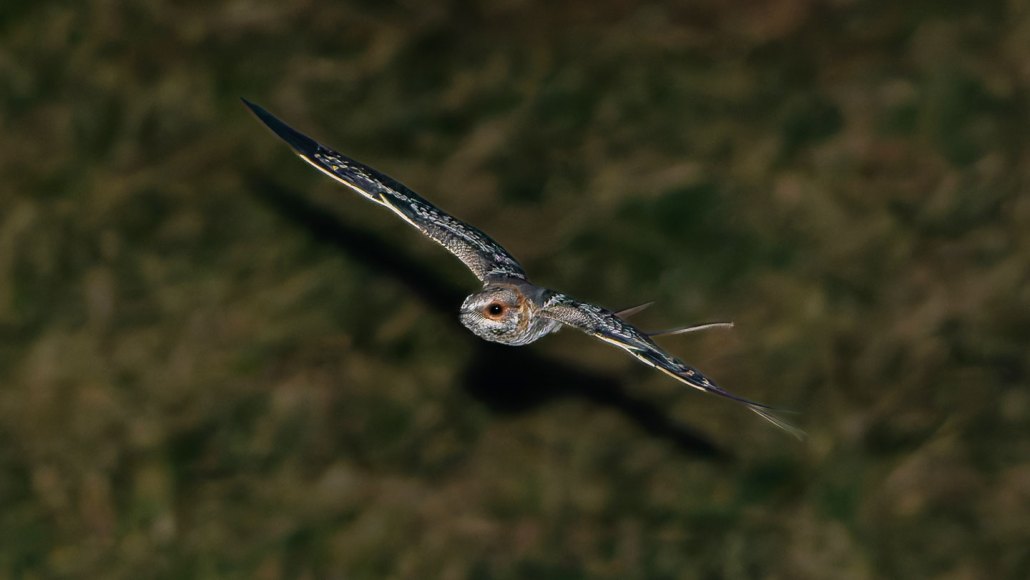
Scissor-tailed nightjars have long been known to make explosive cracking noises at night.
Rogerio Peccioli/iStock/Getty Images Plus
A series of sharp cracks splits the nighttime air in a forest in the Andean foothills. But this isn’t the sound of boots snapping twigs underfoot. It’s a bird.
Male scissor-tailed nightjars (Hydropsalis torquata) create these abrupt sounds by hitting the bones in their wings together in a forceful snap, researchers report in the May Journal of Avian Biology.
Nightjars are largely nocturnal, insect-eating birds related to hummingbirds and swifts. H. torquata males are unusual for their exceptionally long, paired tail feathers. These males were already known to make explosive cracking noises at night as a mating signal to any nearby females. But little was understood about how they were doing it, says Juan Ignacio Areta, an evolutionary naturalist at Instituto de Bio y Geociencias del Noroeste Argentino in Salta, Argentina.
“Many nocturnal animals are well known for being extremely silent, such as the ‘silent’ flight of owls,” Areta says. “We wanted to learn how it was possible for a nocturnal animal to make these loud sounds.”
In late 2022, Areta and Christopher Clark — a behavioral ecologist at the University of California, Riverside — covertly filmed the male birds at night along a forest road near Salta. They used high-speed infrared cameras and then compared the footage to the sounds they were recording.
Often, the nightjars would hop off the ground and swing their wings together behind their backs, creating a loud clack upon impact. Sometimes the males did this while flying or while mating with a female. The birds weren’t just hitting their feathers together. It was clear to the researchers that the snaps came from the wrist bones colliding just below the last bend in the wing. Areta and Clark think the bones vibrating from the forceful collision create the abrupt snapping sound.
The findings add scissor-tailed nightjars to a list of birds that use their bodies, not their voices, to make sound. Members of this percussion band include male Siberian grouse (Falcipennis falcipennis), which strike their uniquely shaped wing feathers together. Male riflebirds scrape their bill across their wings like a wooden rasp. Some manakins — colorful birds in the tropical Americas — are the only other birds known to snap their wrists together like the nightjars, Areta says.
The researchers don’t know what these snaps convey to other nightjars. The males snap when attracting, approaching and mating with females. They also snap when chasing intruders.
“It seems that nightjars are really fond of these sounds,” Areta says.