Comprehension
Reading comprehension questions are tied to articles and graphs from Science News.
We summarize the week's scientific breakthroughs every Thursday.
- Astronomy
Pushing the boundaries of outer space
Students will answer questions about the Science News article “Here are the James Webb Space Telescope’s stunning first pictures,” which highlights dazzling cosmic wonders seen in farthest and clearest views yet of deep space. A version of the article, “Postcards from a new space telescope,” appears in the August 13, 2022 issue of Science News.
- Chemistry
The scoop on ice cream science
Students will answer questions about the online Science News article “Grainy ice cream is unpleasant. Plant-based nanocrystals might help,” which describes new research into improving the shelf life of ice cream. A version of the article, “Cellulose helps ice cream go down smooth,” appears in the May 7, 2022 & May 21, 2022 issue of Science News.
- Earth
Joining forces for rock science
Students will answer questions about the online Science News article “How climbers help scientists vibe with Utah’s famous red rock formations,” which describes how researchers teamed up with rock climbers to collect data that can help assess the seismic stability of red rock formations in Utah. A version of the article, “Climbers help scientists vibe with Utah’s rocks,” appears in the April 23, 2022 issue of Science News.
- Animals
Octopus moms seek the heat
Students will answer questions about the Science News article “Some deep-sea octopuses aren’t the long-haul moms scientists thought they were,” which describes how octopuses laying eggs in warm waters near geothermal springs speed up hatching. A version of the article, “Deep-sea ‘octomoms’ seek the heat,” appears in the April 9, 2022 issue of Science News.
- Paleontology
Dating dino doomsday
Students will answer claim, evidence and reasoning questions about the online Science News article “The Age of Dinosaurs may have ended in springtime.” The article describes how scientists used fossilized fish to determine what season it was when an asteroid wiped out nonavian dinosaurs. A version of the article, “Dinosaur killer may have hit in spring,” appears in the March 26, 2022 issue of Science News.
- Plants
Counting Earth’s tree species
Students will answer questions about the online Science News article “Earth may have 9,200 more tree species than previously thought,” which describes researchers’ efforts to estimate the number of tree species on Earth. A version of the article, “Earth may be hiding thousands of tree species,” appears in the March 12, 2022 issue of Science News
- Science & Society
Defying expectations
Students will answer questions about the online Science News article “Why do some people succeed when others fail? Outliers provide clues,” which describes how research into communities that defy expectations can reveal ways to help others.
- Chemistry
Chemistry that’s out of this world
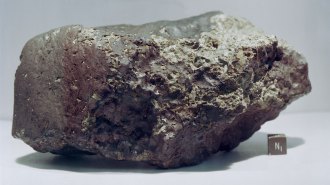
Students will answer questions about the online Science News article “Organic molecules in an ancient Mars meteorite formed via geology, not alien life,” which describes new research into the origin of organic material found in a space rock. A version of the article, “Meteorite’s organics aren’t signs of life,” appears in the February 12, 2022 issue of Science News.
- Psychology
Being mindful of mental health
Students will answer questions about the online Science News article “How mindfulness-based training can give elite athletes a mental edge,” which explores new research into psychological tools to improve mental health. A version of the article, “Mental gymnastics,” appears in the January 29, 2022 issue of Science News.
- Chemistry
Chemistry of wildfire smoke
Students will answer questions about the online Science News article “Wildfire smoke may ramp up toxic ozone production in cities,” which explores new research into the interactions between wildfire smoke and air pollution in cities. A version of the article, “Wildfires may boost urban ozone levels,” appears in the January 15, 2022 issue of Science News.
- Physics
Science in a snap
Students will answer questions about the online Science News article “New high-speed video reveals the physics of a finger snap,” which details scientists’ exploration of the friction required for finger snapping. A version of the article, “Camera captures physics in a snap,” appears in the December 18, 2021 & January 1, 2022 issue of Science News.
- Ecosystems
Rethinking whale appetites
Students will answer questions about the online Science News article “Baleen whales eat (and poop) a lot more than we realized,” which details scientists’ efforts to accurately estimate how much certain whale species eat and what that means for ecosystems. A version of the article, “Whales eat more than we thought,” appears in the December 4, 2021 issue of Science News.