Search Results
All about Explainers: An article type from Science News Explores
Use this lesson plan to learn about an article type called Explainers that is published by Science News Explores in print and online. You can also access a lesson plan template that can be used with any Explainer article. Explainer articles take a deep dive into a key scientific concept or process.
Literacy Practice: Cornell Note-Taking System
Use this lesson plan and the provided template to have your students practice the Cornell Note-taking System with any article. This literacy strategy organizes notes into two columns that provide structure for note-taking, analysis and review and that will help increase students’ learning, comprehension and retention.
Parrot pigmentation by functional group
Scientists have discovered an enzyme that helps oxidize the pigment aldehyde psittacofulvin, which colors parrot feathers red, to carboxyl psittacofulvin, a yellow pigment. After reviewing the basics of molecular structure and bonding, use this activity to introduce functional groups to students before having the students describe how different pigments might create the feather colors in a photo of a parrot. Finally, discuss the importance of understanding properties and reactivity of functional groups.
Catchy catalysts and exciting enzymes
A carnivorous plant enzyme and an enzyme from a symbiotic fungal friend expedite digestion of ants. Use this as an example of enzymes, to introduce catalysts to your students. Then have students investigate how enzymes relate to catalysts, create their own catalyst metaphor and find another example of a catalyst or enzyme. Have students share examples and, as a class, discuss why scientists are interested in learning more about enzymes or other catalysts and potential applications of catalysts.
Investigating phenomena with SEPs
To investigate why some meteors create persistent trails, scientists filmed the New Mexico sky for two years, recording streaks of light. Use shooting stars as an example phenomenon to generate student interest, wonder and questions. Then, have students explore how this phenomenon was studied using Science and Engineering Practices, while evaluating the study’s design, limitations and possibilities for future research. Finally, have students search for another phenomenon that interests them and begin asking questions about it.
Green light means “go”
Just when we all thought we had evaporation all figured out, clever experiments shine a new light on old assumptions. A new study points to light having the ability to help sever bonds (a type of intermolecular force) between water molecules to boost evaporation. Learn how these findings support new scientific claims and challenge the old notion that light affects evaporation only indirectly, through heat generation.
A sweaty plant adaptation
Sweating has a surprising purpose for one desert plant. Students will learn about a chemical adaptation that allows the plant to collect moisture in an arid environment. They’ll answer questions about using videos to collect data and then draw molecular diagrams that illustrate the plant’s adaptation.
Pink diamonds
Colliding tectonic plates might make your diamond blush. Learn how differences in crystal structure give rise to distinctive physical differences, such as the rare pink diamonds of Western Australia. Answer questions about the value of skepticism in science and discuss how uncovering the history of our planet can give us a treasure-hunting lead.
Planning a Garden Plot
Gardens have many functions ranging from vegetable and fruit production to flood mitigation and erosion control. Gardens also can be a haven for pollinators and a repository for native plants. Over the course of a year, students will design a garden for their school or a community organization using scientific concepts they learn in class.
Fluorescing frogs
Light up your class with examples of fluorescence, including recently found biofluorescence in many frog species. Learn about the discovery of fluorescing frogs, discuss the potential evolutionary advantages of fluorescence, answer questions about the chemistry behind fluorescence and perform a demonstration of fluorescence from common objects.
Health Effects of Climate Extremes and Thermal Technology
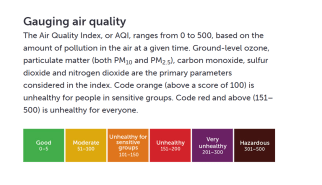
Climate extremes are impacting human health and inspiring new technology. This guide provides lesson plans paired to recent news articles covering a new thermal fabric prototype and its ability to regulate temperature and how wildfire smoke impacts the air quality index and human health.
Not too hot. Not too cold
Staying cool in the summer and keeping warm in the winter may
become easier. Learn about a new thermal fabric prototype and its ability to regulate temperature,
answer questions about its design and function and discuss potential applications.