Search Results
The scoop on ice cream science
Students will answer questions about the online Science News article “Grainy ice cream is unpleasant. Plant-based nanocrystals might help,” which describes new research into improving the shelf life of ice cream. A version of the article, “Cellulose helps ice cream go down smooth,” appears in the May 7, 2022 & May 21, 2022 issue of Science News.
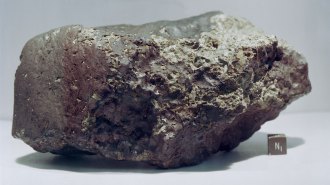
Meteorite’s Organics Aren’t Signs of Life
In this guide, students will learn about the origin of organic material found inside a meteorite from Mars and discuss how new evidence can be used to reevaluate scientific claims.
Evaluating scientific claims with new evidence
Students will compare two Science News articles and analyze how new evidence has revised an initial claim and the reasoning behind that claim. As a bonus, students can answer chemistry questions about abiotic and biotic reactions.
Chemistry that’s out of this world
Students will answer questions about the online Science News article “Organic molecules in an ancient Mars meteorite formed via geology, not alien life,” which describes new research into the origin of organic material found in a space rock. A version of the article, “Meteorite’s organics aren’t signs of life,” appears in the February 12, 2022 issue of Science News.

Wildfires May Boost Urban Ozone Levels
In this guide, students will explore chemical interactions within wildfire smoke and how urban air pollution can influence the reactions.
Chemistry of wildfire smoke
Students will answer questions about the online Science News article “Wildfire smoke may ramp up toxic ozone production in cities,” which explores new research into the interactions between wildfire smoke and air pollution in cities. A version of the article, “Wildfires may boost urban ozone levels,” appears in the January 15, 2022 issue of Science News.
Where there’s smoke, there’s science
Students will discuss the composition and properties of air and wildfire smoke, and explore how substances in smoke react to ramp up a certain type of air pollution.
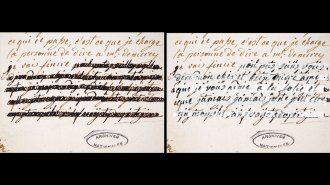
Marie Antoinette’s Letters Are Uncensored by X-rays
In this guide, students will learn how scientists used chemistry to unravel a historical mystery and discuss the uses and limitations of spectroscopy.
Solving a French Revolution mystery with chemistry
Students will answer questions about the online Science News article “Ink analysis reveals Marie Antoinette’s letters’ hidden words and who censored them,” which details how scientists used chemistry to unravel a mystery from the French Revolution. A version of the article, “Marie Antoinette’s letters are uncensored by X-rays,” appears in the November 6, 2021 issue of Science News.
Revealing secrets with spectroscopy
Students will discuss how spectroscopy relates to atomic structure, how the technology can help solve historical mysteries and the limitations and ethics of such work.
Reimagining plastics recycling
Students will evaluate experimental methods for recycling plastics, gather data about the types of plastics they use at home, research plastics recycling in their community and write a letter to local officials that advocates for improving plastics recycling.
Dig into atomic models
Students will research how knowledge of the atom has changed over time, visually represent a historic atomic model and present that model to the class. Students can also explore the standard model of particle physics and discuss ways it could be depicted.