Earth and Space Sciences
We summarize the week's scientific breakthroughs every Thursday.
- Earth
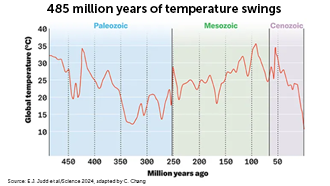
Earth’s history of temperature shifts
Earth’s climate doesn’t have to look like it does now. In fact, it usually hasn’t. Across 4.5 billion years, geologic forces have shaped the planet’s climate from its fiery infancy to the (for now) chilly present. Studying these changes may help us understand what may happen next because of climate change.
- Environment
Winding Watersheds
Pollution that runs off into streams, rivers and lakes can travel far because watersheds are connected by underground aquifers. Students will identify and describe the characteristics of their local and adjacent watersheds before describing how to monitor watershed pollution.
- Space
Cosmic Collision: A Far-Flung Possibility
Computer models suggest a remote yet haunting possibility— that passing stars could carry the potential to warp Earth’s orbit, triggering a cosmic collision. Answer questions about cause and effect. Discuss matter from the scale of the tiniest quark to the vastness of the known universe.
- Health & Medicine
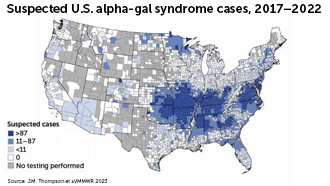
Mapping the spread of ticks
Three types of ticks may spread alpha-gal syndrome, an allergy to red meat. Researchers think the condition is caused by molecules in the saliva of certain tick species. The best way to avoid the syndrome is to prevent tick bites.
- Planetary Science
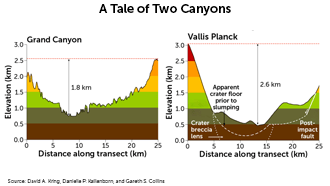
Lunar landforms
Researchers analyzed images of giant canyons on the moon to deduce the physics of how they formed. A massive impact 3.8 billion years ago shot out rock that plunged 3.5 kilometers into the lunar surface, carving two canyons in less than 10 minutes.
- Physics
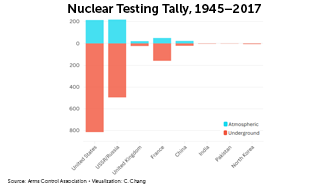
Nuclear testing tally
Beginning with the first test explosion in 1945, more than 2,000 atomic blasts have rattled the globe. Nuclear testing dwindled after a treaty in the 1990s. Recently, some in the United States have called for resumed testing, which could have serious consequences for the environment and global politics.
- Earth
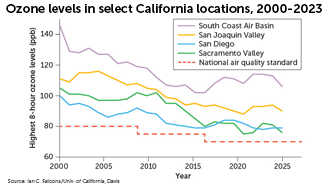
Agriculture may be growing ozone
The air pollutant ozone has been linked to health problems including respiratory illness, reproductive problems and some cancers. Levels of ozone in the United States have come down over time but have started to rise again in places because of wildfires and soil emissions.
- Climate
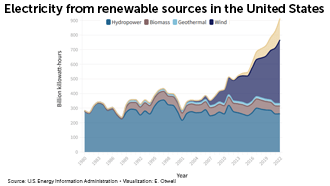
Renewable power is a bright idea
Over the past two decades, electricity from renewable sources, such as wind and solar, has been on the rise. Devices known as grid-forming inverters will likely play a major role in getting renewable energy safely into the power grid.
- Earth
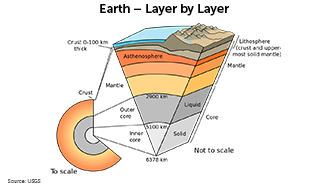
Earth and its many layers
To really understand Earth, you need to travel thousands of kilometers beneath our feet. Starting at the center, Earth is composed of four distinct layers.
- Climate
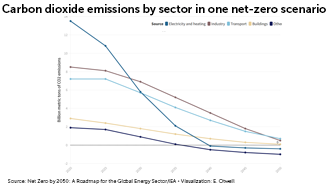
The race to net zero
Drastic cuts to greenhouse emissions are needed to prevent even more catastrophic consequences than the rising sea levels, extreme weather and other impacts our warming world has already faced. Scientists have mapped out potential paths to net-zero, when greenhouse gases emitted are balanced by those removed. This includes decreases in emissions from transportation, industry and other sectors.
- Earth
The case of the haunted railroad
Strange ghostly blue lights have haunted the little town of Summerville, S.C. for decades. Reports of spectral balls of light floating along a desolate stretch of railroad inspired a ghostly local legend. Learn how legends can inspire real-world science. Then discuss similarities and differences between scientific theory and legend while answering questions about a proposed geologic explanation for this phenomenon.
- Earth
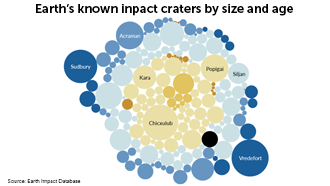
Earth’s impact craters
Space rocks that have smashed into our planet have left impact craters. Many of the craters have been wiped away by erosion, but scientists have cataloged the survivors, including some that are over one billion years old.