Search Results
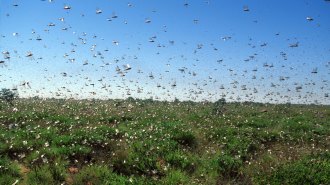
Insect Swarms Might Electrify the Sky
Large swarms of insects could produce as much electricity as a storm cloud. In this guide, students will explore how insect-induced static electricity might affect the atmosphere, review the concepts of electric charge and electrostatic force, and apply those concepts to their own experiences and the biological phenomenon of insect swarms. In a quick activity, students will create a poem or song about serendipity in science.
Sticking to static electricity with Coulomb’s law
Students will use their experiences of static electricity to learn about electric charge and electrostatic force, then apply the concepts to a biological phenomenon. Learning Outcomes: Reinforcement of Coulomb’s Law with interdisciplinary examples.
Insect swarms get charged up
Students will read and answer questions about the online Science News article “Insect swarms might generate as much electric charge as storm clouds,” which explores how insect-induced static electricity might affect the atmosphere. A version of the article, “Insect swarms might electrify the sky” appears in the December 3, 2022 issue of Science News.
What’s the deal with DART?
In this quick activity, students will create a TikTok video about the outcome of a NASA mission to knock an asteroid off course.
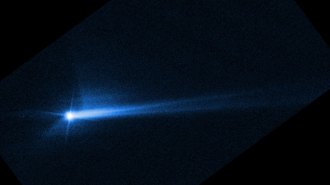
NASA’s DART Mission Is a Success
Did you hear about the spacecraft that crashed into an asteroid — on purpose?! In this guide, students will learn about NASA’s DART mission and discuss the core physics principles behind it.
May the force move you
NASA’s DART mission knocked an asteroid off course. Use the mission to teach core physics principles — including force and Newton’s laws of motion. Learning outcomes: Application of forces and Newton’s laws of motion.
Bumping asteroids off course
Students will answer questions about a NASA mission to smash a spacecraft into an asteroid after reading a Science News article and watching a Science News TikTok video about the mission. A version of the article, “NASA’s DART mission is a success,” appears in the November 5, 2022 issue of Science News.
Flying football physics
Students will answer questions about the online Science News article “Spiraling footballs wobble at one of two specific frequencies,” which describes how researchers figured out why spiraling footballs sometimes drift sideways. A version of the article, “Why spiraling footballs sometimes miss the mark,” appears in the September 10, 2022 issue of Science News.
Solving sports problems with science
Get your students exploring the scientific method by applying scientific problem-solving to their favorite sport. Learning outcomes: Scientific method.
The physics of flying seeds
Students will design and build models inspired by flying seeds with the goal of making the models travel as far as possible. Students will test the models, analyze which ones performed the best and explain why those models performed well using physics principles.
Science in a snap
Students will answer questions about the online Science News article “New high-speed video reveals the physics of a finger snap,” which details scientists’ exploration of the friction required for finger snapping. A version of the article, “Camera captures physics in a snap,” appears in the December 18, 2021 & January 1, 2022 issue of Science News.
Science on screen
Students will discuss the physics of finger snapping and apply their scientific knowledge to think critically about the scientific accuracy of movies and online demonstrations.