Search Results
Fungal Solutions
Across the planet, people throw away over
two billion metric tons of waste every year. That waste feeds into environmental problems from climate change to pollution. So how can we reduce the amount of waste we produce? In this activity, students will categorize and record the waste they produce daily and reflect on the amount of “invisible” waste produced before they receive products. Students will then identify solutions for reducing each category of waste.
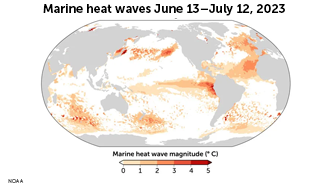
Analysis of marine heat waves
Global temperatures are at an all-time high due to the compounded effects of climate change and El Nino. Oceans around the world are warming at an alarming rate. In summer 2023, some 40 percent of the world’s oceans were affected by heat waves.
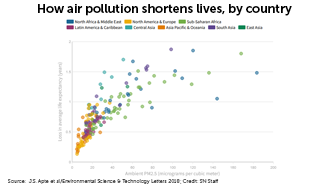
Air pollution and human health
In August of 2018, scientists published research showing how air pollution shaves off about a year on average from human life expectancy. In more polluted regions of Asia and Africa, lives are shortened by 1.5–2 years on average. Loss in life expectancy rises with increasing concentrations of fine particulate air pollution (PM2.5).
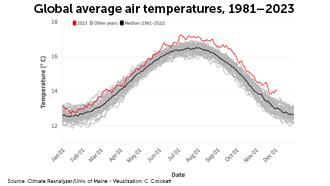
Hottest year on record
Since temperature record-keeping began 150 years ago, the 12-month period from November 2022 through October 2023 was the hottest on record until temperatures in 2024 exceeded those in 2023. The heat raised sea surface temperatures, melted sea ice and endangered human health.
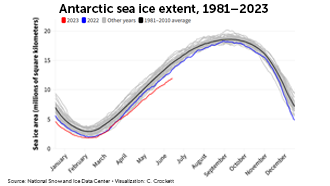
Antarctic sea ice
In 2023, the expanse of floating ice encircling Antarctica hit record lows throughout the year. Scientists expect dramatic declines in sea ice at Earth’s other pole but hadn’t observed major changes in the Antarctic until the last few years.
Immunity and polar bear pathogens
Students will learn how their bodies help protect them from bacteria, viruses and other foreign invaders. Have students review the major components of the immune system and investigate the life cycles of a few prevalent pathogens of polar bears, focusing on the mode of transmission and effects of being infected by the pathogen. Students will then infer why polar bears are being exposed to these pathogens more regularly.
Giant rats in training
Wildlife smugglers beware: A new border-patrol agent may scurry into nearby airports. Learn how African giant pouched rats in tiny red vests are being trained to sniff out elephant ivory and other illegal goods from at-risk species. Then answer questions about the ethics of the experimental design of animal studies and the value of biodiversity.
Covering data literacy
Students will work in groups to answer questions about graphs and data visualizations. Then, they will discuss data literacy and how graphs can promote misinformation
Data on dwindling migratory species
Students will analyze and compare two graphs to summarize a recent report about animals protected by an international treaty called the Convention on the Conservation of Migratory Species of Wild Animals before discussing the possible next steps and limitations of the treaty.
Unsung Heroes of Science
Throughout history, many scientific discoveries and developments have changed the way we view the world. In this activity, students will learn about some of these important scientific contributions and the lesser-known scientists responsible for them. Students will then choose one of these unsung heroes of science and create an artistic piece that celebrates them and their work and contributions to science. The artistic pieces representing lesser-known scientists will be displayed together in a commemoration open to the school.
Designing GMO Campaigns
Humans have modified organisms for millennia through selective breeding and other techniques. But only in the past few decades have people gained the ability to directly alter organisms’ DNA to create Genetically Modified Organisms (GMOs). GMOs can help advance fields such as medicine and agriculture. In this activity, students will learn more about GMOs and their uses before creating an awareness campaign to address GMO misconceptions.
Solving Hard-to-Reach Problems with ROVs
Remotely operated vehicles, or ROVs, are often used in environments that would be unsafe or difficult for people to enter to explore. In this activity, students will think critically about how engineering practices can be used to monitor environmental issues or solve real-world problems before designing and modeling an ROV that could be used to investigate a real-world problem impacting their local environment.