Earth and Space Sciences
We summarize the week's scientific breakthroughs every Thursday.
- Chemistry
Chemistry of wildfire smoke
Students will answer questions about the online Science News article “Wildfire smoke may ramp up toxic ozone production in cities,” which explores new research into the interactions between wildfire smoke and air pollution in cities. A version of the article, “Wildfires may boost urban ozone levels,” appears in the January 15, 2022 issue of Science News.
- Chemistry
Where there’s smoke, there’s science
Students will discuss the composition and properties of air and wildfire smoke, and explore how substances in smoke react to ramp up a certain type of air pollution.
- Climate
Thinking through climate solutions
Students will research how climate change affects a nonhuman species, propose science-based solutions that might lessen the impact of climate change on the species and create an infographic to share with the class.
- Astronomy
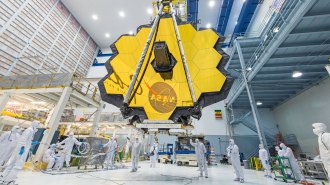
The Origami Satellite
In this guide, students will learn about NASA’s James Webb Space Telescope and discuss how scientific advances have shaped the telescope’s mission.
- Astronomy
Unlocking universal questions
Students will discuss the mission of the James Webb Space Telescope and explore how scientific discoveries over the last few decades have shaped the telescope’s to-do list.
- Tech
Reimagining plastics recycling
Students will evaluate experimental methods for recycling plastics, gather data about the types of plastics they use at home, research plastics recycling in their community and write a letter to local officials that advocates for improving plastics recycling.
- Climate
Earth Cannot Avoid a Warmer Future
In this guide, students will learn about a United Nations assessment that concludes human-caused climate change is behind extreme weather events. Then, students will discuss and compare climate scenarios and visualize some of the data.
- Climate
Visualizing climate change scenarios
Students will learn about climate scenarios, analyze a chart of climate change impacts under four scenarios and create a data visualization for one climate change impact.
- Climate
Looking ahead to a hotter future
Students will answer questions about the online Science News article “The new UN climate change report shows there’s no time for denial or delay,” which describes a massive scientific assessment that concludes human-caused climate change is behind extreme weather events. A version of the story, “Earth cannot avoid a warmer future,” appears in the September 11, 2021 issue of Science News.
- Tech
The significance of simulations
Students will discuss the purpose, benefits and challenges of using computer simulations in scientific research. Then, students will brainstorm a real-world issue that could be investigated with a computer simulation and think about how the simulation would work.
- Earth
Ready to rumble
Students will answer questions about the online Science News “Greece’s Santorini volcano erupts more often when sea level drops,” which describes how a computer simulation revealed a hidden relationship between sea level and a volcano’s explosive history. A version of the story, “Sea level dips spur volcanic eruptions,” appears in the August 28, 2021 issue of Science News.
- Planetary Science
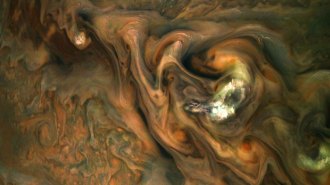
Physics Helps Alien Rain Stay In Shape
In this guide, students will learn how the laws of physics shape rain on other planets and explore how molecules interact within alien raindrops.