Boaty McBoatface and pals’ perilous mission
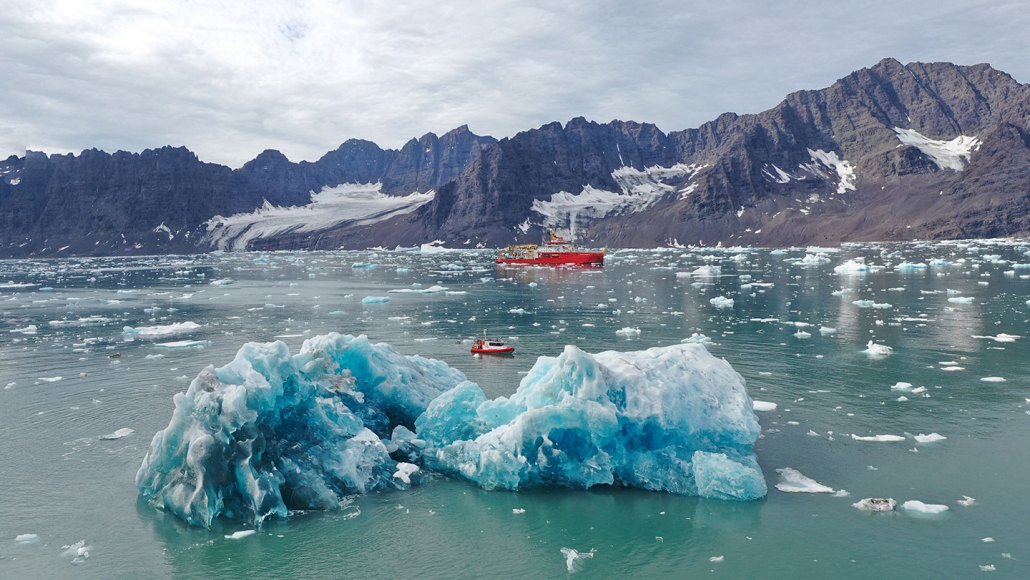
The Royal Research Ship Sir David Attenborough is seen here behind its smaller research vessel, Erebus, in Greenland, where it will deliver a swarm of uncrewed subs and drones to collect crucial data.
British Antarctic Survey
By Susanna Camp
It’s crystal clear that Greenland’s glaciers are melting at an alarming rate, but what’s less obvious is when all that ice melt will reach a point of no return — irreversibly altering critical ocean currents that influence Earth’s climate. Enter the robot brigade, a coordinated fleet of drones, surface vessels and underwater submersibles mapping the dangerous interface where glacial ice meets the warming ocean. For Science News, Mićo Tatalović has the cold, hard truth.
⛴️ Boaty McBoatface and friends
The GIANT (Greenland Ice sheet to AtlaNtic Tipping points from ice loss) project centers on the complex geography of tidewater glaciers, where structural fractures and underwater turbulence accelerate ice loss. Merging satellite data with real-time robotic measurements, high-resolution imaging and an assist from an AI algorithm that scouts the best locations, the machines can be guided into the trickiest terrain. The fleet includes aerial drones for mapping and underwater robots (like the internet-famous Boaty McBoatface). Rugged sensors dropped by helicopter embed themselves directly into the ice to transmit longitudinal movement data. It’s an uncrewed armada designed to withstand extreme cold, severe turbulence and immense subsurface pressures. The British Antarctic Survey is heading up the project, together with 15 collaborating institutions and five international technology partners. Funding comes from the U.K.’s Advanced Research and Invention Agency. The research aims to resolve a fundamental data deficit by observing the atmosphere, ice surface and deep-sea environment simultaneously.
🤖 The underwater robotics market
Commercial-grade robotics are transforming how organizations gather critical data in high-risk environments while keeping human operators safely out of harm’s way. Thanks to this project and others, scientists are gathering the granular data necessary to upgrade climate models and turn localized observations into a clearer picture of the trajectory of global sea level rise. Operating within a global underwater robotics market valued at over $5 billion, the market is rich with manufacturers whose platforms have become indispensable for academic and climate research, industrial applications (such as inspecting offshore wind farms and oil and gas pipelines) and military operations, where autonomous underwater vehicles and surface vessels provide vital intelligence, surveillance and infrastructure protection for global navies.
📡 Pioneers of polar tech
The underlying technology is fueled by a growing ecosystem of specialized players:
- ecoSUB Robotics supplies low-cost microautonomous underwater vehicles to academic and scientific institutions (like the Greenland ice shelf studies). Their compact systems are intentionally built to serve scientific, commercial (such as offshore energy and asset monitoring) and defense sectors for rapid environmental assessment and underwater situational awareness. ecoSUB was cofunded by the U.K.’s Defence Science and Technology Laboratory, and is a division of Planet Ocean Limited, a Camberley, England-based marine science technology specialist, with key partners at the U.K.’s National Oceanography Centre, a major oceanographic institution. The company is private, with an estimated annual revenue of $3 million.
- Sonardyne provides the mission-critical underwater positioning and communication systems that allow the GIANT project’s autonomous fleets to operate in formation. Their proprietary technology serves as the “GPS of the abyss,” a vital component for any commercial firm looking to deploy multirobot arrays in remote environments. Through its dedicated defense arm (and its commercialization partner Forcys), its subsea tracking, positioning and intruder-detecting sonar systems are relied upon by global navies and coast guards to protect ports, critical national infrastructure and naval bases. Sonardyne is a division of Kraken Robotics, whose funding totals about $500 million.
- Saildrone: A leader in autonomous surface vehicles, Saildrone’s wind-powered platforms are mapping the Arctic floor and tracking climate variables for the U.S. National Oceanic and Atmospheric Administration and NASA. Saildrone has a major defense division that supplies the U.S. Navy, and international partners for missions including counternarcotics, border monitoring and tracking climate-vulnerable predators like white sharks. Some of their models integrate defense hardware. For instance, the company is working with defense contractor Lockheed Martin to add a missile launcher to a craft’s payload. The company has raised more than $200 million in private funding including $50 million from Lockheed Martin to scale its global fleet.
The future of climate prediction will be written not just by satellites in the sky, but by a coordinated swarm of machines working deep under the sea.
Disclaimer: The Science News Investors Lab newsletter is for informational purposes only and does not constitute investment advice. Society for Science and Science News Media Group assumes no liability for any financial decisions or losses resulting from the use of the content in this newsletter. Society for Science and Science News Media Group do not receive payments from, and do not have any ownership or investment interest in, the companies mentioned in this newsletter. Please consult a qualified financial advisor before making any investment decisions.