The money in the molecular grid: Materials science
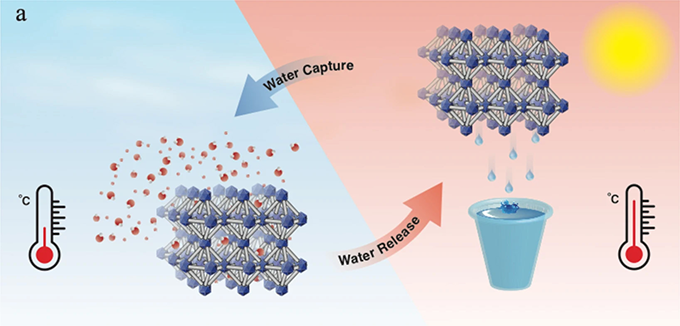
By absorbing humidity from cool air (left) and then releasing it at higher temperature, materials called metal-organic frameworks (MOFs) can collect water without using much energy.
M.W. Logan, S. Langevin and Z. Xia/Scientific Reports, 2020
By Susanna Camp
Metaphors are a great way to explain complex terms in relatable language. When awarding this year’s Nobel Prize in Chemistry, the Royal Swedish Academy of Sciences members and commentators applied no less than five different creative analogies to describe the groundbreaking research on metal-organic frameworks (MOFs) that took home the prize. Indulge us while we dwell on these mental images for a spell:
- Like “Hermione’s handbag or Mary Poppins’ carpet bag”, MOFs look small on the outside but are vast on the inside. The large internal surface area of MOFs allows them to store immense quantities of gas in a tiny volume.
- Like “rooms in a hotel”, there are cavities within the molecular structure of MOFs. Gas molecules or other chemicals can check in and out of these tiny, well-ordered “rooms”.
- Molecular architects: The laureates were described as designers who build molecular-scale structures. In this analogy, metal ions serve as the “cornerstones” and long organic molecules act as the “links” to build crystals with large cavities.
- “A molecular sponge”: This analogy emphasizes the porous and absorbent nature of MOFs, which can soak up and contain gases and liquids.
- The TARDIS from Doctor Who: Like Hermione’s bag, the TARDIS from the science-fiction series is also famously “bigger on the inside” and was used to describe the surprising interior volume of MOFs.
Science News senior writer Meghan Rosen reports on the spatial molecular structures making headlines.
🕳️ Tiny holes, big returns
What exactly are MOFs? These molecular structures are built by stitching together metal ions and organic linkers, creating a vast, organized network of tunnels and cages. Their exceptional internal surface area allows MOFs to soak up and separate specific gases and chemicals with unprecedented efficiency. The applications aim to address several of humanity’s most pressing resource needs and environmental challenges, meaning MOFs could be an indispensable tool for the next industrial era. Their ability to selectively capture gases means they can contribute to industrial decarbonization, extracting air pollutants directly from smokestacks and even open spaces. Beyond climate, MOFs are positioned to address global water security through atmospheric water harvesting, literally pulling potable liquid from the air in arid zones. Furthermore, in lab studies, their highly tailored structures can trap and recover ultra-dilute, high-value materials, such as rare earth elements from waste streams or toxic “forever chemicals” (PFAS) from contaminated water sources.
💸 The money in the molecular grid
Materials science is a $3 trillion market, with room to grow. The investment landscape already has a few emerging contenders in the MOF and MOF-adjacent space.
- Heirloom Carbon, which specializes in sucking CO2 directly from the air, secured a $150 million Series B round in late 2024, contributing to its total funding of over $200 million. While Heirloom uses a modified limestone — not MOFs — for capturing CO2, its success validates the market appetite for cost-effective atmospheric adsorption (the adhesion of atoms, ions or molecules from a gas, liquid or dissolved solid to a surface).
- Closer to the core MOF technology is Swiss company novoMOF, which recently raised a $5.4 million Series A round in April 2025. The company targets its MOFs to high-emissions industries such as steel, and space-limited situations where “Hermione’s handbag” might be useful, such as maritime transport CO2 capture.
- A third compelling player is Decarbontek, which has developed a system to quickly move CO2 in and out of their MOFs’ proverbial hotel rooms, for applications including cement plants and treating gas emitted from landfills. The company is private with no publicly available investment data.
Keep your eye on this space as these molecular cages capture more funding.
Disclaimer: The Science News Investors Lab newsletter is for informational purposes only and does not constitute investment advice. Society for Science and Science News Media Group assumes no liability for any financial decisions or losses resulting from the use of the content in this newsletter. Society for Science and Science News Media Group do not receive payments from, and do not have any ownership or investment interest in, the companies mentioned in this newsletter. Please consult a qualified financial advisor before making any investment decisions.