Mustard plants launch an immunological response to bacteria much as animals do, researchers have found.
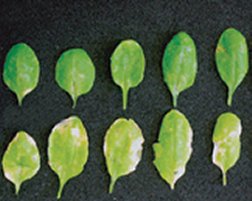
DAMAGE REPORT. Several days after exposure to bacteria, leaves from a normal mustard plant (top row) show less damage from disease than do leaves from a plant in which a nitric oxide–synthesizer gene was disabled (bottom). D. Zeidler and Durner
The laboratory mustard Arabidopsis thaliana reacts with a burst of nitric oxide when it encounters certain compounds from bacterial cells, says Jörg Durner of GSF-National Research Center for Environment and Health in Neuherberg, Germany.
Log in
Subscribers, enter your e-mail address for full access to the Science News archives and digital editions.