Uncategorized
- Humans
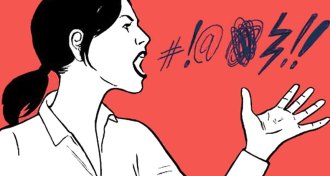
Cognitive scientist puts profanity in its place
Swearing provides unappreciated insights into human thought and language, a cognitive scientist argues in the new book What the F.
- Astronomy
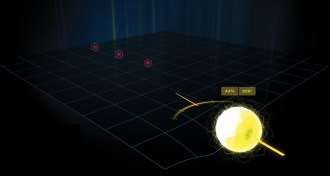
Black hole app lets you blow up stars
NOVA’s Black Hole app for iPad is an addictive game that teaches lessons about gravity and astronomy while letting you hurl stars at one another.
- Planetary Science
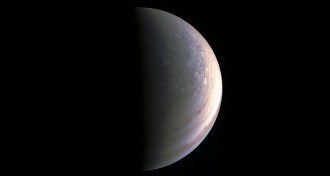
Juno transmits first intimate snapshots of Jupiter
Hurricane-like clouds spiral over Jupiter’s poles, new photos taken by NASA’s Juno spacecraft reveal.
- Planetary Science
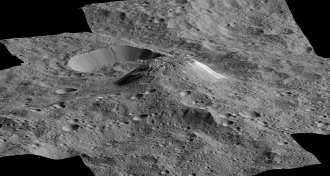
Water plays big role in shaping dwarf planet Ceres
Findings from the Dawn spacecraft turn up cryovolcanoes, ice patches and hydrated minerals on Ceres, supporting the idea that water helped shape the dwarf planet.
- Health & Medicine
Bacterial weaponry that causes stillbirth revealed
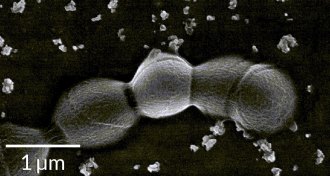
Vaginal bacteria may cause stillbirth by deploying tiny weapons
- Materials Science
High-tech cloth could make summer days a breeze
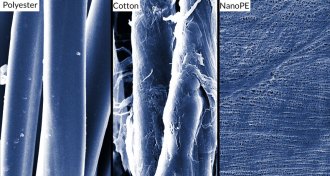
A plastic material like kitchen cling wrap may be the next big thing in high-tech clothing. The fabric lets heat pass through, but blocks visible light, making it opaque enough to wear.
- Animals
In drought, zebra finches wring water from their own fat
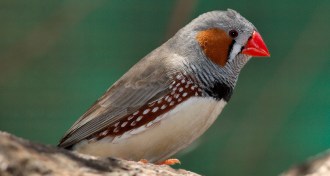
A zebra finch with no water or food can keep itself hydrated by metabolizing body fat.
- Paleontology
Greenland may be home to Earth’s oldest fossils
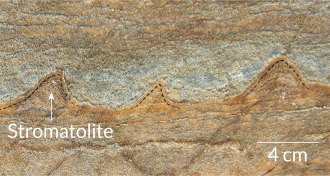
Dating to 3.7 billion years ago, mounds of sediment called stromatolites found in Greenland may be the oldest fossilized evidence of life on Earth.
- Neuroscience
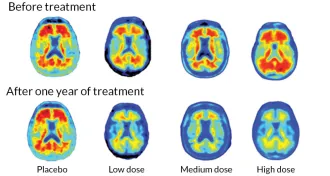
New Alzheimer’s drug shows promise in small trial
A much-anticipated Alzheimer’s drug shows promise in a new trial, but experts temper hope with caution.
- Humans
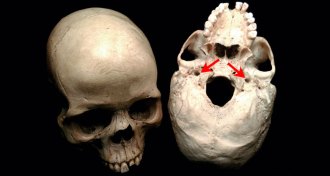
Brain’s blood appetite grew faster than its size
Over evolutionary time, the energy demands of hominid brains increased faster than their volume, a new study finds.
- Astronomy
Radio signal probably not from extraterrestrials
A possible radio signal from extraterrestrials probably originated a lot closer to home.
- Animals
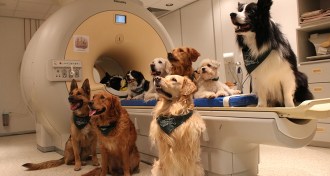
Dog brains divide language tasks much like humans do
Dogs understand what we say separately from how we say it.