NASA races to have the first moon base and nuclear-propulsion spacecraft
The ambitious and expensive plan ignites hope but caution after deep government cost-cutting
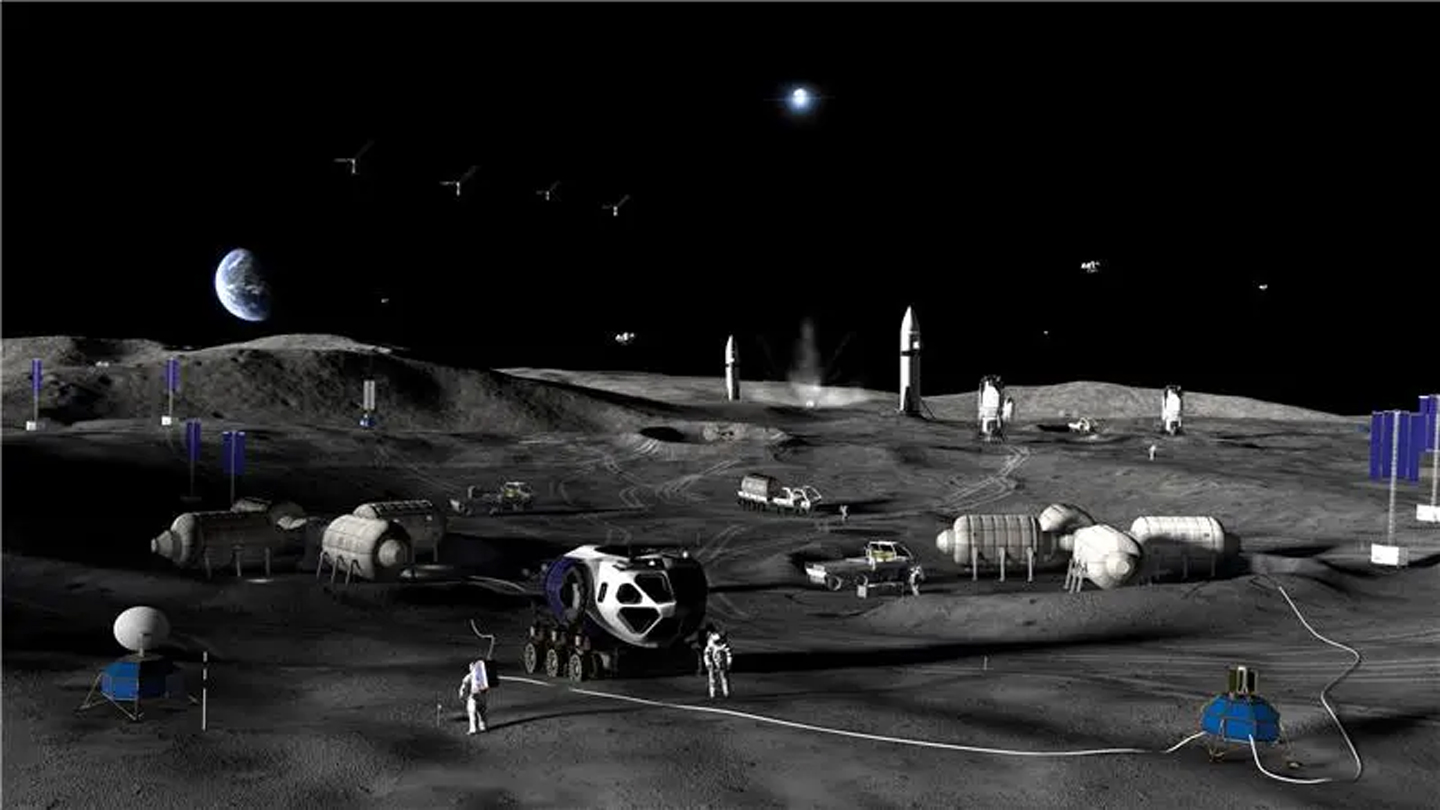
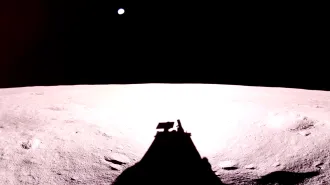
By the mid-2030s, NASA’s proposed moon base (illustrated) will be capable of sustaining humans for long durations.
NASA
NASA is hitting the accelerator on space missions and moon trips in the hopes of achieving some big firsts — a permanent moon base and an interplanetary spacecraft harnessing nuclear propulsion.
Over the next seven years, the agency is planning to launch dozens of mostly robotic missions to the moon at an estimated cost of $20 billion, with the goal of establishing a permanent moon base, NASA officials announced March 24. They also unveiled plans to launch the first nuclear propulsion interplanetary spacecraft in 2028, called the Space Reactor-1 Freedom. The spacecraft will fly to Mars and deliver three or so autonomous rotorcraft akin to NASA’s now-defunct Ingenuity helicopter.
“This is the moment where we should all start believing again, when ideas become missions and when hard work delivers world-changing accomplishments,” NASA Administrator Jared Isaacman said a livestream event dubbed Ignition, detailing the agency’s lofty and expensive ambitions.
The announcements come at a troubling time for the space agency. Last May, the Trump administration proposed slashing NASA’s science funding for fiscal year 2026 in half, though Congress ultimately rejected the cuts. With the president’s fiscal year 2027 budget request looming, it’s unclear how much financial support NASA will have to achieve its goals.
What’s more, NASA lost a large amount of personnel and expertise last year under the administration’s efforts to shrink the federal government. “The agency just had its largest loss, percentage wise, of its workforce in a single year,” says Casey Dreier, the chief of space policy at the Planetary Society, headquartered in Pasadena, Calif. Recent surveys by the Partnership for Public Service indicate that around 38 percent of NASA employees believe their teams are worse at delivering quality output compared with last year, while around 45 percent believe that they’ve become worse at meeting important deadlines. “None of these bode well for the ambitious deadlines NASA is setting for itself,” Dreier says.
The announcements came about a week ahead of the scheduled launch of Artemis II, originally planned for early February but delayed by leaks, and about a month after NASA canceled its 2027 moon landing and scheduled two more for later on.
“On the face of it, this is very exciting,” says planetary scientist Paul Byrne of Washington University in St. Louis. But for any of NASA’s dreams to become reality, it will take a lot of money, Byrne says. “The history of human and robotic spaceflight is littered with ambitious timelines that are never fully realized.”
Here’s a closer look at NASA’s plans.
Building a moon base
By 2030, NASA aims to have the initial elements of a permanent lunar outpost established near the moon’s south pole. The initial infrastructure will include power, surface communication, vehicles and preparing the surface for development, in addition to a constellation of communications and observational satellites, said Carlos Garcia-Galan, NASA’s program executive for the moon base, at the event. “Once that’s established, we’re going to transition into achieving semipermanent and permanent crew presence on the moon base.”
To focus on building the lunar base, NASA will pause its efforts to build the first lunar space station, known as the Gateway Space Station, Garcia-Galan said. NASA and its industry and international partners will be “putting together options and concepts on how we take everything we got [for Gateway] and we make it work for us towards building the moon base.”
By the end of 2028, NASA aims to complete about 25 launches and drop about 4,000 kilograms of payload onto the lunar surface. One of the landers in 2027 will deliver the golf cart–sized VIPER rover, which will explore the lunar surface for water and other volatiles — chemicals that readily vaporize and are important for habitability.
The VIPER project is being revived after having been discontinued in 2024 due to cost increases and launch delays. In its new role as a component of the moon base, VIPER will not only prospect for resources but also help discover new locations on the moon for meaningful science, Galan-Garcia said. “Some of these areas that have permanent or semipermanent shadows have … volatiles that are billions of years old, and we’re going to go after those things and try to understand our universe.”
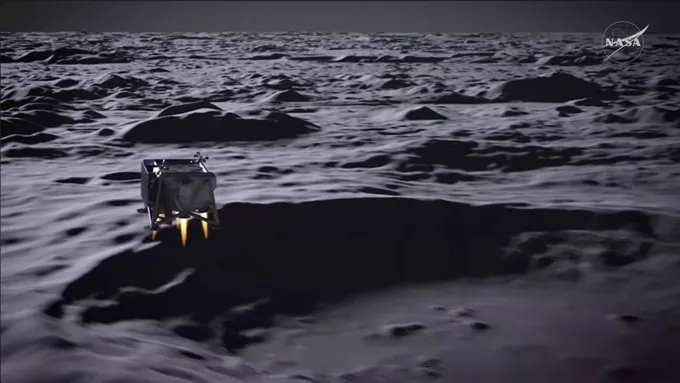
Far-hopping drones will also journey to the moon around that time. Though helicopters would be unable to sustain flight in the extremely thin lunar atmosphere, these Moonfall drones will “be capable of basically several propulsive hops that can go about 50 kilometers each in total … about 150 seconds from launch to landing on each hop,” Garcia-Galan said.
From 2029 to 2033, NASA hopes to make an additional 27 or so launches and deliver roughly 60,000 kilograms of payload. That will include a pressurized rover that can travel up to 3.5 kilometers an hour. It will function like a mobile habitat and allow astronauts to work inside without space suits.
And finally, from 2033 to 2036, NASA is planning to make about 29 launches and deliver some 150,000 kilograms of payload to the moon’s surface, which includes nuclear fission power and habitat modules to enable continuous human habitation, Garcia-Galan said.
The timeline is aggressive, says Karan Jani, an astrophysicist from Vanderbilt University and founding director of the Vanderbilt Lunar Labs Initiative in Nashville. But with commercial players helping to boost the number of launches and landers that NASA will need to meet its timeline, “this sounds very feasible,” he says.
A hurdle that NASA will have to overcome will be fostering young scientists and engineers who can contribute to making the moon base a reality. The United States has not considered a serious campaign to the moon in 50-plus years, Jani says, “so there has never been a need in the last several years to train students specifically for that.”
Funding uncertainties and research disruptions caused by the Trump administration have also hampered early career scientists and hopeful students. “We’re getting very mixed messaging,” Byrne says.
Nuclear propulsion in space
If all goes to plan, SR-1 Freedom will launch in 2028 and spend about a year traveling to Mars using a technology called nuclear electric propulsion, which harnesses the electrical power produced by a nuclear fission reactor. The roughly 20-kilowatt reactor onboard will function similarly to nuclear power plants on Earth and will power only the spacecraft’s thrusters.
The United States hasn’t tested a flight reactor in a spacecraft since 1965. And unlike that craft, which was an experimental satellite called SNAP-10A, SR-1 Freedom would fly far beyond Earth’s orbit.
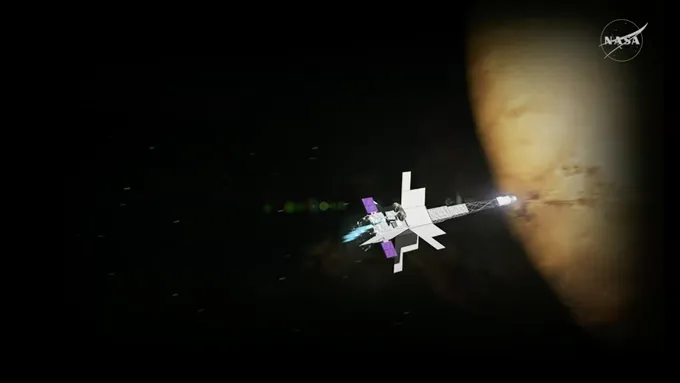
Beyond proving that the United States can build, launch and operate a nuclear-propulsion system, SR-1 Freedom will provide operational experience with a space nuclear reactor, said Steven Sinacore, NASA’s program executive for Fission Surface Power, at the event. That will “catalyze a sustained cadence of space nuclear missions that will power the future of American space exploration,” he said. “Nuclear-powered electric propulsion spacecraft will move cargo in space like railroads move freight on Earth, with incredibly high efficiency compared to chemical propulsion.”
Ultimately, data gathered by the SR-1 Freedom mission will help inform the development of a nuclear reactor on the moon in 2030, dubbed Lunar Reactor-1. “Nuclear power will keep lunar bases operating through the 14-day [or] 354-hour night,” Sinacore said.
After that, production could be scaled up, and nuclear reactors could power human missions on Mars, Sinacore said. “Without it, the alternative is football fields of solar panels that will be ineffective during dust storms.”
If the agency’s nuclear dreams are to be realized, Byrne says, it will have to get to work and secure funding. “If they’re serious about doing a nuclear-powered lunar base they’re going to have to start working with international partners and industry soon,” he says. “Within the next six to 12 months we’ll have to see positive indications that NASA’s budget will not just stay stable but grow.”
Skyfall mission to Mars
SR-1 Freedom won’t go to Mars alone. It will carry a fleet of helicopters and drop them into the thin Martian air in a mission called Skyfall.
The helicopters will be similar to NASA’s Ingenuity craft, which rode to Mars along with the Perseverance spacecraft in February 2021 and defied all expectations to keep flying until January 2024.
The Ignition presentation was light on details about Skyfall, but Virginia-based company AeroVironment offered details in a statement in July 2025. Skyfall’s three helicopters would spread out across the Red Planet to scout for resources and identify potential landing sites for the first human missions to Mars.
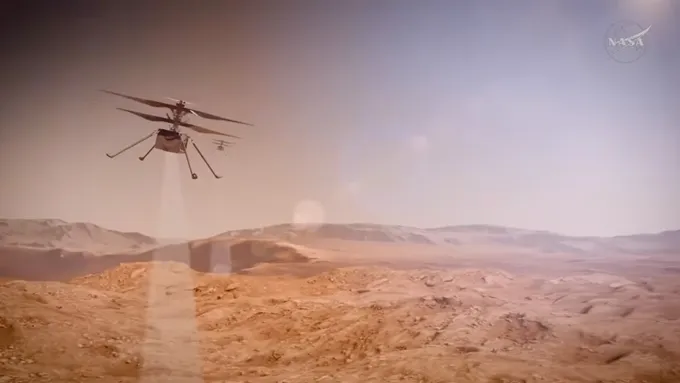
Unlike every other Mars surface mission so far, Skyfall won’t begin with a landing. The helicopters would deploy from their capsule as it falls through the Martian atmosphere.
“By flying the helicopters down to the Mars surface under their own power, Skyfall would eliminate the necessity for a landing platform — traditionally one of the most expensive, complex and risky elements of any Mars mission,” AeroVironment wrote in the statement.
But of course, this all hinges on the successful launch of SR-1 Freedom.
“Honestly, it’s a wait-and-see. We are at an inflection point,” Byrne says. “This could either go and be a damp squib, like we’ve seen so many times before,” he says. “Or, in hindsight, it could be the time we look back at and say, ‘This is when things began to turn around.’”