Project Hail Mary made us wonder how to survive a trip to interstellar space
The fate of astronauts in Andy Weir’s book-turned-movie shows how risky that trip might be
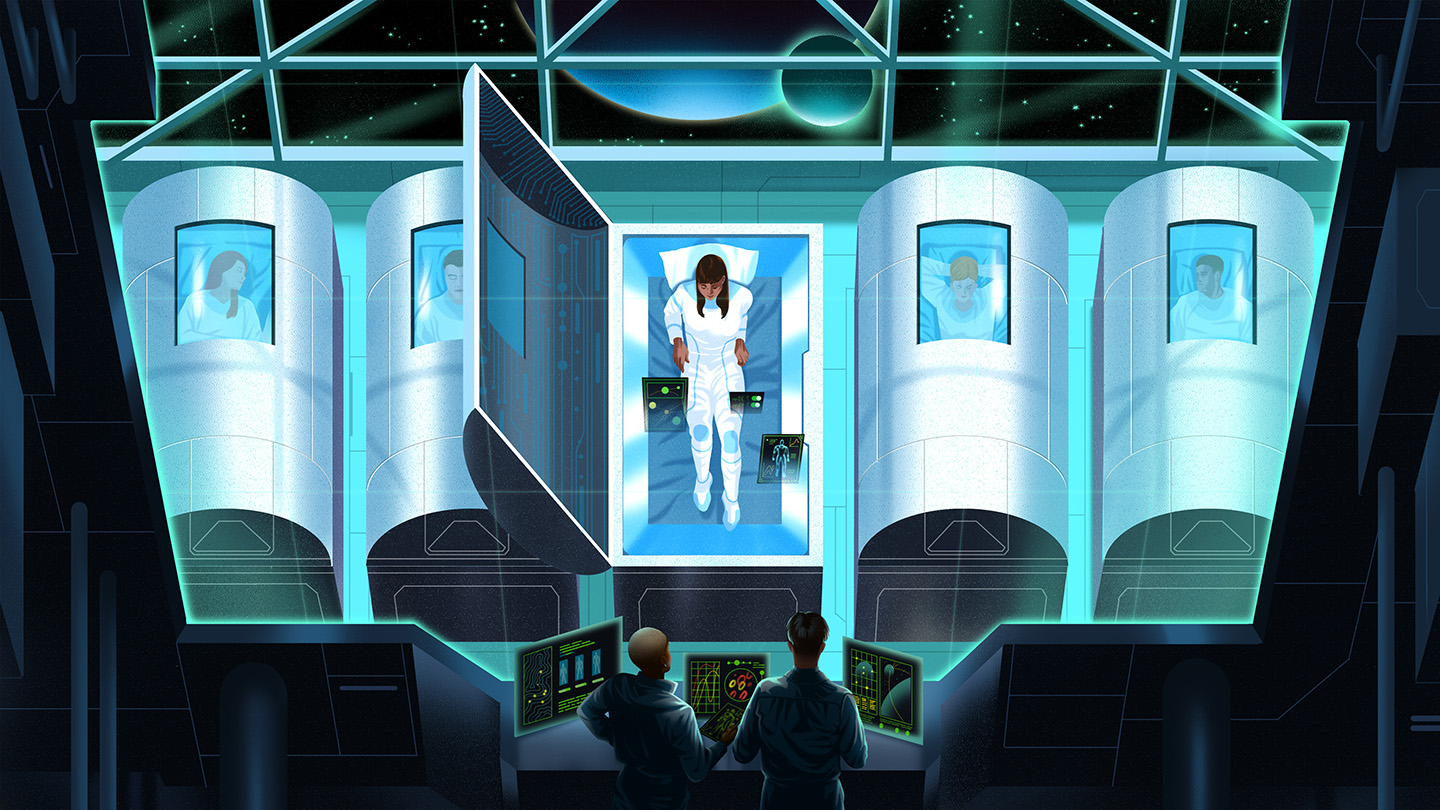
An astronaut emerges from human hibernation (center) while crewmates watch over those still in torpor.
Glenn Harvey
Editor’s note: This story contains light spoilers for Project Hail Mary.
I have long puzzled over something in Andy Weir’s 2021 book Project Hail Mary: Why did two of the three fictional astronauts die during an interstellar trip?
It might be because Weir put his travelers into four-year-long medically induced comas, says Haig Aintablian, an emergency physician and flight surgeon who directs UCLA’s space medicine program.
“How cool would it be if you went to sleep a few hours after launch, and you woke up right as you arrived on the planet or the celestial body that you’re approaching?” But, he says, “I don’t think keeping the human alive and in a comatose state is necessarily the best option.”
After all, “the human body is not designed to just be a stagnant blob,” he says. Comatose astronauts would be in danger of deadly blood clots and debilitating muscle wasting from inaction. Infections stemming from tubes and devices required to keep a comatose person alive also would be risky.
So, I wondered, what other ways might people survive interstellar travel?
Frozen, Aintablian suggests. “When the day comes where you could freeze someone and just thaw them, you would have solved the issue,” he says.
But the problem may be more than technological. No one knows if human bodies can withstand the physiological rigors of freezing and thawing the way wood frogs do. Human hearts don’t function well below about 28° Celsius, says integrative biologist Matthew Regan of the University of Montreal. Some people have survived deeper body temperature dips but only temporary ones, he says, not the years it would take to travel to a distant star.
Maybe hibernating our way to the stars is the answer.
Some small mammals that hibernate, like arctic ground squirrels, drop their body temperatures to below freezing during torpor, when the rodents’ metabolism drastically slows. “It’s 2 percent of what it usually is,” Regan says. “They’re just barely ticking over. It’s like pilot light levels.”
Hibernating bears save less energy, dropping their body temperatures only a few degrees to 31° C or 32° C (around 88° to 90° Fahrenheit). Torpid animals are sedentary but they don’t develop blood clots and their muscles don’t atrophy, unlike bedridden humans.
If humans could dial back our metabolism even a tad like bears do, space voyages would require fewer resources to keep the crew fed, healthy and happy. Torpor may even help protect against ionizing radiation, a big problem for space travelers, Regan says.
But it probably wouldn’t be possible to snooze the whole trip. Every couple of weeks, ground squirrels and other hibernators rouse, rewarming their bodies and moving around. No one is sure why. It may promote muscle regeneration and help the brain stay healthy, says neurochemist Kelly Drew of the University of Alaska Fairbanks.
Humans also may need to wake up to keep their brains sharp and muscles strong. And to eat.
That’s because it might not be a good idea to fatten up astronauts before the big trip, says hibernation biologist Hannah Carey of the University of Wisconsin–Madison. Bears that pack on pounds before hibernation develop high levels of cholesterol; the bears recover as their weight dwindles but in humans, that side effect might put astronauts at risk for heart disease.
Some captive ground squirrels in Carey’s lab got roly-poly quickly but then died mysteriously during hibernation. “They still had a lot of body fat on them. So it’s not that they were running out,” Carey says. Perhaps their hearts couldn’t take the stress, she suggests.
Still, none of that explains why the astronauts died in Project Hail Mary. With the movie adaptation headed to theaters in March, I asked Weir what happened. Their deaths weren’t a failure of human biology, he says. “It was a tech failure. I mean, being in a coma for four years is a dangerous proposition in the best of times. So a small tech failure can lead to catastrophic results. Which it did in this case.”