
All Stories by Lisa Grossman
- Astronomy
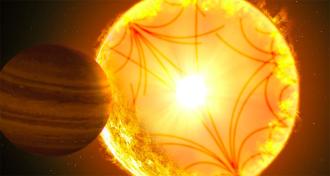
The first planet Kepler spotted has finally been confirmed 10 years later
Astronomers had dismissed the first exoplanet candidate spotted by the Kepler space telescope as a false alarm.
- Astronomy
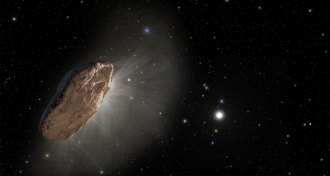
3 explanations for ‘Oumuamua that aren’t alien spaceships
Astronomers are coming up with some creative ideas to explain the weird behavior of the first known interstellar object.
- Planetary Science
Hayabusa2 just tried to collect asteroid dust for the first time
The Japanese Hayabusa2 spacecraft touched down on asteroid Ryugu and attempted to gather a sample of its rock to bring back to Earth.
- Astronomy
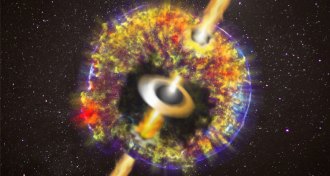
Colliding neutron stars shot a light-speed jet through space
A stream of particles created in a neutron star crash, detected in 2017 using gravitational waves, could explain certain mysterious flashes of light.
- Planetary Science
Neptune’s smallest moon may be a chip off another moon
Neptune’s tiniest moon probably formed when a comet hit a larger moon.
- Planetary Science
Mars’ lake may need an underground volcano to exist
If a lake under Martian ice is real, there must be a subsurface magma pool to keep conditions warm enough for water to remain liquid, scientists say.
- Physics
The quest for quasicrystals is a physics adventure tale
In ‘The Second Kind of Impossible,’ physicist Paul Steinhardt recounts his journey to find quasicrystals in nature.
- Planetary Science
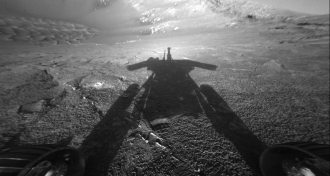
After 15 years on Mars, it’s the end of the road for Opportunity
After 15 years of exploring Mars, a dust storm led to the demise of NASA’s longest-lived rover.
- Planetary Science
A basketball-sized rock hit the moon during the last lunar eclipse
Professional and amateur astronomers joined forces to analyze the impact.
- Planetary Science
Titan’s oddly thick atmosphere may come from cooked organic compounds
Saturn’s moon Titan might get some of its hazy atmosphere by baking organic molecules in a warm core.
- Planetary Science
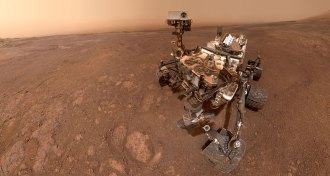
NASA’s Curiosity Mars rover weighed the mountain it’s climbing
Curiosity measures gravity as it drives, allowing scientists to weigh Mount Sharp and determine that the rock is less dense than expected.
- Planetary Science
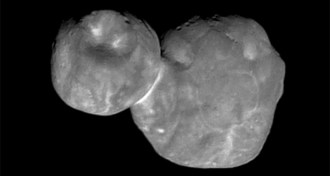
The latest picture of Ultima Thule reveals a remarkably smooth face
Kuiper Belt object MU69, nicknamed Ultima Thule, is largely unmarred by impact craters, suggesting the Kuiper Belt might lack small objects.