Miso hungry: Space food takes off
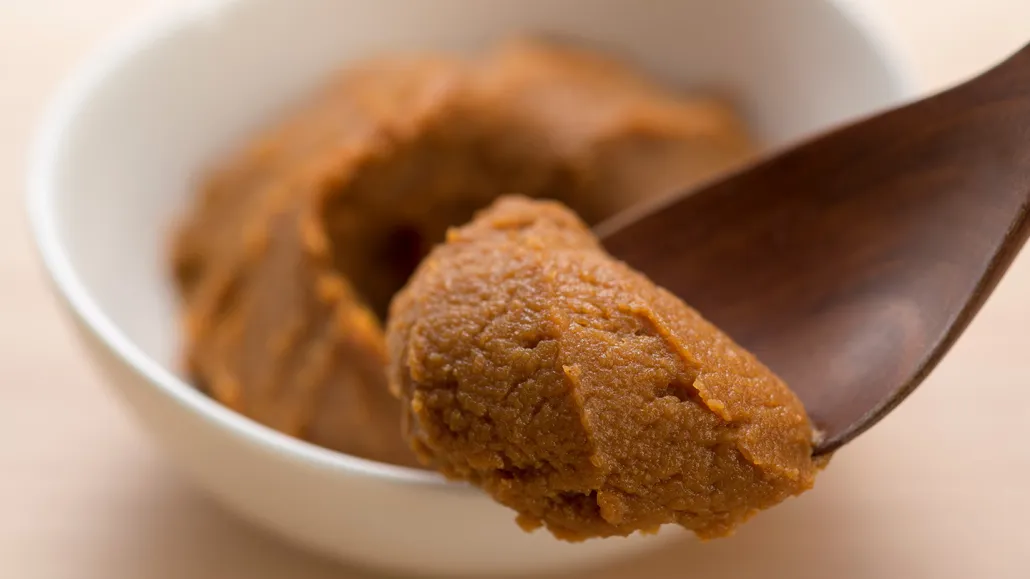
The space environment may impart a unique taste of space on foods fermented there. For miso, that led to a nuttier, more roasted flavor, according to a new study.
kuppa_rock/iStock/Getty Images Plus
By Susanna Camp
Researchers have successfully fermented miso on the International Space Station (ISS), proving that the microbes responsible for that savory umami sauce can harmonize in microgravity. If we are ever to achieve sustained human life on lunar bases, space stations or missions to other planets, the ability to grow food and medicine via fermentation will be a welcome logistics hack. McKenzie Prillaman brings the cosmic culinary scoop for SN.
🦠 Microgravity mold
To test the viability of space-based fermented food, researchers sent soybeans and a fungus-dosed rice called kōji to the ISS to undergo a 30-day fermentation process. The scientists compared the space-grown miso to control samples fermented on Earth, utilizing DNA sequencing and chemical profiling. The study revealed that while the space miso had a similar microbial composition to its Earthly counterpart, it possessed a distinct chemical signature and a unique, savory flavor profile, potentially influenced by radiation or microgravity. These findings suggest that the environment beyond Earth can be leveraged as a variable to create novel tastes, paving the way for sustainable, long-term food systems that provide both nutrition and culinary variety for future astronauts.
🚀 The race for space food
On earth, biotech pioneers have been grappling for decades with the constraints of a changing planet: limited land, water and air. Space food is a category unto itself. No longer defined by dehydrated packaged foods, the ISS has recently transitioned into a sophisticated laboratory for biological food production. The most visible innovation is the Vegetable Production System (Veggie), launched in 2014 to allow astronauts to harvest and sample their own yields. More recently, NASA and the Canadian Space Agency have hosted the Deep Space Food Challenge to encourage innovative and sustainable food systems on the ISS.
👩🍳 Intergalactic test kitchen
Here are a few biotech food producers hoping to scale beyond Earth’s orbit:
- Aleph Farms is a pioneer in meat cultivated from cells. In 2019, they successfully “printed” meat on the ISS using a 3-D bioprinter. Now, the company is developing biofarms that can produce fresh meat in a microgravity environment using minimal water and space. The company has raised over $148 million, including backing from Leonardo DiCaprio.
- Interstellar Lab designs biopod modules, controlled-environment greenhouses that can be deployed on Earth or in space. Their pods use advanced aeroponics (growing plants in air/mist, without soil) and AI software trained on plant growth data to automate crop growth in extreme conditions. They won NASA’s Deep Space Food Challenge in 2025 and have raised over $9 million in seed and grant funding.
- Solar Foods uses electricity to split hydrogen from water and combine it with carbon dioxide and nutrients to “feed” a microbe that grows an edible protein called Solein. Because astronauts breathe out CO2 and have access to solar power, Solein is practically a closed-loop food source, requiring no land and almost no water. They’ve raised over $78 million, including support from the European Space Agency.
- Redwire (NYSE: RDW) makes sensors, lighting and irrigation devices that allow other companies to grow food in orbit. They operate the Advanced Plant Habitat on the ISS. Redwire is a public company with annual revenue exceeding $300 million.
Here’s hoping the future of deep-space exploration will be as flavorful as it is functional.
Disclaimer: The Science News Investors Lab newsletter is for informational purposes only and does not constitute investment advice. Society for Science and Science News Media Group assumes no liability for any financial decisions or losses resulting from the use of the content in this newsletter. Society for Science and Science News Media Group do not receive payments from, and do not have any ownership or investment interest in, the companies mentioned in this newsletter. Please consult a qualified financial advisor before making any investment decisions.