Public-private partnerships go to space
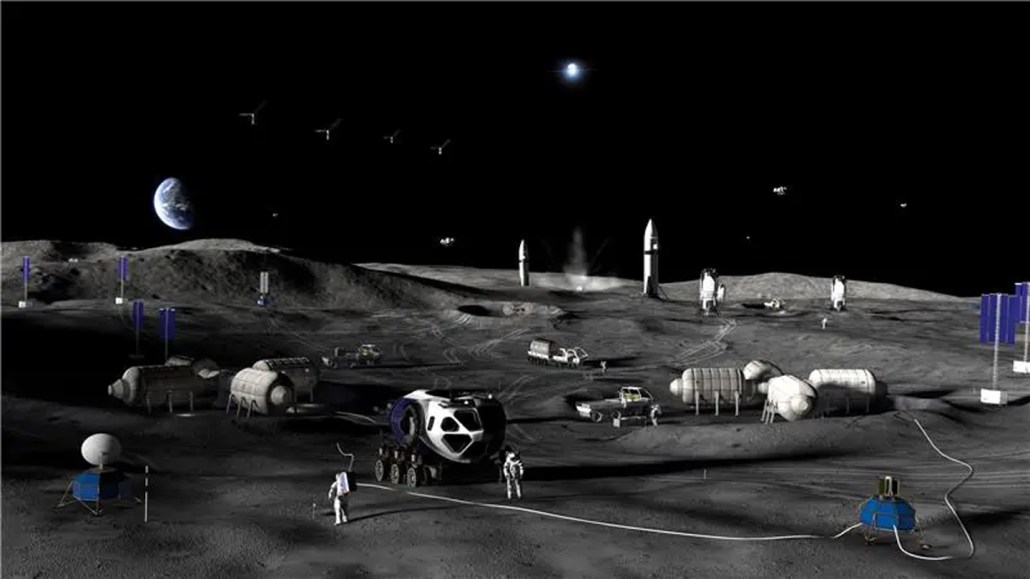
By the mid-2030s, NASA’s proposed moon base (illustrated) will be capable of sustaining humans for long durations.
NASA
By Susanna Camp
Public-private partnerships are key to innovation. Government agencies bring the R&D scale and regulatory stability, while the private sector offers agile capital, competitive speed and “fail-fast” execution. These collaborative efforts can take initiatives farther with higher impacts (think GPS, the Human Genome Project, and mRNA vaccines). The rise of a new lunar economy is another prime example. This month, humanity witnessed the Artemis II mission blast off — ferrying astronauts toward the moon and back for the first time in half a century. As NASA seeks a dual strategy to establish a permanent moon base and launch interplanetary spacecraft featuring nuclear propulsion, they’re bringing big tech into the picture. Science News’s Nikk Ogasa and Lisa Grossman map out the plans.
☢️ Hot cores and high stakes
The upshot: NASA has announced two critical initiatives to solve the logistics of deep space. First, the Fission Surface Power project aims to demonstrate a small nuclear reactor to provide continuous energy for a lunar base, an important need considering lunar nights last for two Earth weeks. Second, for their upcoming Mars missions, they’re developing a nuclear reactor that generates electricity for the spacecraft’s thrusters to maximize speed, cost and efficiency. To meet their timelines, they’re leaning on a select group of commercial players who already have experience launching and landing payloads.
👨🚀 Space barons buckle up
This private intervention isn’t just a preference; it’s a necessity born of a hollowed-out agency. Following years of budget cuts and a dwindling internal workforce, NASA lacks the localized funds and staff to get the job done on its own. A core cadre of space barons (most notably Elon Musk of SpaceX and Jeff Bezos of Blue Origin) are already in lockstep with the government. Their personal obsessions with interplanetary travel have coincided perfectly with the administration’s quest for space colonization, with multibillion dollar agreements in the offing. In this environment, the boundaries are blurring between public service and private profit.
🚀 The big guns
Here are some of the most prominent commercial players in the new space race.
- Firefly Aerospace (NASDAQ: FLY): The first private company to land a spacecraft on the moon, Firefly Aerospace was awarded a $176.7 million NASA contract in July 2025 to deliver two rovers and three scientific instruments to the lunar South Pole in 2029. As part of the agency’s Commercial Lunar Payload Services initiative, the Blue Ghost Mission 4 aims to study lunar resources such as water and minerals and support the Artemis campaign. Firefly reported revenues of over $159 million in 2025.
- Intuitive Machines (NASDAQ: LUNR) was awarded $180.4 million to deliver NASA-funded equipment including cameras, sensors and a time capsule to the lunar surface. Since their IPO in 2023, they have secured over $700 million in NASA contracts.
- BWX Technologies (NYSE: BWXT) built a key test unit for NASA’s nuclear propulsion program. BWXT specializes in nuclear fuel manufacturing, and in 2025 announced over $4 billion in contracts for manufacturing nuclear reactor components for the U.S. Navy.
- Blue Origin: Jeff Bezos’s firm won a $3.4 billion NASA contract to build a lunar landing system for astronauts. The company, with over $2 billion in funding from the U.S. Space Force, has a significantly larger R&D runway than government-bound competitors.
In the new lunar economy, look beyond the rockets to the utilities that will keep the lights on in the most expensive neighborhood in the galaxy.
Disclaimer: The Science News Investors Lab newsletter is for informational purposes only and does not constitute investment advice. Society for Science and Science News Media Group assumes no liability for any financial decisions or losses resulting from the use of the content in this newsletter. Society for Science and Science News Media Group do not receive payments from, and do not have any ownership or investment interest in, the companies mentioned in this newsletter. Please consult a qualified financial advisor before making any investment decisions.