Conversations with Maya: Dr. Edward Thorp
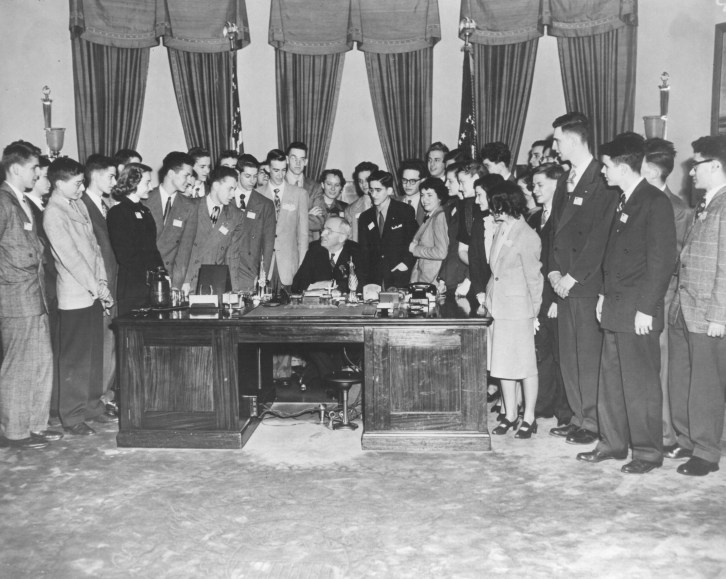
Edward Thorp’s Westinghouse Science Talent Search class meeting President Harry Truman. Photo courtesy of Society for Science & the Public.
Maya Ajmera, President & CEO of Society for Science & the Public and Publisher of Science News, sat down to chat with Dr. Edward Thorp — a mathematics professor, inventor, entrepreneur, founder of the first quant hedge fund, blackjack player and the best-selling author of Beat the Dealer, the first book to mathematically prove that the house advantage in blackjack could be overcome by card counting. Thorp also published his autobiography, A Man for All Markets, earlier this year. We are thrilled to share an edited summary of the conversation.
I grew up in the ’40s in California during World War II. Money was scarce. I was going to a high school with very little in the way of academics. I was interested in science, but nobody else there was, so I began teaching myself science. Physics, astronomy, mathematics, chemistry, a little biology — just by reading books and studying on my own. A retired engineer next door gave me a free subscription to Science News-Letter, which helped me to understand that there’s a whole big world of science and there were many interesting possibilities for working in that world.
I’m really excited to share that the Society has a program called Science News in High Schools that brings Science News to more than 4,000 high schools across the country. Through a sponsorship program, the magazine is free to the schools and includes a teaching guide. What advice do you have for students on why reading magazines like Science News is so important?
One of the great things about Science News was that it gave me a broader view of science and all the various areas in which scientists were active. It expanded my menu of possible choices. Science News also pushed me to gather more general knowledge in science that I might not have had if I hadn’t been reading the magazine.
We were thrilled to see the Science Talent Search included in your life story. Can you talk to me about the impact that competition had on your life?
A few years before I graduated from high school, I was concerned about finding enough money to go to college, so I delivered newspapers and did other jobs. Then I saw a story in Science News-Letter that they had a Science Talent Search contest, and that turned out to be quite a revelation for me. I was fortunate enough to become a finalist and go to Washington, D.C., and really see what the world was like. Because I was a Science Talent Search finalist, it made it easier to get scholarships at whatever university I wanted to go to. I could only afford to go to the University of California because the tuition was minimal at that time, $70 a year. Hard to believe, isn’t it? The Science Talent Search was one of the main things that really opened my eyes to the world of science and what it was like.
Who did you get to meet when you were in Washington?
It was the first time I ever took a train. The year was 1949, and it was a three-day train ride to Washington, D.C. In the course of my time in Washington, we met Nobel Prize–winner I.I. Rabi, who talked with us at some length, and we visited the 60-inch cyclotron. And then, we had an audience in the Oval Office with President Harry Truman. We all had our pictures taken with him, and he shook each of our hands. I remember his hand very vividly still: It felt like a nicely upholstered, well-used leather armchair with a little talcum powder on it.
We tell all our students who compete in the Science Talent Search, and throughout our competitions, that communications and the humanities are also important. It’s part of the creative and intellectual process of being a scientist or a mathematician or an engineer.
Yes, I have met quite a few great scientists over the course of my lifetime and what I’ve learned is that the great scientists — for the most part — have a very substantial interest in the humanities. It’s interesting that the greater minds have room for both science and the humanities and have a curiosity about both things. I don’t know which comes first, but I think it goes both ways. The people who have more talent, more often than not, will be capable in the humanities. This brings a broader perspective in their scientific work.
One thing I’ve also noticed in interacting with both younger and older scientists is that if a scientist can express him or herself more clearly and cogently, that person becomes much more effective in both conveying what they’ve done to other people and in working together with other people. It is very valuable to be able to speak clearly, distinctly and cogently.
What was it about the humanities that got you excited?
I had one remarkable English teacher who taught American literature. One summer, he lent me 60 books — I spent the summer between my junior and senior years sitting on the beach reading and bodysurfing. There were things like The Brothers Karamazov, Of Mice and Men, The Jungle and Sinclair Lewis’ Arrowsmith. It was a revelation in my view of the world, and it enormously enlarged my vocabulary.
Switching gears, you are well known for your blackjack skills; you even wrote a best-selling book called Beat the Dealer in the ’60s. Where did your interest in blackjack begin and are you still playing today?
Well, I got interested in blackjack, you might say, purely by chance. I got interested in applying physics to predicting the outcome of a roulette spin. I went to Las Vegas for a vacation after I got my Ph.D. in math because I wanted to observe roulette wheels. While I was there, I happened to play a little blackjack. After playing for about 40 minutes, I saw how you could beat the game, and it turned out I was right. And that’s how I came to write what turned out to be a New York Times best-selling book on card counting at blackjack. It was the first book of that type, and it led large numbers of people to head to the casinos in Las Vegas. It also caused the casinos to try to change the rules, unsuccessfully.
Dr. Thorp, you have had an unbelievably varied and storied career. You were a professor of math, you’re a blackjack guru, you created a hedge fund, you developed the first wearable computer; most people just do one of those things in their lifetime and are pretty content. What are the key lessons you’ve learned from having such a diverse and unique career path?
Well, what was the handicap for me in junior high and high school — having to teach myself and not having any mentors or academic courses of any value — also proved to be a benefit because I learned to think through things for myself. If something came up, like “can you beat gambling games,” and everybody would say, “No, you couldn’t,” I wouldn’t accept that. I would say, “Well, I’ll check it out for myself and see what I think.”
So I didn’t go with conventional wisdom most of my life. I just simply tried to think independently, and I wanted things that were evidence-based.
I’d also like to add that one of the most common things that people ask me is, what should I do to become successful in science, finance, gambling? I tell them not to start out with some goal, like trying to make money. Instead, figure out what it is you like to do, because the activity that you do — call it work, but it won’t be work if you choose it right — the activity that you do is going to be a very large part of your life and you want to be happy doing it. So choose something that will make you happy and it’s probably something that you’re good at. And then, just follow your dreams in that direction and you’ll more than likely find out that everything will work out very well for you. It’s the people who try to go against what they really want to do that end up being so unhappy.