Metal structures like the Golden Gate Bridge, monuments and cars are vulnerable to corrosion, even when covered with protective coatings.
Paul Quayle/Alamy
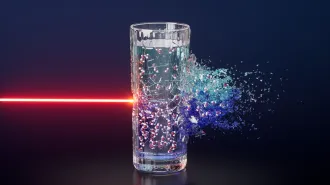
Water droplets can do their own version of the electric slide. But instead of tearing up the dance floor, they may be wearing away at our cars, infrastructure and cultural heritage sites.
Water drops that become charged by sliding along a surface can then transfer their charge when they land on materials with the right electrical properties, including metals. This eventually drives the material to corrode, even when covered by a protective coating, researchers report August 26 in Nature. Water may also pick up charge in clouds, thunderstorms and waterfalls, so this effect might be widespread.
This work could pave the way for better anticorrosion coatings, says Stefan Weber, a physicist at the University of Stuttgart in Germany who was not involved in the study. Earlier work had shown that sliding along many surfaces causes water drops to become charged, but looking to sliding electrification as a source of corrosion represents a step forward, Weber says.
It’s electric
As drops of water slid down common surfaces, including leaves and a commercial kind of glass called polystyrene glass, they can pick up an electrical charge. In an experimental setup (left), when thousands of these drops landed on the Teflon-coated copper, they caused damage visible by microscope (bottom row; scale bar represents 100 micrometers).

Corrosion’s impact on the global economy is not trivial. This broad category of damage that includes rust cost the U.S. automotive industry alone more than $30 billion in 1999. Corrosion costs are not consistently tracked, but estimates put the global cost in the trillions.
Previous work attributed damage to the physical impact of water droplets, as well as small amounts of corrosive compounds like acid that they might contain. At first, it was not clear whether these electrified drops caused damage, says Zhongyuan Ni, a physicist at the Max Planck Institute for Polymer Research in Mainz, Germany. In early experiments, he could find no damage to a surface after hundreds of drops. “One day, I just let the experiment [keep] running. I forget; I [went] to drink coffee or something,” he says. When he came back, he found signs of damage that prompted him and his colleagues to investigate further.
With knowledge that thousands — not hundreds — of drops were needed to create observable damage, the researchers continuously released drops of water onto Teflon-coated copper surface samples. They imbued drops with charge by sliding them along common surfaces like leaves and construction materials. Each surface was tilted to ensure that water drops would land on the coated copper. For comparison, the team also released water drops directly onto Teflon-coated copper with no sliding.
All of the samples hit with sliding drops appeared damaged when inspected under a microscope, but not a sample hit with direct drops. A different microscopy technique used on a damaged sample revealed that the charged water drops had not only penetrated the Teflon, but reached and corroded the copper. The team observed similar deterioration on samples of polystyrene glass–coated copper and gold, showing that the phenomenon is not unique to Teflon-coated copper.
While these charged water drops could be in the clouds or sliding along your windshield, they should not scare you, Ni says. Their effects are small. But they add up for monuments, machinery and infrastructure that are exposed to the elements for years. Small charges shouldn’t be ignored, Ni says. Even if they’re tiny, “sometimes they will play an important role.”