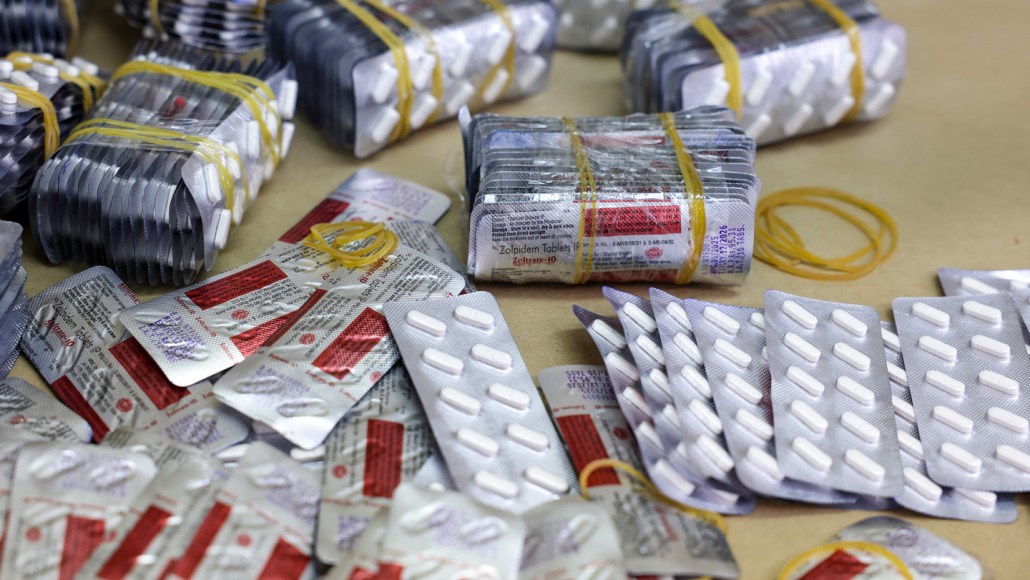
Authorities believe these blister packs contain illicit fentanyl. Drug traffickers can skirt the law by cooking up novel varieties authorities haven't cataloged. A new reference library that doesn't rely on measurements of known molecules could help law enforcement end the game of cat and mouse.
ANGELA WEISS/AFP/Getty Images
This is a human-written story voiced by AI. Got feedback? Take our survey . (See our AI policy here .)
Illicit laboratories do a criminally good job of synthesizing new forms of dangerous drugs that slip under the radar, but a new method could spot variants of the powerful opioid drug fentanyl even before they’ve been cataloged by authorities.
Measuring a suspicious pill’s traits and comparing them to computer-generated reference values could reveal chemical signatures of previously unseen fentanyl variants, researchers report April 27 at bioRxiv.org. Although the system isn’t yet ready for use by law enforcement officials, the ability to look beyond molecules on the official books could one day help them stay a step ahead of opioid traffickers.
Used in anesthesia and pain medication, fentanyl is up to 100 times as potent as its cousin morphine. Just two milligrams — the amount that fits on the tip of a pencil — is potentially lethal, and the United States reported more than 72,000 overdose deaths in 2023 alone. Fentanyl contains no natural ingredients, and underground labs can tweak its structure just enough to avoid detection while retaining its heroinlike effect. That’s made it profitable to lace pills with a powerful substance that many users don’t know they’re consuming.
The only way experts can know if a pill contains a fentanyl variant is by comparing it to a reference library made by analyzing pure chemical compounds in the lab. But calculations indicate that there are billions of possible forms of fentanyl — and experts know only about 60,000 of them. Forensic and toxicology labs can’t keep up. “It’s become a whack-a-mole problem,” says biochemist David Wishart of the University of Alberta in Edmonton, Canada, who wasn’t involved with the work.
Bioanalytical chemist Tom Metz says, “Pure forms are not going to get us where we need to be.” Metz, of Pacific Northwest National Laboratory in Richland, Wash, and his colleagues set out to eliminate the need for traditional reference libraries. In prior work, they used two customized instruments to identify chemical features shared by fentanyl compounds and to distinguish between many unrelated molecules that share fentanyl’s molecular mass.
All fentanyls have a common core chemistry, but labs can vary surrounding chemical groups. “It’s like a Christmas tree — nearly always a pine tree of some sort, but each household will decorate it differently,” Metz says. The instruments give clues to the precise elements that make up molecules, how they’re structured and the shape they adopt during analysis.
Now that the researchers knew which measurements would thoroughly profile fentanyls, for the new study they dreamed up a database of hypothetical variants. They computationally broke apart each of the roughly 60,000 known fentanyl and fentanyl-like molecules into a few different fragments, then recombined them to create several billion molecules. Next, they eliminated nonsensical and implausible molecules from their digital catalog, such as ones unlikely to penetrate the brain’s protective barrier. Finally, with help from machine learning, they predicted what real-world chemical measurements of the dreamed-up structures would look like. They combined that data with that of the 60,000 known structures to make their final digital library of over 1 billion analogs.
The researchers could not test street drugs, so instead they created a mock fentanyl pill with traces of 12 commercially available fentanyl varieties, along with a chemically similar nonopioid decoy, cut with typical street pill ingredients like caffeine. They completed the feature-identifying measurements, then handed the raw data and the computer-generated library to another analytical chemist who’d never seen the mock pill, with a prompt: “We suspect there’s fentanyl in this sample. Can you tell us which, if any, analogs are in it?”
The answer was a resounding “Yes.” After multiple cycles of narrowing down possible matches, the blinded chemist identified six of the mock pill’s fentanyl components perfectly and narrowed another four down to a few possible candidates each, no pure compound library needed. The remaining two lacked the signatures used for flagging or could not be fully teased apart. The results have not yet been peer-reviewed.
The approach is a “tremendous first step,” but it relies on customized instruments unavailable to most forensic or national security laboratories, says chemist A. Way Fountain III of the University of South Carolina in Columbia, who wasn’t part of the study. And the technique should be tested with other classes of drugs or molecules to show where improvements are needed, Fountain says.
Such tests are underway. Among several classes of molecules Metz and his colleagues are studying, they have also identified common features in a new family of lab-made opioids called nitazenes that are becoming prevalent in overdose cases.
Wishart thinks the work will help modernize the forensic community’s approach for identifying unknown compounds. Relying on a reference library of pure compounds “is still very 19th century thinking,” he says.
Molecular pharmacologist Gary Miller of Columbia University, who wasn’t involved with the research, agrees. “Reference-free identification could be revolutionary from a scientific standpoint,” he says. “These data demonstrate that the approach can work.”