Personalized brain stimulation can ease chronic pain
A new process for mapping and treating severe pain shows promise

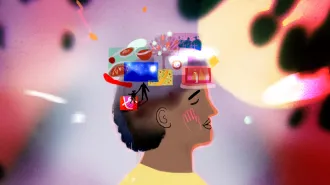
Bespoke brain maps of people with severe pain may allow new treatments.
Say-Cheese/iStock/Getty Images Plus
By mapping a woman’s pain in her brain, scientists could dial it down. A small series of case studies, published July 30 in Brain Stimulation, suggests that even tenacious, complex pain signals can be interrupted by hitting the right spot with electricity.
Unlike the acute agony of a broken arm, some sorts of pain last well beyond the healing stage. Chronic pain, generated by changes in the brain and spinal cord, is especially hard to treat. “We have been limited in what we can do for these patients, and they have a great deal of suffering,” says neurosurgeon Michael Lim of Stanford University School of Medicine. The results open up a new way to treat this sort of pernicious pain, says Lim, who wasn’t involved in the study.
One approach to treating chronic pain involves targeting the brain directly with deep brain stimulation, or DBS. The method relies on electrodes on thin wires implanted in the brain and a battery pack that’s implanted in the chest. DBS is most commonly used to treat Parkinson’s disease, and it’s being studied for its effectiveness in other conditions, including depression.
So far, tests of DBS for chronic pain have yielded inconsistent outcomes, working for some people but not others. That spottiness might have to do with the complexities of pain that comes from changes to the brain itself. The experience of pain is built by collections of brain networks, including those that handle sensory input, chemical signals and even emotional components, says Vivek Buch, a neurosurgeon and neuroscientist at Stanford University. “And somehow they’re coming together as an integrated signal to give a person a perception of pain.”
To add more complexity, each person’s brain may handle things differently. Chronic pain, as well as psychiatric disorders such as depression and obsessive-compulsive disorder, “are just not one-size-fits-all,” Buch says.
The study’s premise was simple: First, map a person’s specific collection of pain signals. Then once this map is drawn, deliver small, precise electrical signals to scramble the pain signals and ideally, provide relief.
Buch and his colleagues recruited three people, all of whom suffered from severe and chronic face pain. These volunteers underwent surgeries in which clinicians inserted temporary electrodes through small holes in the skull into key brain regions. Over the next three days, researchers systematically sent small blips of electricity through these wires to different spots in the volunteers’ brains.
This mapping yielded specific information about each person’s pain, says Karl Deisseroth, a neuroscientist, psychiatrist and Howard Hughes Medical Institute investigator at Stanford. “Finding out, for a particular person, the location, the pattern of stimulation that helps that person is crucial for determining what definitive treatment might work.”
Results varied for the three people. One of the volunteers didn’t get much relief from any of the combinations of stimulation; two people’s pain improved.
One participant, a woman in her 40s, went on to have four permanent electrode wires implanted in the regions of her brain that responded positively during testing. Six and 12 months later, she’s still feeling better. “She’s doing really great,” Buch says. “She sends us text messages routinely.” The second woman, who had relief during testing, plans on getting a permanent implant soon, Buch says.
The person who didn’t experience much relief from the electrical stimulation still taught the researchers a lot. Successful outcomes are important, Deisseroth says, “but it’s just as important to identify if the definitive treatment is not going to work.”
“To have an objective measure guiding whether or not you take someone through a particular course of treatment, that’s a dream in psychiatry and psychiatry-adjacent fields and disorders,” Deisseroth says. “And so to see this work, and to be able to guide us [to] who should get a treatment, is just a very important step for the field.”
Looking ahead, the researchers hope to explore more conditions with this brain-mapping approach, both as a therapeutic effort and a way to learn more about how the brain works. “From my perspective in psychiatry,” Deisseroth says, “I don’t know that there’s a ceiling on where we can go.”