All Stories
- Neuroscience
Caffeine may improve memory
Taking the stimulant after learning new information boosted people’s recall the next day.
- Plants
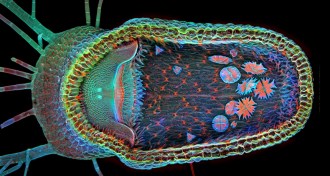
Bladderwort opens wide
Under a microscope, the tiny trap of a carnivorous plant becomes an impressive gaping maw.
- Astronomy
“Black holes” in space
Science News Letter was the first publication to use the term in print in 1964.
- Astronomy
Enormous cosmic lens magnifies supernova
Galaxy warps light of distant exploding star, greatly increasing its brightness.
- Agriculture
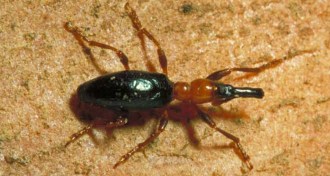
Sweet potato weevils have favorite colors
When it comes to eradicating the sweet potato weevil, the devil is in the colorful details.
- Earth
The long and winding Colorado
The history of the West’s iconic river is written in the dramatic landscapes it has shaped. How to interpret that chronicle has become a contentious issue among geologists.
- Math
Tomorrow’s catch
A biologist who formerly applied his mathematical talents in finance has developed new ways of predicting the ups and downs of fish populations.
- Life
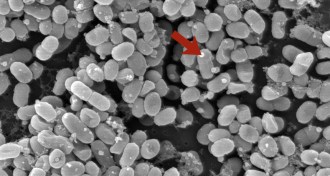
Marine microbes shed packets of DNA, nutrients
The world’s most abundant marine microorganism, the photosynthetic bacteria Prochlorococcus, spits out nutrient-rich vesicles into ocean waters, perhaps for genetic exchange or as a survival mechanism.
- Neuroscience
A schizophrenia drug turns on protein factories in cells
Haloperidol reshapes neurons, which might explain how the medicine works.
- Computing
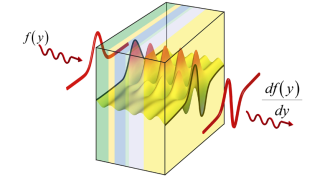
Materials’ light tricks may soon extend to doing math
A simulation paves the way toward metamaterials that can perform ultrafast complex mathematical operations using light waves.
- Animals
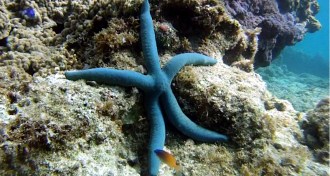
Finally, evidence that a starfish’s eyes let it see
The sea star’s vision isn’t great, but it’s good enough to help the animal find its way home.
- Genetics
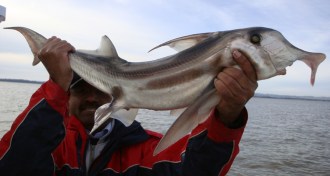
Elephant shark genome small and slow to evolve
The animals have the smallest genome of non-bony fishes and the slowest-evolving genes among vertebrates, a study suggests.