Measles cases in the U.S. hit a new 34-year high

With five months left in 2026, the country could lose its measles elimination status
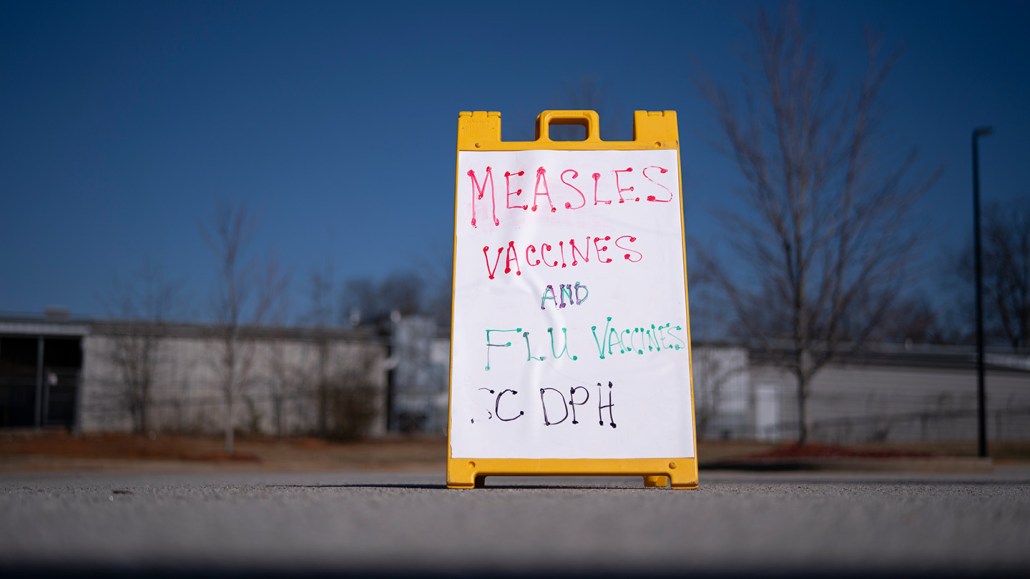
A folding sign that says "Measles vaccines and flu vaccines SC DPH" stands in the middle of a sidewalk with a distant building in the background

A clinic in Spartanburg, S.C., offers free MMR and flu vaccines as cases of measles surge in February 2026. The outbreak helped push U.S. measles case counts to a 34-year high.

Sean Rayford/Getty Images

The number of measles cases in the United States has outstripped last year’s 33-year high.

Already this year, health officials have recorded 2,295 cases, the Johns Hopkins Bloomberg School of Public Health reports July 21. That surpasses the 2,286 cases documented in 2025. Many of this year’s cases have come from an explosive outbreak in South Carolina and one simmering in Utah. Another 40 states, as well as New York City and Washington, D.C., have also reported cases.

Before 2025, the last time the United States recorded more than 2,000 cases was in 1992. The U.S. Centers for Disease Control and Prevention is expected to report similar numbers when it updates its case count this Friday.

Declining vaccination rates have helped the virus regain a foothold, raising concerns that the United States will lose its measles elimination status — a designation it has held since 2000. Measles is so contagious that at least 95 percent of people in a community need to be vaccinated to prevent the virus from spreading. Across 33 states, the average two-dose measles, mumps and rubella, or MMR, vaccination rate fell from about 94 percent before the COVID-19 pandemic to about 91 percent afterward, researchers reported in JAMA in 2025.

Science News spoke with William Moss, an infectious disease epidemiologist at the Johns Hopkins Bloomberg School of Public Health, about where the U.S. outbreak stands and how it fits into the global picture of measles spread. The conversation has been edited for length and clarity.

SN: We’ve recorded more than 2,000 cases two years in a row. What does that mean?

Moss: This indicates that we have not been able to shut down measles virus transmission in this country. That’s a reflection of communities scattered throughout the United States that are under-vaccinated.

I often like to point out that the age distribution of cases here in the United States reflects broad age ranges. Only about 20 percent of the cases are in children younger than five. You’ve got about 50 percent of cases in 5- to 19-year-olds, and then about 30 percent in adults older than 20.

This wide age distribution of cases that we’re seeing — both last year and this year — is an indicator that this has been a long-standing problem of under-vaccination in some communities. It’s not just a recent phenomenon of decrease in vaccination coverage, because then we would expect to see a higher proportion of cases in the youngest age group.

So, this has been long in the making.

SN: How have things changed since measles began spreading early last year?

Moss: Things haven’t changed too much. Obviously, the virus has entered different communities with different underlying reasons, perhaps, for under-vaccination. Under-vaccinated communities of different sizes are driving the size of outbreaks.

I like to use a forest fire metaphor, where you’ve got these sparks going out from the outbreak in West Texas [that began in January 2025]. Some of those sparks land in vulnerable communities and you get a larger outbreak there. Some of them land in communities like Maryland, where I live. We’ve had a number of importations over the past two years, but no sustained outbreak because it’s landing in a community with fairly high vaccine coverage.

SN: Do you think the United States might lose its elimination status this year?

Moss: I would be shocked if we don’t lose our elimination status.

What [loss of that status] means is that there’s been endemic measles virus transmission for 12 months or more. It’s a somewhat arbitrary threshold, but that’s basically to allow countries or regions to maintain elimination status if they have importation of measles virus — which we always have — and some short-term, sustained transmission.

The argument against losing measles elimination status would be that transmission within the United States represents multiple independent importation events and then shorter-term transmission that dies out. Then there’s another importation event. I know CDC and others are [doing genetic analyses on] the measles virus to see if they see any major [genetic] differences. If we saw [the genetics] significantly change over time that might be evidence that there have been repeated importations rather than continuous transmission. But I don’t think we’re going to see that.

SN: The United States is not the only place struggling with measles. Where do things stand on a global scale?

Moss: [The ongoing outbreak in the United States] has really been a North American outbreak. Mexico has had over 12,000 cases. Canada lost their elimination status in November last year. There’s been a lot of movement of the virus across borders between those two countries and the United States. We’ve certainly had this setback in North America. When Canada lost its elimination status, the whole World Health Organization region of the Americas lost it.

Elimination is a very fragile state. It’s very hard to maintain measles elimination status because of the threat of importation from other countries. If you look beyond the Americas, the really big, devastating outbreak this year has been in Bangladesh, with close to 50,000 [confirmed] cases. Measles cases are often way underreported as well, so it’s hard to sometimes tell just by the numbers.

SN: What are you most concerned about?

Moss: The big thing for me over the past year and a half has been the withdrawal of the United States in supporting many global public health efforts, including immunization. The withdrawal of the United States from the World Health Organization, and the withdrawal of huge amounts of funding. The withdrawal of U.S. support for Gavi, the Vaccine Alliance, that supports many low-income countries not only in routine immunization for measles, but also mass vaccination campaigns…. And then the dismantling of USAID, which supported many immunization programs.

The United States is not alone in this. European countries have also withdrawn support for global public health initiatives.

Here in the United States, the undermining of confidence in vaccines that we’ve seen with the current administration is being manifested in these measles outbreaks…. We obviously have holes in our protective immunity, and these are often not visible until measles virus starts circulating.

SN: Any final thoughts?

Moss: There has been a steady increase in nonmedical exemptions. But a lot of states have tried to relax their school entry requirements through legislation — and a lot of that legislation has not passed.

In general, parents in the United States recognize the value of vaccinations, measles vaccinations included. There has been a few percentage-point decline in measles vaccine coverage among kindergartners, but it’s still quite high. I don’t think we’re going to see a real dramatic drop in that. I think most parents are in favor of vaccination. I saw a recent number of people who self-identify as MAHA [the Make America Healthy Again movement]: 86 percent are supportive of [measles] vaccination. So I think there is broad support.

Erin I. Garcia de Jesus is a staff writer at Science News. She holds a Ph.D. in microbiology from the University of Washington and a master’s in science communication from the University of California, Santa Cruz.