A private moon lander challenges ideas about lunar volcanism
Blue Ghost’s first measurements test a long-running explanation for the man in the moon
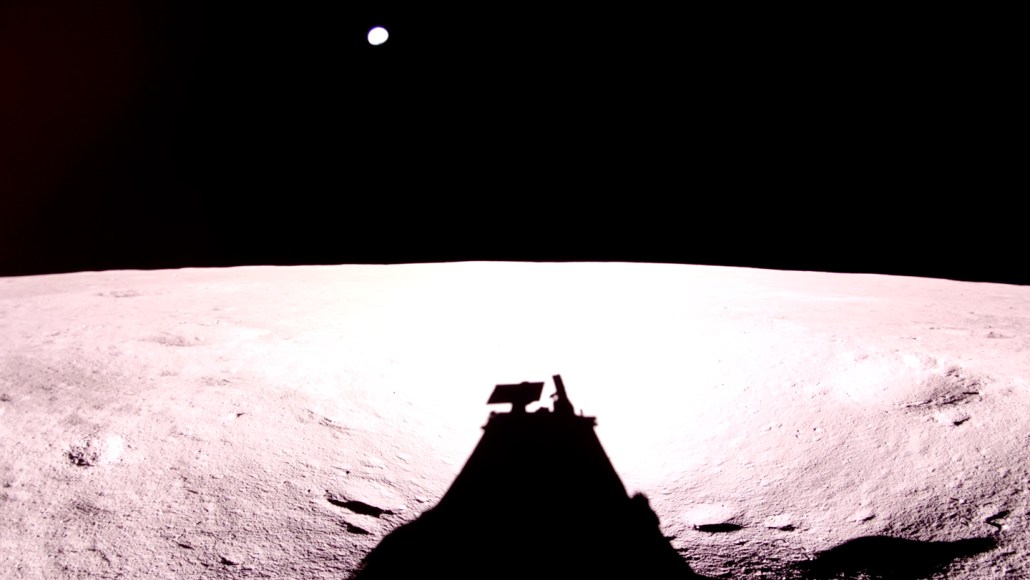
Blue Ghost’s shadow stretches across the moon’s surface after the Firefly Aerospace lander touched down there in March 2025. Its first science measurements revive a lunar mystery.
NASA, Firefly Aerospace
The first measurements from a private spacecraft on the moon may reopen an old debate about why the moon’s Earth-facing side looks the way it does.
Instruments aboard Firefly Aerospace’s Blue Ghost lander found that the underground heat at its landing site may not differ as much as scientists expected from heat measured from Apollo landing sites, researchers report in several talks March 17 at the Lunar and Planetary Science Conference in the Woodlands, Texas. The result could reshape thinking about how the moon’s familiar dark patches formed.
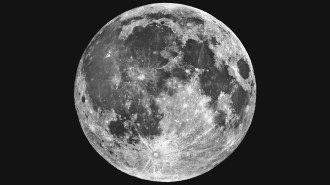
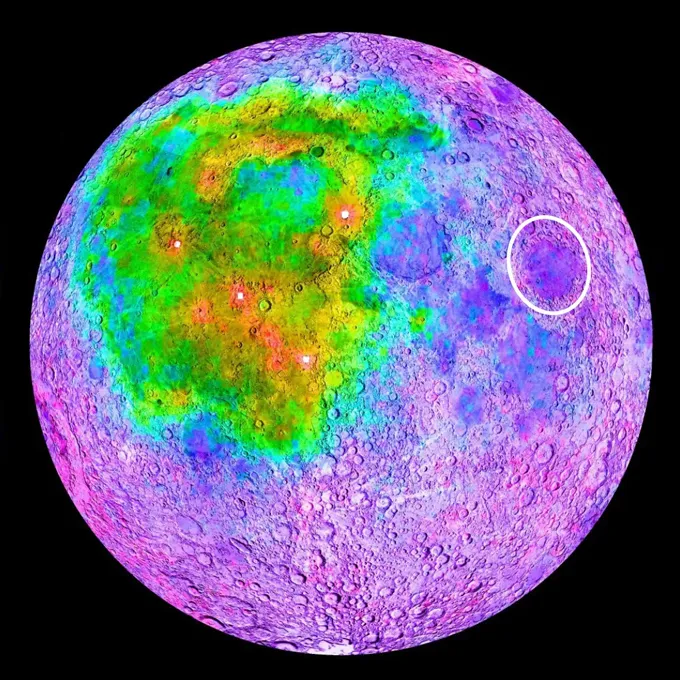
Almost all the moon’s lava flows are concentrated on its nearside, in dark plains that give us the man in the moon. Scientists have long argued that a concentration of heat-producing chemical elements on the nearside helped support extensive volcanism there. So on March 2, 2025, Blue Ghost landed outside the heat-rich terrain in an impact basin called Mare Crisium, to see if it really was cooler there.
“The idea was, if we go outside of that region, we can eliminate any internal bias and get a straight up measurement of the outside,” says planetary geophysicist Robert Grimm of the Southwest Research Institute in Boulder, Colo., who presented some of the results. “We hope that Mare Crisium is far enough away [from the heat-rich terrain] that it represents the normal moon, the background moon.”
Several of the Apollo missions of the 1960s and ‘70s landed in ancient lunar lava flows called maria. The rocks returned by astronauts were rich in elements that scientists collectively call KREEP, for the elements they contain. Researchers assumed that composition was similar in rocks all over the moon.
So it was a surprise in the late 1990s when NASA’s Lunar Prospector spacecraft found radioactive proxies for those elements concentrated in a region that includes many of the nearside lava flows — but hardly anywhere else. That region is now called the Procellarum KREEP Terrane, or PKT.
All those radioactive elements could have provided enough heat to melt the mantle beneath the PKT, creating volcanic flows there but not on the rest of the moon, scientists proposed in 2000. But without measurements from outside the PKT, they couldn’t be sure.
That’s where Blue Ghost comes in.
The lander carried two instruments that could probe the moon’s internal temperature, one that drilled nearly a meter beneath the lander to measure heat flow, and another that inferred temperatures down to about 200 kilometers.
If lava flows in the maria were mainly due to heat-producing elements, the temperature beneath Mare Crisium should be different from that beneath the Apollo landers, Grimm says. After all, Blue Ghost landed in a spot thought to be outside the PKT.
But the temperatures were surprisingly close. Measurements from Blue Ghost’s drill were comparable to those from similar instruments on Apollo 15 and 17, geophysicist Seiichi Nagihara of Texas Tech University in Lubbock reported at the meeting. And the measurements at greater depth differed from Apollo 12 by less than 230 degrees Celsius, rather than the expected 700 degrees.
To explain the results, Grimm points to measurements from another lunar orbiter called GRAIL, which found in 2013 that the lunar crust is thinner within the PKT than elsewhere on the moon. Perhaps volcanism was easier there because there was simply less crust for magma to fight through to reach the surface, he says.
“I think [Blue Ghost’s finding] reverses a quarter century of thought about the PKT,” Grimm says.
Not everyone is convinced. That 200-degree difference could still be consistent with more heat-producing elements near Apollo 12 than at Mare Crisium, says planetary scientist Mark Wieczorek of the Institut de Physique du Globe de Paris, a coauthor on the study proposing that idea in 2000. More recent research also suggests that the PKT could be smaller than previously thought, which means Apollo 12 might have been right on the region’s edge rather than well inside.
The debate might be settled with another planned private mission, targeted for 2027, which will carry similar heat-measuring instruments to the Schrödinger crater on the moon’s crater-covered farside. That will be a better test, since the farside is lacking in both maria and heat-producing elements.
“Geophysicists might argue about how to interpret the results,” Wieczorek says, “but we are all in agreement that we need more measurements.”