The only U.S. particle collider shuts down – so a new one may rise
The Relativistic Heavy Ion Collider stops work after more than 25 years of mind-bending discoveries
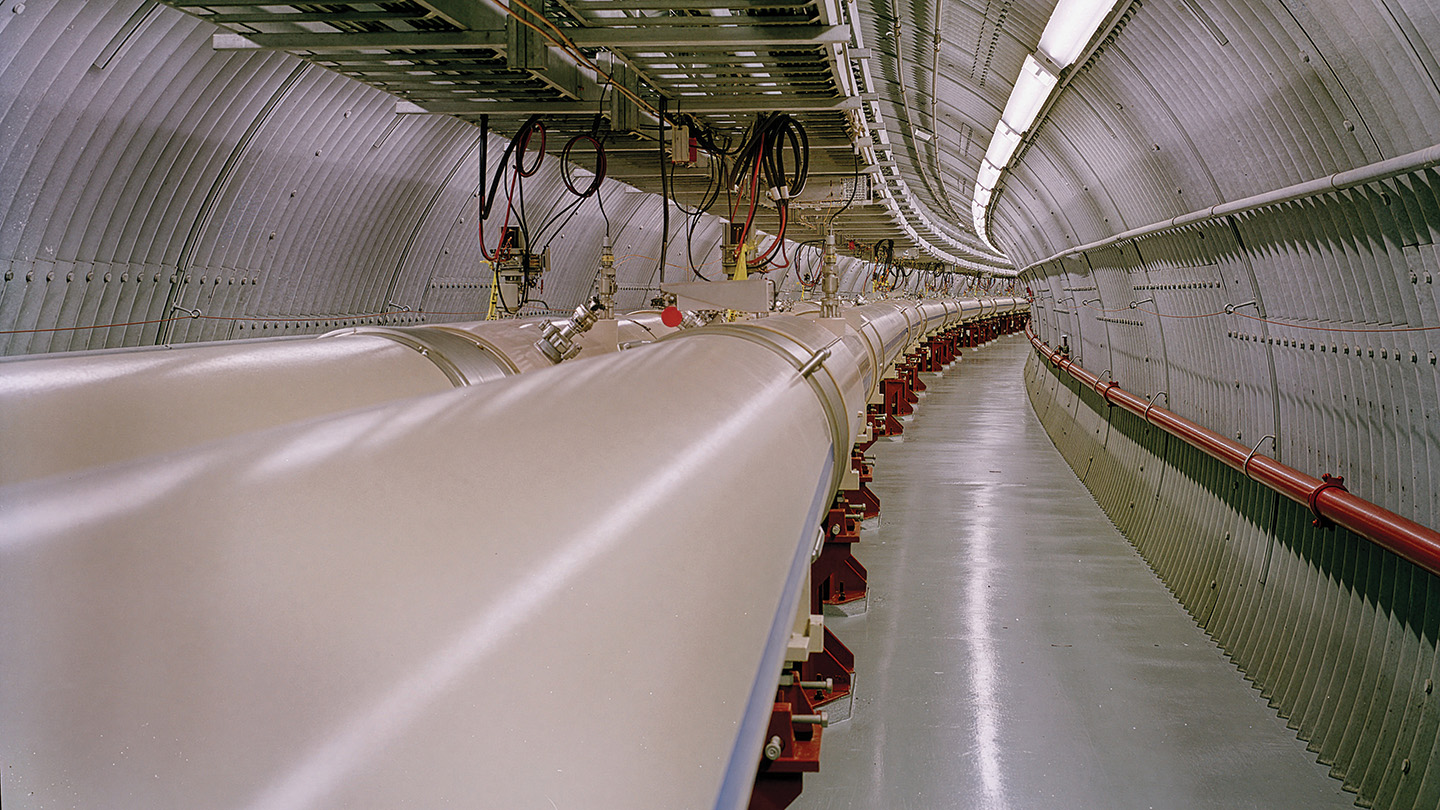
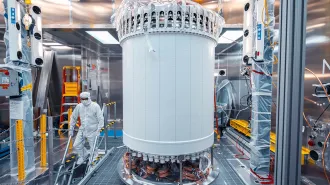
The Relativistic Heavy Ion Collider consisted of two rings (shown) that accelerated protons and atomic nuclei to near light speed before smashing them together.
Brookhaven National Laboratory/Flickr (CC BY-NC-ND 2.0)
This is a human-written story voiced by AI. Got feedback? Take our survey . (See our AI policy here .)
I peeked in on the house-sized particle detector known as STAR just after it took its last-ever snapshot of one of the most extreme types of fireball ever created. Inside, the conditions just after the Big Bang had been re-created in miniature by colliding gold atomic nuclei, just as had been done countless times over the 25 years of the detector’s existence. Now that era was nearing its end.
Physicist Alex Jentsch took stock of the moment, which he said called for an ambiguous sort of recognition: “Either celebrate or grieve, one of the two.”
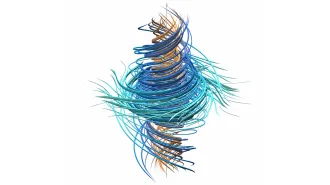
A whirring fan tousled our hair as we gazed at STAR, an organized tangle of wires, tubes, electronics and particle-detection systems. Above our heads, a surprisingly thin pipe threaded into the machine, the conduit through which atomic nuclei — positively charged ions — were flung to their demise. In the STAR control room, alarms slowly beeped as in a hospital. Scientists flashed the latest collisions on a monitor, fireworks of curving lines in blue, green and cyan.
STAR was designed to capture the aftermath of smashups of atomic nuclei traveling at nearly the speed of light, produced by the Relativistic Heavy Ion Collider, or RHIC, at Brookhaven National Laboratory in Upton, N.Y. Now, RHIC (pronounced “Rick”) had collided its last beams of gold nuclei as it neared a final shutdown in preparation for a next-generation collider-to-be.
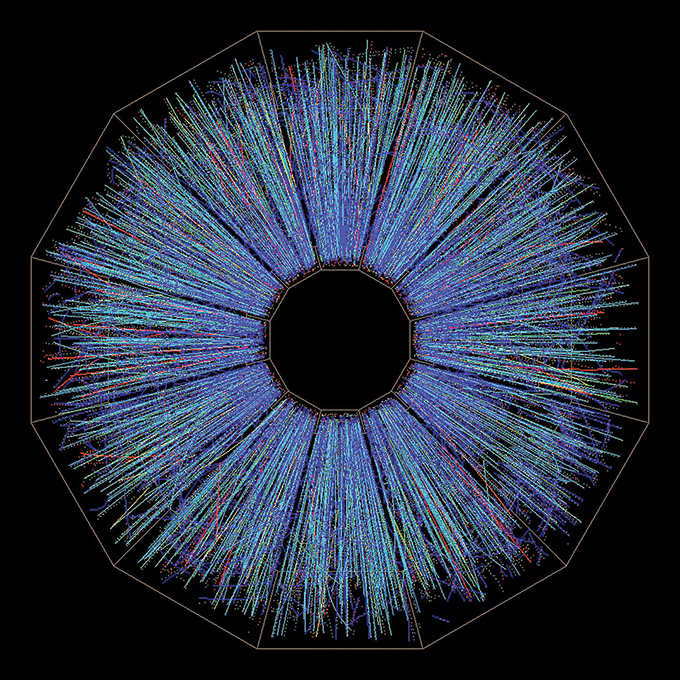
Beginning in the 2000s, experiments at RHIC unveiled the early-universe particle slurry called the quark-gluon plasma. The facility went on to reveal surprising new details of this primordial soup of the universe, from which the particles that make up stars, galaxies, planets — and, eventually, us — descended. And that’s just the half of it. RHIC also collided protons, characterizing the subatomic particles in exquisite detail and uncovering the surprisingly tumultuous inner world of these pervasive constituents of matter.
On the day I visited, scientists were switching the collider over to proton collisions in an effort to gather every last shred of data possible before the shutdown. RHIC switched off for good at a ceremony on February 6.
“RHIC had a spectacular run … beyond what anyone could dream,” says Wolfram Fischer, an accelerator physicist at Brookhaven.
RHIC’s closure marks the end for the only particle collider operating in the United States, and the only collider of its kind in the world. Most particle accelerators are unable to steer two particle beams to crash head-on into one another. That’s what colliders do, and it makes them a rare and precious commodity. The country’s other collider of recent memory, the Tevatron at Fermilab in Batavia, Ill., shut down in 2011.
But RHIC’s ending is a hopeful one. It makes way for the Electron-Ion Collider, planned to start up in the mid-2030s. “That’s where the future is, and hopefully it will be equally spectacular,” Fischer says.
The Electron-Ion Collider will build on RHIC’s discoveries. It will occupy the same tunnel and reuse much of RHIC’s equipment and infrastructure. But instead of slamming together protons and heavy atomic nuclei, it will collide electrons with protons or atomic nuclei to produce deep insights into the structure of the proton.
“It is a 3-D imaging of the proton, really in full glory,” says Brookhaven physicist Elke-Caroline Aschenauer. The collider may even reveal a mysterious substance called a color glass condensate thought to lurk within protons.
The subatomic rabbit hole
I toured the lab, its detectors and other parts of the facility in early December. I embarked on this journey in part because Brookhaven National Laboratory holds special significance in my life. I grew up not far from the lab, where the collider’s 3.8-kilometer ring nestles into the Long Island pine barrens. It’s part of how I became enamored with physics, and, eventually, with writing about the field.
As a teen taking part in a student research program at the lab, I was fascinated to learn that protons are not simple balls of positive charge as they were depicted in textbooks. Instead, they are composed of smaller stuff called quarks and gluons. This was the 1990s, the era of The Matrix, and for teenaged me, this proton revelation was my “red pill,” as they say in the film: I needed to know how deep the rabbit hole went. As it turns out, it went much, much deeper.
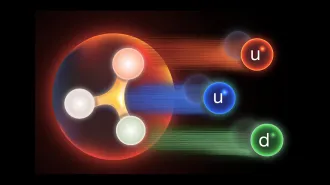
In the simplest picture, protons are made up of three quarks — two “up” quarks and one “down” quark — and particles called gluons, which, true to their name, act like glue. These particles transmit the strong nuclear force, which sticks quarks together within protons, neutrons and other particles.
And that’s only a small piece of the immense complexity of the proton. The particles froth with the fervor of quantum mechanics, in which reality is uncertain and fluctuating. As a result, they contain a “sea” of short-lived quarks and their antimatter equivalent, antiquarks, with gluons swarming about them like the dust cloud around Peanuts character Pigpen.
The strong force is so strong that quarks and gluons can’t be observed individually; they are always bound together into larger particles. “The laws of nature prohibit them from being alone,” says Brookhaven physicist Abhay Deshpande.
That is, except during the fleeting existence of the quark-gluon plasma. This state of matter existed just after the Big Bang, when the universe was so hot that a mess of quarks and gluons mingled together. As this particle soup cooled, protons, neutrons and other particles condensed out of it about 10 microseconds after the birth of the universe.
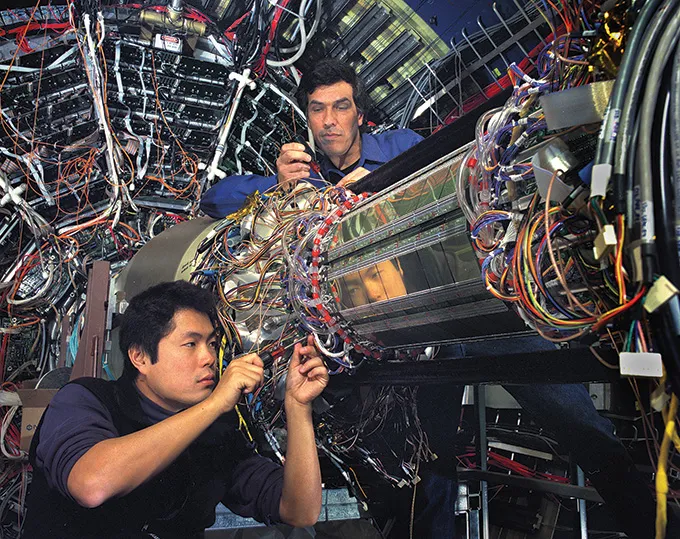
As I was wrapping my teenage head around the existence of quarks, scientists at Brookhaven were trying to re-create this quark-gluon plasma.
The facility stripped the electrons off atoms before slinging them to near light speed, steering them clockwise and counterclockwise in circles using 1,740 powerful superconducting magnets and slamming the particles into one another. The idea was that when heavy atomic nuclei collided, they would produce trillion-degree temperatures that would melt their protons and neutrons into a quark-gluon plasma. Multilayered detectors would then observe the resulting debris, hopefully identifying the fingerprints of the sought-after substance.
In 2005, scientists with RHIC’s four detectors — STAR, PHENIX, PHOBOS and BRAHMS — jointly announced the discovery of a new state of hot, dense matter in a special issue of Nuclear Physics A. The substance, now confirmed to be quark-gluon plasma, lasted about 10 quadrillionths of a nanosecond and reached trillions of degrees Celsius within a region only about 10 trillionths of a millimeter across.
“That was the first time quarks and gluons were seen, or at least observed indirectly, as being outside of protons and neutrons,” Deshpande says. “That was a big deal.”
But in a scientific shocker, the state of matter RHIC found was not a gas of free-floating quarks and gluons, as scientists expected the quark-gluon plasma to be. Instead, the quarks and gluons interacted with one another as in a liquid. In fact, RHIC revealed, the quark-gluon plasma is a near-perfect liquid, meaning that it has vanishingly small viscosity and can flow with almost no resistance. “It has a very distinct persona,” Deshpande says. “It likes to flow.”
The rise of sPHENIX
Once they had re-created the quark-gluon plasma, scientists wanted to know more about it. Researchers upgraded their detectors numerous times to better study this fleeting state of matter. The STAR detector has had new pieces cobbled onto it even in recent years. In our visit, newly added components perched on odd platforms, like books teetering on an overloaded bookshelf in a long-inhabited office.
PHENIX researchers chose a different tactic. Instead of continuing to upgrade PHENIX, they decided it was better to start fresh. Scientists knew that RHIC might not continue running much longer, so they designed a new instrument to live fast and die young. In 2023, sPHENIX switched on.
When we visited the three-story detector during my December tour, the contrast with the aging STAR was immediately apparent. If STAR was a well-used pair of hiking shoes — sturdy, comfortable but showing their age — then sPHENIX was a pair of kicks just off the shelf. It was shiny and modern and bright, freshly painted in cornflower blue.
With its new, faster electronics and more sensitive hardware, sPHENIX got cranking. “We’ve taken more data this year than the entirety of the 25 years of RHIC running,” says physicist Rosi Reed of Lehigh University in Bethlehem, Pa.
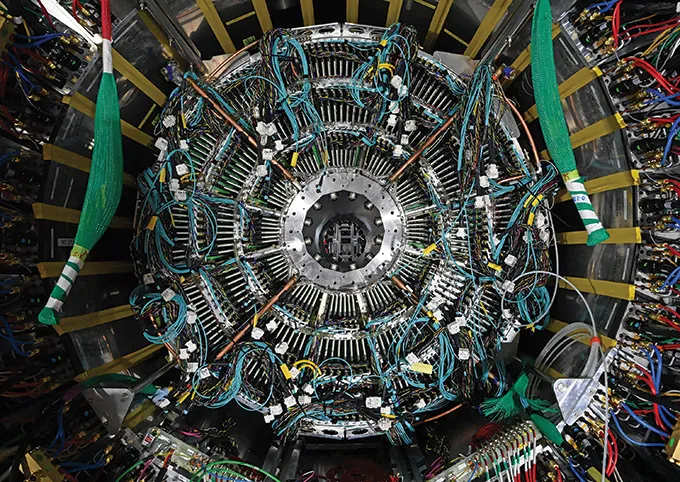
sPHENIX serves as a bridge to the Electron-Ion Collider. For one thing, the detector used a data-collection strategy that will be essential for the new facility.
Most particle collider detectors generate too much information to store it all. So they record only events that meet certain conditions for being interesting. But then you have to ask, “ ‘What about those things I’m not seeing?’ ” Reed says.
Components of sPHENIX can collect data nonstop via a method called streaming, throwing nothing away. This is how the entirety of the Electron-Ion Collider’s detector will run, a feat made possible by improved computer processing and storage capabilities, as well as AI techniques that will help sift through that multitude of data.
In an office adjoining the hall that houses sPHENIX, remnants of celebratory bagels and cream cheese lay scattered on a table. Not exactly champagne, but I was raised in these parts, so I can clue you in: Bagels are the champagne of Long Island.
sPHENIX still feels fresh, so moving on from it is bittersweet, Reed says. “Nobody ever wants to see the ending of something. I think that we could, if there was more time, do more. But I’m really happy and proud of what we’ve managed to accomplish.”
A spin on protons
In the RHIC control room, another stop on my tour, run coordinator Travis Shrey appeared relaxed, as if swapping out gold nuclei for protons along a 3.8-kilometer accelerator is no biggie. “We didn’t plan on running protons this year,” Shrey, an accelerator physicist, said nonchalantly. “This is kind of like a last-minute thing.” Unflappability is presumably a desirable quality for someone in charge of operations for a machine so big that it’s visible from outer space.
RHIC’s proton beams are special: They can be polarized. That means the protons, which have tiny magnetic fields, are aligned so their magnetic poles are all pointing in the same direction, like packages with “this way up” signs cruising around a conveyor belt. But the packages are subatomic particles, and the conveyor belt has them zipping at close to the speed of light.
These polarized beams allowed RHIC to investigate the proton in ways never before possible. In particular, they brought scientists closer to resolving a puzzle so vexing to physicists that it was known as a “crisis” when it first came to light in 1987.
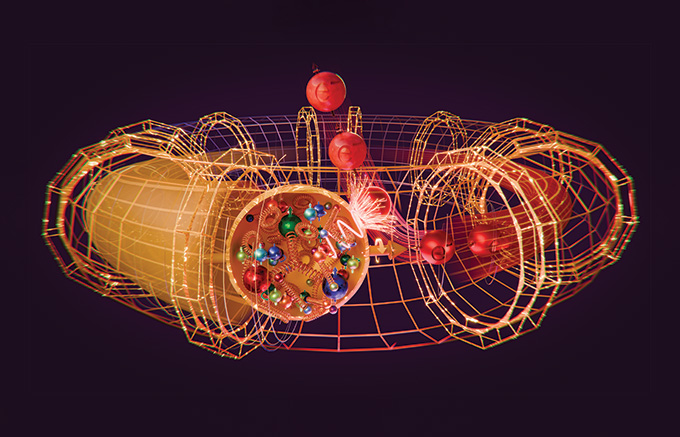
At issue is the proton’s spin, the quantum property that gives it a magnetic field. Spin is a quantum version of angular momentum, a sort of rotational oomph. That might seem abstract, but it’s as important to a particle as its mass or electric charge. Spin comes in either integer or half-integer values and determines a particle’s role. Building blocks of matter, such as protons, electrons and neutrons, have spins of ½ and are known as fermions. Particles that transmit forces, like gluons or photons, have integer spins and are known as bosons. If protons were bosons instead of fermions, atomic nuclei — and the universe as we know it — wouldn’t exist.
At first, physicists expected that the quarks, which each have spin of their own, made up the spin of the proton. But experiments indicated that only about 30 percent of the spin was coming from quarks. “That was a bit of a shock,” says Jentsch, of Brookhaven. “Where does the rest of it come from?”
RHIC’s polarized proton beams revealed that gluons contribute to the spin, making up about 20 to 30 percent. But that still leaves about half of the spin unexplained.
This is where the new Electron-Ion Collider comes in. When it starts up in the mid-2030s, it will provide maps of the positions and momenta of the particles that make up the proton. And that will allow scientists to investigate another potential source of spin. In addition to the intrinsic spins of the quarks and gluons, their swirling motions within the proton may also add to the proton’s spin.
The “electron” in the Electron-Ion Collider is crucial here. The collider will use electrons to probe protons, rather than colliding protons with protons. That’s a game changer because, while protons have smaller constituents, electrons do not. So an electron is a more precise probe that provides a fine-grained view of protons’ inner world.
“You can think about it like an electron microscope,” Aschenauer says. “It’s really a precision machine which will give us all the secrets of the visible matter which can be unraveled.”
Doing that requires a collider that is unlike any built before. The Electron-Ion Collider will have polarized electron beams and polarized ion beams. Polarizing both is not an easy ask: The two types of particles behave quite differently in an accelerator. That means the collider is “everything hard about an electron machine and everything hard about an ion machine,” Shrey says. “And then you’re going to add them together, so that adds a whole new level of complication. It is the most challenging machine there is.”
To construct it, Brookhaven is partnering with Jefferson Lab in Newport News, Va. And scientists are not starting from scratch. RHIC consisted of two rings of equipment for steering, focusing and monitoring the two beams, one of which traveled clockwise and the other counterclockwise through the tunnel. The counterclockwise ring will stay mostly as-is to accelerate the protons and ions. The other will be removed and replaced by a new electron ring. Also remaining in place are the multiple stages of pre-accelerators the protons and ions go through before entering the collider.
Some of the magnets for steering the electron beams will be recycled from an electron accelerator at Argonne National Laboratory in Lemont, Ill., called the Advanced Photon Source, which itself was upgraded in 2024, leaving its magnets up for grabs. The bright yellow, minifridge-sized electromagnets are already at Brookhaven, laid out in rows upon rows in a storage room, like a farm growing an unusual crop.
Components of STAR and sPHENIX will also find new life in the Electron-Ion Collider’s detector. You can think of RHIC’s shutdown not as an end, but as a metamorphosis.
The proton’s quantum essence
Fittingly, the Electron-Ion Collider could give scientists an even better understanding of RHIC’s signature discovery, the quark-gluon plasma.
Some of the biggest uncertainties in studies of the quark-gluon plasma come from unknowns about the initial states of the protons and neutrons within the atomic nuclei that are being collided. So one way to better grasp that state of matter is to understand the proton itself.
Protons are subject to the laws of quantum physics, in which objects don’t exist as concrete entities with fixed properties. That feature “really encapsulates the essence of quantum mechanics,” says Brookhaven theoretical physicist Raju Venugopalan. “What you see depends on how you probe the object.” Like that optical illusion that can appear as either a rabbit or a duck depending on your perspective, scientists get a different view of the proton depending on how they look at it.
When studied at low energies, protons appear as simple, three-quark objects. At higher energies, the sea of transient quarks and antiquarks comes into play. At the highest energies, like those at RHIC and eventually the Electron-Ion Collider, scientists believe the proton becomes clogged with multitudes of gluons, making a dense wall called a color glass condensate.
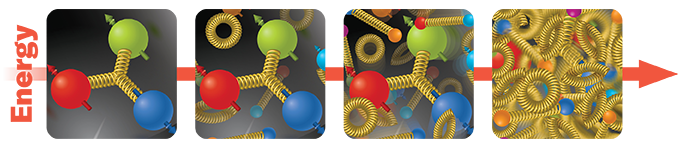
In the collisions of atomic nuclei at RHIC, it’s thought that the gluons of their color glass condensates interacted with one another, producing the quark-gluon plasma. But scientists haven’t been able to fully confirm the existence of that color glass condensate or study it in detail. The Electron-Ion Collider could allow that. And that could have repercussions across physics.
Protons and the quark-gluon plasma are described by a theory called quantum chromodynamics. The mathematics of that theory are so complex that there’s still a mystery behind how quarks and gluons are confined within the proton. How do the gluons of the color glass condensate know how far to extend from the proton’s center, for example? Understanding the color glass condensate could shed light on that question of confinement.
Perhaps the weirdest thing about the color glass condensate is that when the gluons condense into these globs, they somehow shake off their quantum nature. “You think of the stuff inside a proton as being this intensely quantum mechanical stuff, right? All these quarks and gluons kind of fluctuating around,” Venugopalan says. But, he says, the “globs of glue” that make up the color glass condensate behave like classical, not quantum, objects. That means studying the color glass condensate could also help scientists study where the boundary lies between the quantum world and the classical world, another major quandary of physics.
Exposing the color glass condensate could unveil some of physics’ deepest mysteries. “The Electron-Ion Collider, in that sense, is kind of the ultimate machine,” Venugopalan says.
A refuge for curiosity
When I was a senior in high school, we were assigned to write essays about our favorite place in the community. Most people wrote about the beach. A bit cliché, but we did live on an island. I wrote about Brookhaven National Lab.
Before my December trip, though, I hadn’t visited the site in decades. Why did I feel compelled to see RHIC one last time? Perhaps it’s because I’m still amazed this facility existed — a testament to what humans can accomplish when we’re allowed to follow pure scientific curiosity. What, exactly, the universe is made of is perhaps the most fundamental information one might want to know. The experiments at RHIC have undoubtedly gotten us closer to that. In the process, they produced more than 600 Ph.D.s (and inspired at least one journalist).
I also wanted to visit RHIC because I’m worried. At this moment in history, when U.S. science funding is being threatened, I fear a facility like the Electron-Ion Collider could be hard to see through to completion. Its construction is expected to cost nearly $3 billion, with the majority of the money coming from the Department of Energy’s Office of Science. When I asked Deshpande about funding concerns at a meeting of the American Physical Society last March, he noted that the project is an international collaboration, with some funding coming from foreign governments and other sources. But, he said at the time, “we are always worried.”
Inside a Next-Gen Collider
In the Electron-Ion Collider, protons and atomic nuclei will be created and pre-accelerated (orange) before being injected into the collider’s counterclockwise ring (yellow). The electron beam will be created and accelerated in a separate ring before entering the clockwise ring (red). Particles will collide at one or more detectors (green) that will measure
the results.

And the United States is not the only one at this game. The proposed Electron-ion collider in China, to be located in Huizhou, is earlier in the planning process than the U.S. effort, but if it goes ahead, it’s projected to begin operations in the late 2030s.
In my college years, I spent a summer doing research at Stony Brook University in New York, which neighbors Brookhaven and had many scientists working on RHIC experiments. My mentor from back then, physicist Thomas Hemmick, a member of the sPHENIX team, is an optimist. He reassured me: “The track record of DOE Nuclear Physics is that their highest priority for new construction has always been built, and so that gives a lot of confidence to the field.” According to a 2023 U.S. Nuclear Science Advisory Committee report, the Electron-Ion Collider is the highest priority. In a statement to Science News, a DOE spokesperson expressed excitement about “the possibilities for world-leading science that will be enabled by the Electron-Ion Collider.” To Hemmick, the transition to the new collider marks “the birth of hope at the end of an era.”
Recently, my teenage niece has begun asking me about physics, delving into the same kinds of deep questions that grabbed my attention as a kid. I hope that the country still has room for a collider that can serve as inspiration for her, and for others of her generation.