Saving whales, one ship at a time
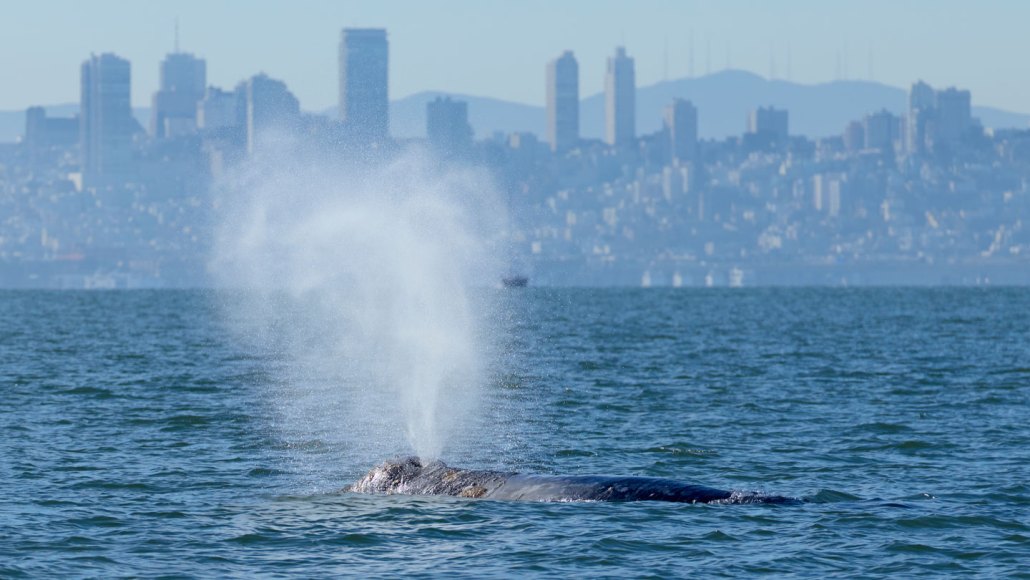
A gray whale surfaces in San Francisco Bay on February 26. Whales are increasingly foraging in the heavily trafficked bay, facing danger of collision with ships.
Darrin Allen © NOAA Permit #26532
By Susanna Camp
Whale lovers and ship pilots unite! Thanks to a scientific coalition and a new company operating in San Francisco Bay, AI-powered thermal monitoring can detect foraging gray whales from 7 kilometers away, giving vessels crucial time to avert potential collisions. It’s a win for conservation that doubles as smart risk management, helping operators dodge liability, environmental fines and the logistical headache of a ship strike. Carolyn Gramling tells the whale’s tale in Science News.
🌡️ Thermal imaging meets machine learning
The solution, developed by scientists at the Woods Hole Oceanographic Institution (WHOI) in Massachusetts, starts with thermal cameras mounted on radio towers, passenger ferries and other vantage points to scan the water for whales in real time. Integrated with a machine learning algorithm trained on a boatload of water temperature images, the system can infer that slightly warmer water is coming from whales and their blowholes. With human researchers in the loop to verify these detections, alerts are sent to nearby vessels, with sufficient lead time to adjust course or speed.
⛴️ The marine safety market
In 2025 alone, 21 gray whales (Eschrichtius robustus) were found dead in and around San Francisco Bay, with 40 percent of those fatalities attributed to vessel collisions. After the whales themselves, the primary beneficiaries of this innovation include commercial container shipping lines, passenger ferry operators and environmental regulators — all of whom are under mounting pressure to reduce accidental marine strikes. With global maritime traffic continuing to expand and coastal biodiversity under strain, the market for tech-enabled maritime monitoring is transitioning from a niche research endeavor to a critical component of institutional compliance and operational safety.
⚓️ Funding the blue frontier
Here are some of the companies in the space:
- WhaleSpotter is the company formed to commercialize the solution developed by the scientists covered in the article. They’ve partnered with the Benioff Ocean Science Laboratory at the University of California, Santa Barbara, as well as the U.S. Coast Guard, whale-tracking experts and local ferry companies. They have also received a $1 million grant via WHOI (where the algorithm was created) from Matson Navigation Company (NYSE: MATX), a prominent container shipping firm.
- Project CETI (Cetacean Translation Initiative) applies machine learning and robotics to understanding whale communication. They are supported by philanthropic grants from the National Geographic Society, Harvard University and other academic institutions and private foundations including Google Research. The nonprofit organization reported $6 million in revenue in 2024.
- Ocean Alliance collects data on whales. Their drones are all branded SnotBot because the original flies through whale spouts to collect genetic and microbiome data. The robotic fliers can also assist with tagging and tracking whales or with disentangling trapped whales. They’re a nonprofit company with no publicly disclosed funding sources.
We love to see it when protecting nature is also a pragmatic business decision.
Disclaimer: The Science News Investors Lab newsletter is for informational purposes only and does not constitute investment advice. Society for Science and Science News Media Group assumes no liability for any financial decisions or losses resulting from the use of the content in this newsletter. Society for Science and Science News Media Group do not receive payments from, and do not have any ownership or investment interest in, the companies mentioned in this newsletter. Please consult a qualified financial advisor before making any investment decisions.