The power plant players unlocking the grid
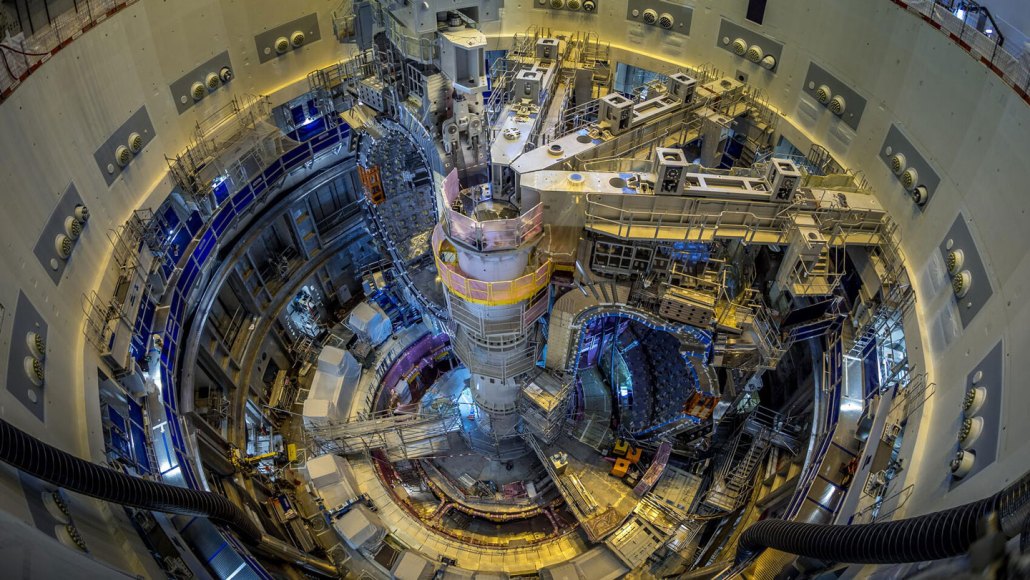
Fusion facilities like ITER (shown under construction in January) will use strong magnetic fields to confine plasma, potentially generating the extreme conditions needed to produce more energy than is required to operate the device.
The ITER Organization
By Susanna Camp
History is full of aha moments where an apparent failure was actually the breakthrough people didn’t know they needed. Take champagne, discovered when French winemakers kept finding their bottles exploding under pressure. Or sticky notes, developed from a glue that was rejected by leadership at 3M for being too weak, but later redeployed for the purpose we all know and love. Nuclear fusion just experienced another of these serendipitous discoveries. For decades, it wasn’t clear how the subatomic particles known as alpha particles would affect the turbulence that drains heat from a reactor’s core, preventing the reactor from reaching self-sustaining fusion. Now, new simulations suggest that the particles help. The new research turns what was once viewed as a potential operational hindrance into a critical performance booster. SN‘s Emily Conover has the info blast.
🗣️ Talking tokamaks
The breakthrough stems from advanced computational modeling of tokamaks, doughnut-shaped reactors that use powerful magnetic fields to confine superheated plasma. Scientists at the Max Planck Institute for Plasma Physics in Garching, Germany and colleagues discovered that as alpha particles interact with the plasma, they kick off flows that break up the microturbulence responsible for heat loss, acting as a stabilizing agent that keeps the plasma toastier and better confined. When these effects are baked into reactor simulations for next-generation facilities like SPARC (in the United States) and ITER (in France), the predicted heating skyrockets. Though there are uncertainties in the models, knowing how alpha particles act is key to designing a commercially viable reactor, one that maintains the extreme conditions required for clean, carbon-free energy.
💸 A multibillion dollar ignition
Fusion energy is enjoying a renewed emphasis on commercialization, due in part to data center projects. The global market is projected to reach approximately $18 billion in 2026, and projected to reach $33 billion within the next five years. As fusion moves from a government-led research experiment to a private, innovation-led commercial ecosystem, companies that can produce higher energy yields at lower costs will dominate the coming energy grid transition.
🏭 Power plant players
The private fusion sector is dominated by well-funded heavyweights and agile startups, all racing to prove net energy gain.
- Commonwealth Fusion Systems: Known for developing the world’s strongest superconducting magnet for fusion, CFS is now focused on making compact tokamak reactors. Their SPARC project is specifically designed to leverage these advanced magnetic technologies to reach commercial-scale power by the early 2030s. The company has raised nearly $3 billion to date.
- Helion Energy: Helion is currently constructing a fusion power plant in Washington state. The facility is scheduled to begin operations by 2028. At that point the firm says it will supply 50 megawatts of zero-carbon electricity directly to nearby Microsoft data centers, though some experts are skeptical. Helion has raised over $1.5 billion in total capital, including high-profile backing from Thrive Capital, Lightspeed Ventures and SoftBank.
- TAE Technologies‘ method of confining feisty, hot plasmas involves a combination of magnets and a plasma’s own magnetic fields, with an assist from particle accelerator technology and an alternative fuel that’s a mélange of protons and the element boron. The company has secured over $1.5 billion in funding from giants like Google and Chevron, and merged in December 2025 with Trump Media and Technology Group.
The grid just got a little less gridlocked.
Disclaimer: The Science News Investors Lab newsletter is for informational purposes only and does not constitute investment advice. Society for Science and Science News Media Group assumes no liability for any financial decisions or losses resulting from the use of the content in this newsletter. Society for Science and Science News Media Group do not receive payments from, and do not have any ownership or investment interest in, the companies mentioned in this newsletter. Please consult a qualified financial advisor before making any investment decisions.