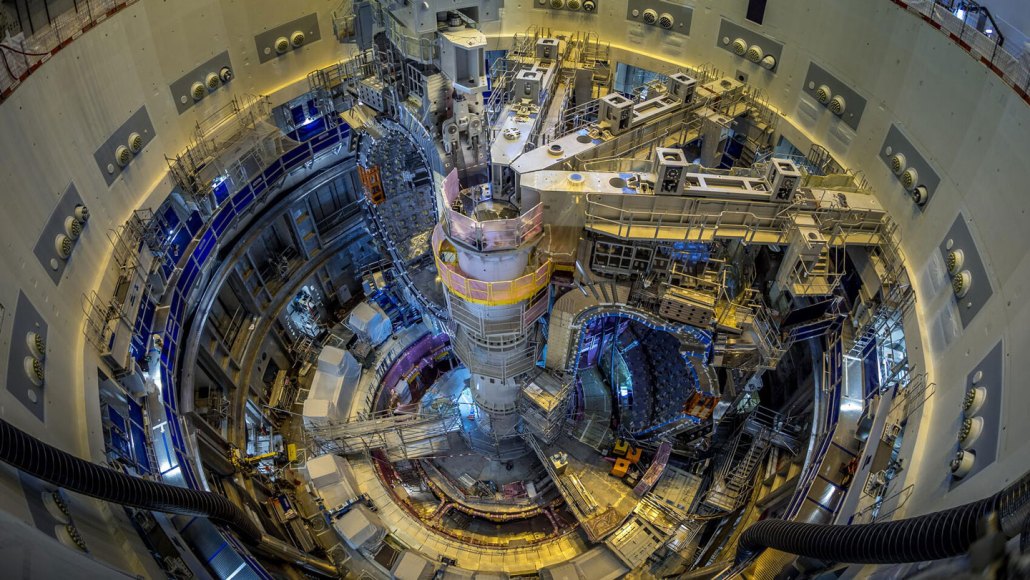
Fusion facilities like ITER (shown under construction in January) will use strong magnetic fields to confine plasma, potentially generating the extreme conditions needed to produce more energy than is required to operate the device.
The ITER Organization
This is a human-written story voiced by AI. Got feedback? Take our survey . (See our AI policy here .)
Good news for fusion fans: A phenomenon that might have hindered efforts to generate energy using nuclear fusion may actually be beneficial.
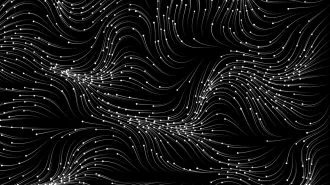
In computer simulations of two planned fusion reactors, energetic products of fusion called alpha particles helped dissipate small-scale turbulence, tiny eddies of particles that otherwise would have sapped heat from the center of the reactor, degrading its performance. The result, reported in a paper submitted May 11 to arXiv.org, adds to a growing body of research suggesting that alpha particles will affect turbulence in ways that boost reactor performance rather than worsen it, as had previously been feared.
Fusion is the process that powers the sun: Two atomic nuclei merge into one, releasing energy. If it could be harnessed on Earth, fusion could generate energy without the carbon emissions of fossil fuels or the long-lived radioactive waste produced by nuclear reactors based on fission, the splitting of atomic nuclei.
Several companies are working to build commercially viable fusion reactors. Interest in the technology is surging: On June 9, the U.S. Department of Energy released a roadmap for fusion power in the coming decade. But no reactor has yet generated the conditions under which fusion can flourish, and uncertainties swirl around the physics.
One of those uncertainties involves alpha particles themselves. In fusion reactors, magnetic fields keep a cloud of charged particles, called plasma, confined in a tight, superhot bundle. Within that plasma, hydrogen nuclei fuse to produce alpha particles — positively charged helium nuclei. Maintaining the plasma’s confinement is crucial for fusion, but it wasn’t clear whether the alpha particles would help or hurt.
The idea that alpha particles could regulate turbulence and improve fusion performance has been envisioned for a long time, but without clear evidence. Now, experiments and simulations are making this process clearer, says plasma physicist William Heidbrink of the University of California, Irvine, who was not involved in the research. “Maybe this thing, which seems sort of magical and fanciful, could really work positively.”
Alpha particles are key players in fusion reactors. They carry energy that gets dumped into the surrounding plasma, heating it. Once a reactor really gets going, it should become self-sustaining: The alpha particles produced by the fusion reactions heat the plasma, keeping conditions ripe for more fusion.
“If you don’t know how the alphas will behave, there is no way to make an economically viable reactor,” says plasma physicist Jacobo Varela of the University of Texas at Austin, who was not involved with the research. “In a reactor, everything is about the alphas and how they behave.”
For the new study, plasma physicist Alessandro Di Siena and colleagues simulated two reactors currently under construction: ITER, an international research project in southern France, and SPARC in Devens, Mass., designed by Commonwealth Fusion Systems, which partly funded the study. Both are doughnut-shaped devices called tokamaks that confine plasma with strong magnetic fields.
In the simulations, alpha particles kicked off flows of plasma that broke up small-scale turbulence, keeping the plasma hotter and better confined. That produced more fusion and yet more alpha particles. “What we see is that you can enter in a type of positive feedback loop,” says Di Siena, of the Max Planck Institute for Plasma Physics in Garching, Germany. When this effect was included, alpha particle heating increased by up to 25 percent in SPARC and up to 18 percent in ITER.
Experimental evidence has been pointing the same way. While existing tokamaks can’t produce the exact conditions relevant for a commercially useful fusion reactor, experiments have suggested that energetic charged particles such as alpha particles could be beneficial for confinement — including a 2024 study at the Joint European Torus in England, now being decommissioned. And a 2025 study at the DIII-D tokamak in San Diego found similar turbulence effects to the new simulation.
There are still uncertainties in these types of simulations, including on the predicted heating boost of up to 25 percent. So, as far as specific numbers go, “I would take it with something of a grain of salt,” says Phil Snyder, vice president of plasma physics at Commonwealth Fusion Systems. But the overall trend is what’s important, he says. When the alphas’ effect on turbulence is included, “you can end up producing significantly more fusion power than you would have predicted if you did not include this effect.”