Conversations with Maya: Peter Jay Hotez
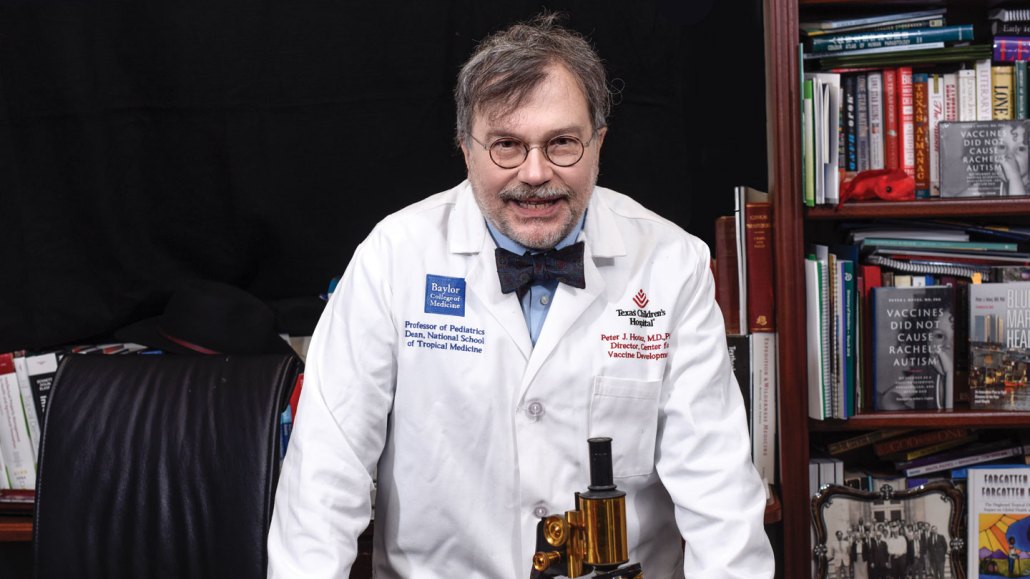
Dr. Peter Hotez, Internationally recognized physician-scientist in neglected tropical diseases and vaccine development
Maya Ajmera, President & CEO of the Society for Science and Executive Publisher of Science News, chatted with Peter Jay Hotez, Dean of the National School of Tropical Medicine and Professor of Pediatrics and Molecular Virology and Microbiology at Baylor College of Medicine. Hotez is the Codirector of the Texas Children’s Hospital Center for Vaccine Development and the Endowed Chair of Tropical Pediatrics at Texas Children’s Hospital.
What sparked your interest in science?
I grew up in West Hartford, Conn., and had an early passion for studying microorganisms. My parents bought me a pretty serviceable microscope, and I used to collect water from a local brook and look for protozoa. I also had a passion for maps. I guess if you combine microorganisms with maps, you get parasitology and tropical medicine. I knew early on in my life that that’s what I wanted to do.
Do you remember your STS project?
I do. My physics teacher at the time was a fantastic guy named Daniel Hoyt. He was one of those teachers who purchased a lot of used scientific equipment for his classroom. I worked with earthworms, including taking electrocardiogram recordings of earthworms. This led to my STS project titled “Effect of Acetylcholine Chloride and Atropine on the Electrocardiology of Lumbrucus and its Relation to Mammalian Smooth Muscle.”
Throughout your career, you have worked to address neglected tropical diseases (NTDs). What major opportunities for progress stand out to you today?
I began investigating NTDs as a research scientist, and that thread still continues. Today, I devote my life to vaccines for neglected diseases. Our team of scientists at the Texas Children’s Hospital Center for Vaccine Development at Baylor College of Medicine has accelerated two parasitic disease vaccines for hookworm and schistosomiasis, which are in Phase 2 clinical trials. We also have a new Chagas disease vaccine entering a Phase 1 trial, and we used that same approach to make two low-cost COVID-19 vaccines. The health economists we collaborate with said all our vaccines should be a couple of dollars a dose if we want them to be used. We therefore always use low-cost approaches to produce vaccines, like microbial fermentation and yeast.
Twelve years ago, we adopted a coronavirus program and started making vaccines for SARS and MERS. Then when the COVID-19 sequence came online in early 2020, we made two low-cost COVID vaccine technologies that were adopted by India and Indonesia. We transferred the tech to the pharmaceutical companies Biological E and BioFarma, which scaled up and produced Corbevax and IndoVac, respectively. One hundred million doses were administered. With that, we were able to provide proof of concept that you don’t have to be a big pharma company to do big things. That has been very meaningful.
On the policy end, the focus has been getting people to care about neglected tropical diseases, which represent more than a dozen major chronic infectious diseases mainly prevalent in tropical areas. Together with a couple of colleagues from the United Kingdom, we wrote one of the first scientific papers using the term neglected tropical disease back in 2005.
That policy and advocacy experience positioned me well to push back against anti-vaccine groups, which became another very important aspect of my life. I have four adult children, including Rachel, who has autism and intellectual disabilities. A few years ago, I wrote a book called Vaccines Did Not Cause Rachel’s Autism, which wound up making me public enemy number one with anti-vaccine groups.
My life has this duality to it: being a working scientist — which includes keeping up with lab meetings, grants, papers, major revisions and resubmissions — and also having a foot in public engagement, including defending vaccines and explaining to the public why they should care about NTDs.
As an advocate for vaccine diplomacy, can you explain what that means and how we can encourage more international cooperation in public health?
During the COVID-19 pandemic, the thinking was that only the big pharma companies had the chops to fight the virus. And eventually the crumbs would filter down to the low- and middle-income countries. But that was a failed policy, right? It did not work well; we knew it was going to fail.
I have spent decades with this concept that we can make the early prototype vaccines in our research laboratories in Texas, but then transfer the technology and ownership to vaccine producers in low- and middle-income countries so that they can take the lead on owning the technology and scaling it up. That’s what we did for COVID-19. It’s what we do for our parasitic disease vaccines. We’re hoping to do it for our hookworm vaccine, which is now looking very promising.
Even before COVID-19, I had the opportunity to test this out in 2015 when the Obama administration appointed me as U.S. Science Envoy. I worked with the U.S. State Department to build vaccine diplomacy initiatives with Muslim-majority countries in the Middle East and North Africa.
You have been a champion of science communication throughout your career. How can scientists more effectively communicate complex topics to the general public?
Unfortunately, I had to learn it by trial and error, and I often say it was more error than trial. I believe we should teach science communication in medical schools, Ph.D. programs and during postdoctoral training.
I have found that a lot of the stuff that’s dogma around science communication turned out to be false. Everyone always told me, “Peter, you gotta talk to the American people like they’re in the fourth grade. Don’t make it complicated. You’re gonna really have to dumb it down and not use jargon.” Well, they were right about not using jargon, but dumbing it down was not very successful. It makes you sound condescending, which is a real turnoff for a lot of people. From my experience, Americans like it when you speak to them like educated adults, and they are willing to tolerate a considerable level of complexity.
You have been a leading voice for the efficacy of vaccines. Are you concerned about the mainstreaming of anti-scientific views?
In recent years, the anti-vaccine movement has gone from pushing phony stuff around autism to becoming embedded in a major U.S. political party. They began attacking biomedicine like climate change deniers were attacking climate science a decade ago. This has become a very dangerous movement. In my most recent book, The Deadly Rise of Anti-science, I point out that the anti-science disinformation vaccine machine is so powerful now that it convinced 200,000 Americans not to take a COVID-19 vaccine after vaccines were widely available during the COVID-19 delta wave, which led to their deaths.
They were victims of this anti-science disinformation machine. It’s organized, it’s deliberate, it’s politically motivated, it’s predatory and it’s a killer. That’s why I wrote the book. It’s not a theoretical or academic discussion. Improving science communication and combating anti-science is now more important than ever.
There are many challenges facing the world today. What keeps you up at night? What gives you hope for the future?
What keeps me up at night is that I think we’re in a new normal with pandemics. We’ve had SARS in 2002 and MERS in 2012. COVID-19 is just a part of that cadence. By that reasoning, we’re going to have another major coronavirus epidemic or pandemic before the end of this decade. We’re also at risk for emerging viruses transmitted by mosquitoes, such as dengue, Zika, chikungunya or even yellow fever.
It’s happening because of a confluence of physical and social determinants: climate change working hand in glove with urbanization, poverty and human and animal migrations. This new normal is very troubling for me. Equally troubling is the fact that you’ve got groups with nefarious intent that want to prevent us from taking on these challenges.
What gives me hope is the strength of our research universities and institutions, seeing young people who still want to become scientists, and seeing the kinds of science outreach that Society for Science is doing. Seeing people still striving to do big things in science — that’s what gives me hope.