Space
We summarize the week's scientific breakthroughs every Thursday.
- Astronomy
Primordial stars left their imprint on dwarf galaxy
A smattering of stars in a dwarf galaxy outside the Milky Way witnessed explosions from the first generation of stars.
- Earth
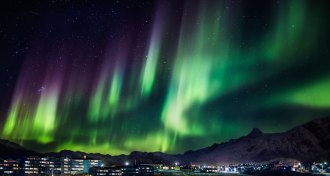
Spot the northern lights with Aurorasaurus
Crowdsourced Aurorasaurus project uses Twitter to track the northern lights.
- Astronomy
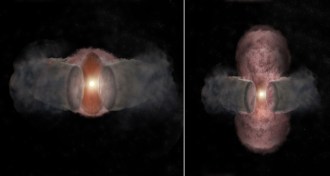
Fountains of spewing gas provide look at megastar formation
Fountains of gas erupt from a young massive star, giving astronomers a play-by-play on how stellar heavyweights form.
- Astronomy
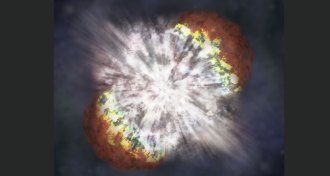
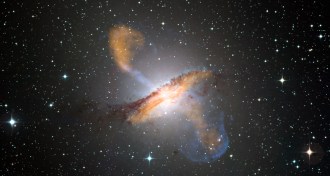
‘Supernova sweeping’ cleans up a galaxy’s gas
Supernovas might sweep the remaining gas out of a galaxy after a supermassive black hole triggers the end of star formation.
- Astronomy
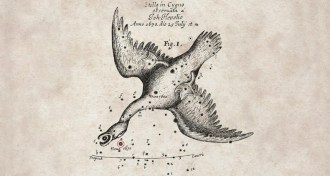
Enigmatic 17th century nova wasn’t a nova at all
A nova observed in 1670 was actually two stars colliding, new evidence suggests.
- Planetary Science
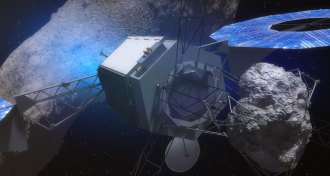
NASA has a plan for putting rock from asteroid in moon’s orbit
NASA selects concept for its Asteroid Redirect Mission, which will let astronauts train for future missions to Mars.
- Astronomy
What’s in a name? In science, a lot
Classification systems are essential to science. But any classification system, however useful, is ultimately simplistic.
- Astronomy
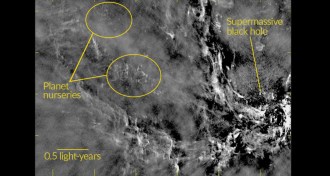
Unlikely nursery for new planets is next to massive black hole
Planet nurseries encircle young stars within a few light-years of the supermassive black hole in the center of the Milky Way, scientists claim.
- Planetary Science
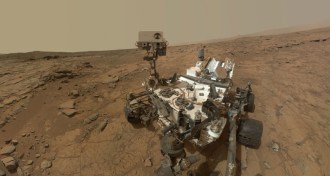
Potentially life-friendly nitrogen compounds found on Mars
“Fixed” nitrogen has been found in Mars deposits, raising the possibility that ancient life could have used it to build biomolecules.
- Planetary Science
Earth, neighbors weren’t the first rocky planets in the solar system
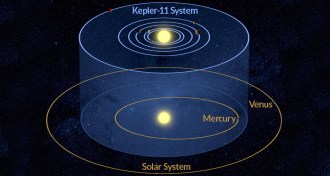
Jupiter might have swept an earlier generation of rocky planets into the sun, leaving room for Earth and its neighbors to form.
- Astronomy
Solo planets may be surprisingly common
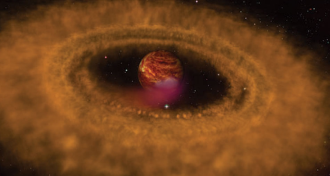
Rogue planets may form as stars do, but on a smaller scale, or they may go forced out of orbit during planetary ping-pong. Researchers are scanning the skies for them.
- Planetary Science
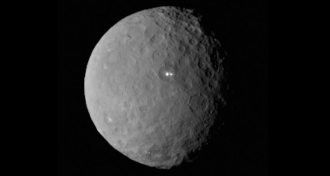
Bright patches on Ceres are plumes of water, maybe
Bright patches on Ceres could be plumes of water venting into space.