Here’s why sneakers squeak on the basketball court

The shoes’ soles wrinkle in pulses that repeat thousands of times a second

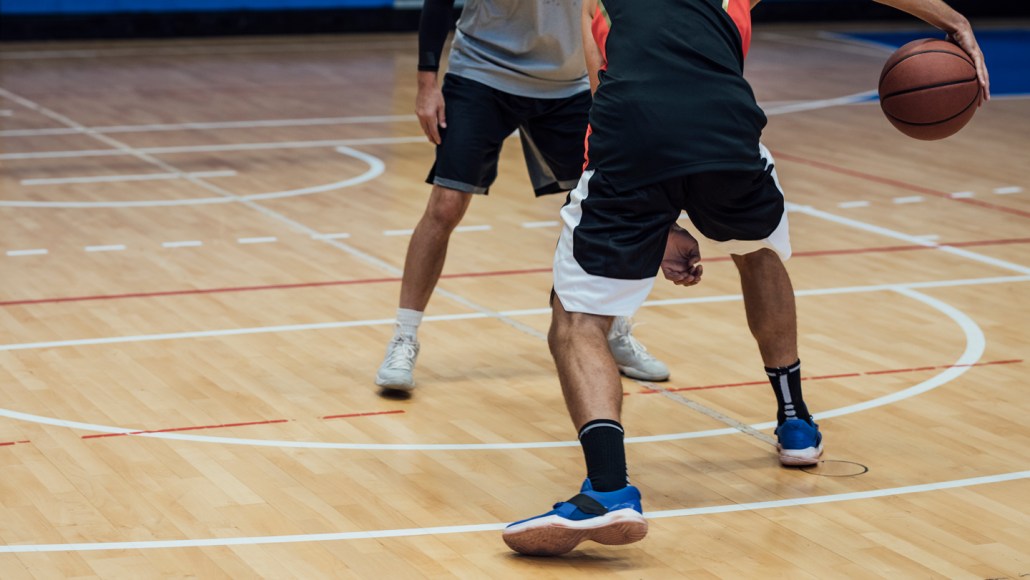
Two basketball players, shown from the waist down, face off on a court.

The loud squeaks of shoes on a basketball court result from parts of the sole slipping in pulses that repeat thousands of times a second.

FreshSplash/Getty Images

The soundtrack of a basketball game is punctuated by squeaking sneakers. Now, physicists understand why.

High-speed video of a skidding shoe reveals stick-slip motion, a stop-and-go situation in which parts of the sole stick in place as other parts slip forward. The shoe slips in pulses, as small regions of the sole buckle slightly and detach from the surface, Harvard applied physicist Adel Djellouli and colleagues report in the Feb. 26 Nature. The regular repetition of those pulses produces the squeak, the researchers found.

The pulses travel along the sole, a bit like how a tablecloth can be snapped into place by sending a wrinkle of motion across it. But in the shoe, the pulses repeat about 4,800 times a second, producing a kick that alters the surrounding air pressure to create sound. The pulsation rate matches the frequency of the sound the shoe makes, which determines its pitch.

In the experiments, a glass surface served as a stand-in for the hard, smooth floor of a basketball court, allowing researchers to image the shoe from below. Based on a concept called total internal reflection, images of the shoe’s sole were bright where it contacted the glass, and dark where the shoe had buckled away from the surface.

Further investigation using blocks of silicone rubber revealed that the ridges on a sneaker’s tread are essential to the sound. A flat piece of rubber, moved along the glass plate, resulted in chaotic pulses at uneven intervals, producing a muddled noise rather than a clear pitch. Ridges help to organize the pulses by guiding them, so rubber blocks with tread squeaked vigorously.

The thickness and stiffness of the block sets the pitch of the sound, the researchers found. And that suggests a way to make silent shoes: Tune the squeak to the ultrasound range, inaudible to humans. That could be accomplished by making the sole thin — although that might not be ideal for athletic activities — or changing its composition, Djellouli says. “As long as you don’t mind annoying your dog.”

The researchers also designed rubber blocks that squeaked at specific pitches and then used them to play “The Imperial March” from Star Wars, revealing another scientific truth: Darth Vader would have seemed much less intimidating if squeaky shoes marked his entrance.

Physicists perform “The Imperial March” from Star Wars using rubber blocks that squeak as they slide on glass.A. Djellouli et al/Nature 2026

Senior physics writer Emily Conover has a Ph.D. in physics from the University of Chicago. She is a two-time winner of the D.C. Science Writers’ Association Newsbrief award and a winner of the Acoustical Society of America’s Science Communication Award.