A massive clump of dark matter may lurk in the Milky Way

The invisible blob of matter is thought to be about 10 million times the sun’s mass

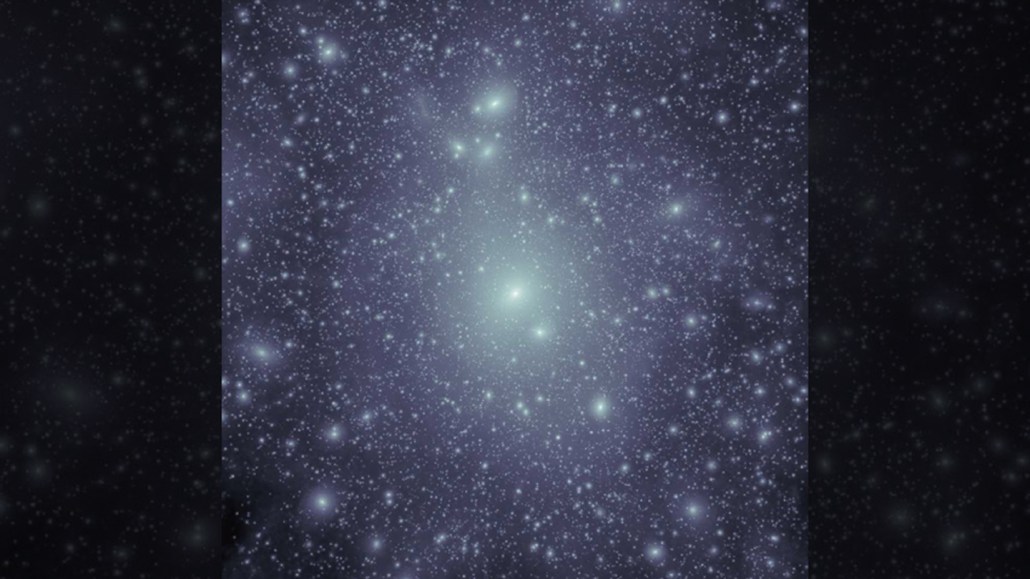
Bright spots on a dark background show dark matter's distribution in clumps.

Dark matter halos that surround galaxies are predicted to have multitudes of clumps called subhalos (bright spots in this simulation).

P. Madau, J. Diemand and M. Kuhlen/The Astrophysical Journal 2008

A huge clump of dark matter could be sitting on our galactic doorstep.

Scientists found evidence of an invisible, massive nugget in the galactic neighborhood of the sun. The suspected clod of dark matter has a mass about 10 million times that of the sun, researchers report January 29 in Physical Review Letters.

Dark matter is an unidentified substance, evident based only on its impact on the cosmos. The Milky Way is enveloped in an enormous dark matter “halo,” and scientists suspect that untold numbers of smaller clumps, called “subhalos’” reside within it. Now they have a candidate, located about a kiloparsec from the sun, or around 3,260 light-years.

Scientists spotted the unobtrusive object by monitoring remnants of dead stars called pulsars, which send out bursts of radio waves at a regular clip. Tracking how the rate of pulses changes over time allows scientists to make a variety of measurements of the cosmos.

Out of 53 pulsars the researchers studied, one pair of neighboring pulsars showed signs of a shift in their pulse rate that pointed to a gravitational pull from something massive. To estimate the mass of the object, the researchers included additional pulsars in the vicinity of the original pair, for a total of 19 pulsars. Notably, there were no stars or gas clouds nearby that could explain the observations, leaving dark matter as the likely culprit.

Different dark matter theories predict different distributions of dark matter subhalos. So, if scientists could map out all of the Milky Way’s subhalos, that could pin down the nature of dark matter, says astrophysicist Sukanya Chakrabarti of the University of Alabama in Huntsville. “That’s the final goal. That’s what we’re after.”

Senior physics writer Emily Conover has a Ph.D. in physics from the University of Chicago. She is a two-time winner of the D.C. Science Writers’ Association Newsbrief award and a winner of the Acoustical Society of America’s Science Communication Award.