Watch the first video of a sperm whale birth captured by scientists
The footage reveals unprecedented cooperation for sperm whales that transcends kin groups
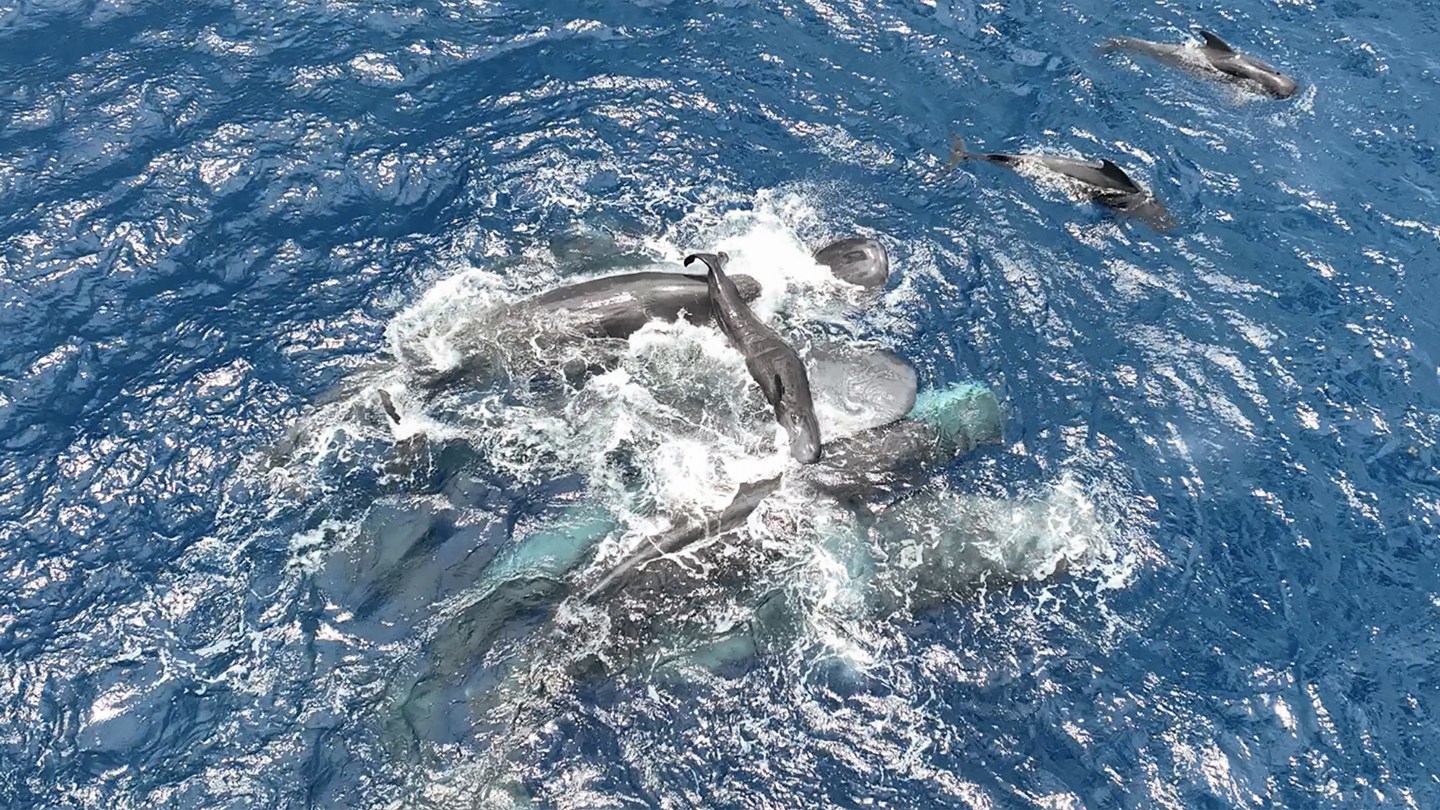
A newborn sperm whale calf is held above water by adults until it can swim on its own.
Project CETI
It takes a village to deliver a whale calf.
The birth of a sperm whale (Physeter macrocephalus) has been captured on camera in more intimate detail than ever before, researchers report March 26 in Science. The female sperm whale giving birth was aided by 10 other sperm whales, almost all female, but not all kin. The footage makes clear that, like humans, sperm whales benefit from cooperation, so much so that the instinct to help transcends family barriers.
“Not only did we capture such an amazing dataset, but we actually knew each of these whales,” says marine biologist David Gruber with Project CETI, a nonprofit based in the Caribbean island Dominica dedicated to sperm whale research. That made it possible to tease out the role of each whale in the birthing process.
Observing the birth of a whale is extremely rare, and there have been only a handful of scientific studies that describe a sperm whale birth. While scientists had seen sperm whales helping each other during birth before, none of those accounts were recorded on video.
In 2023, off the coast of Dominica, Gruber and colleagues used two aerial drones to record the 34-minute birthing process. The group of whales surrounded the laboring mother, named Rounder. After delivery, the group took turns lifting the newborn to the surface for hours, so it could breathe air until it could swim on its own.
The team computationally defined each whale’s position in stills from the footage over time. A team member with the most knowledge of the whales then tracked which whale was which.
The team was then able to see how each whale’s role in the birth related to kin relationships. The gathering included groups belonging to two different female lines that do not typically spend time together searching for food. Analyzing the video revealed that until several hours after the birth, the whales from the two groups fully mixed together, and they all participated in supporting the newborn at some point. The four whales that maintained the most consistent contact with the calf included the calf’s mother, aunt, an elder kin member and a whale from outside the kin group.
“The baby sperm whale is negatively buoyant, and so it would have sunk,” says Gruber, which is why it is so important to have cooperative care following the birth. Similar behaviors involving pushing newborns to the surface has been observed in killer whales, belugas and other cetaceans. Gruber says this behavior potentially goes back to when those species shared a common ancestor.
The researchers also recorded audio and, with additional colleagues, analyzed it by graphing the whale sounds by characteristics such as rhythm. The specific sounds that the sperm whales made, also known as codas, changed during important moments in the process, they report March 26 in Scientific Reports. One coda was heard more frequently during the birth. There was also more variability in the whales’ vocal styles when they encountered several pilot whales (Globicephala macrorhynchus), which sometimes antagonize sperm whales.
Different sounds being associated with the birth is not surprising, says behavioral marine biologist Denise Herzing, who heads the Wild Dolphin Project, a nonprofit in Jupiter, Fla., focused on Atlantic spotted dolphins (Stenella frontalis). “Marine mammals in general, have specific sounds during specific behavioral contexts.”
The studies suggest that high-stakes situations like the birth of a calf have driven these whales to evolve cooperative instincts. Herzing thinks this is spot on. “We see different alliances of dolphins grouping into bigger groups to fight off a predator or to mate,” she says.
Gruber says his colleagues weren’t looking for a whale birth when they chanced upon one. But they were fortunate enough to be in the right place at the right time with enough equipment. And the whales seemed to include them in the event, Gruber says. “They literally carried the baby right past the front of our boat.”
It took cooperation from the human team, too — in the form of getting footage, developing methods, and mapping knowledge of the whales’ relationships — to share the experience of seeing the birth with the world. “It was a very profound experience for all of us.”