New Hubble images may solve the case of a disappearing exoplanet
A fading dust cloud hints that the once-seen exoplanet Fomalhaut b was never a planet
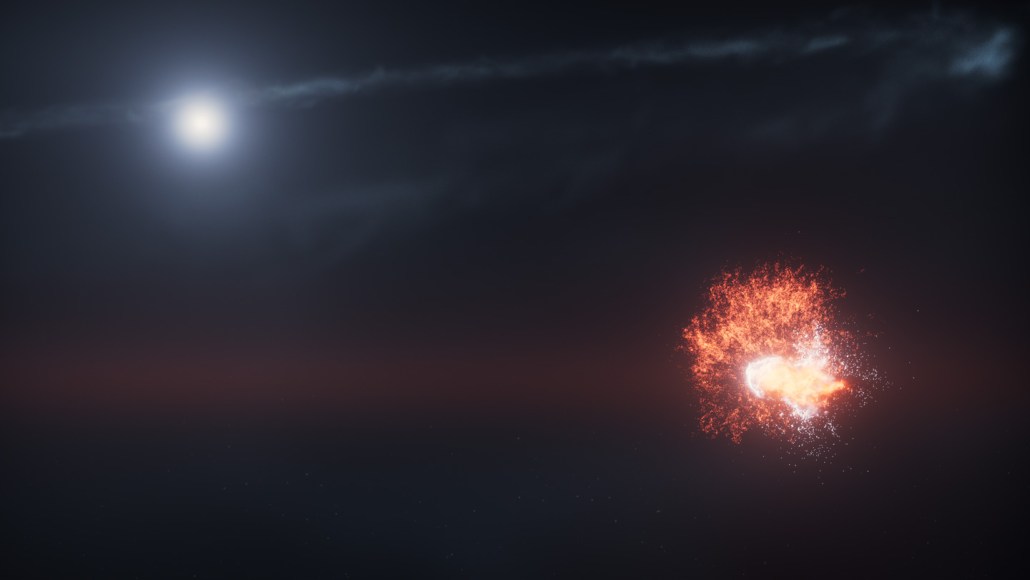
The Hubble Space Telescope spotted evidence of a collision of asteroid-sized bodies (re-created in this artist’s illustration). The smashup gives clues to planet formation.
Ralf Crawford/STScI, NASA, ESA
Two asteroid-sized objects orbiting a famous star have collided, Hubble Space Telescope images suggest. The collision provides a rare look at the violent process of planetary construction around a young star — similar to collisions that probably shaped our own solar system, astronomers report December 18 in Science.
“It’s the first time we’ve ever seen colliding planetesimals outside of our own solar system,” says Jason Wang, an astronomer at Northwestern University in Evanston, Ill. The event also solves a long-standing mystery about a disappearing exoplanet.
The colliding objects, suspected planet building blocks called planetesimals, slammed into each other in the debris disk of Fomalhaut, a star located just 25 light-years from Earth. Fomalhaut is well-known for its prominent ring of dust and rubble, a region where planet formation is actively happening.
The impact released a vast cloud of dust, appearing like a bright blob in Hubble images. From the size of this cloud, researchers estimate that the impacting planetesimals were around 30 kilometers in diameter, slightly larger than the Martian moon, Phobos.
The blob’s existence is enticing because it could solve a cold case of the vanishing exoplanet Fomalhaut b. The planet, discovered in 2008, was hailed as the first planet orbiting a star other than the sun that was directly imaged in visible light. But then, the planet disappeared. Follow-up observations failed to locate it, leading scientists to doubt its existence.
The new Hubble data offer another hypothesis. Like this new blob, Fomalhaut b was probably not a planet at all, but rather an expanding cloud of dust produced by a previous collision between planetesimals. The new cloud looks similar to Fomalhaut b when it was first discovered. And the “exoplanet” faded and expanded over time, until being barely visible. That trajectory could offer clues to the new blob’s fate.

When Wang and colleagues first spotted the new blob, “we were kind of confused at first, like, you know, what is this thing? Is this real?” he says. “It took us a while to kind of match all those lines of evidence.”
When the evidence did come together, astronomers got more than they bargained for in studying the buildup of planetary systems.
“What’s cool about this paper is that for the first time ever we are seeing one of these disks change over time,” says astrophysicist Tim Pearce of the University of Warwick in Coventry, England, who wasn’t involved in the study. That’s unusual in the field of protoplanetary disks, where scientists usually observe structures that “basically look the same for a human lifetime,” he says. By seeing these events in action, astronomers can test their ideas about how planets are born, confirming that large-scale collisions are a frequent part of the birth of a solar system.
While telescopes can detect the dust in these disks, larger bodies like asteroids or dwarf planets are typically too dim and cool to be seen directly. This impact reveals the presence of these bodies and the size of the cloud offers an indirect way to gauge their size. Detecting two such events within a 20-year window allows researchers to begin establishing a timescale for how often these massive impacts occur, which in turn is a proxy for their abundance, because with more objects in orbit, collisions are more likely.
The researchers intend to continue tracking the Fomalhaut system to study the evolution of the dust cloud. However, the aging Hubble Space Telescope has become less reliable. A failure of one of its pointing gyroscopes in 2024 has limited its ability to steadily observe Fomalhaut. Fortunately, the James Webb Space Telescope is also capable of observing the system, providing a new way to monitor the debris disk and potentially witness new impacts as they happen.