Physicists discovered neutrinos 70 years ago. The ghostly particles still have secrets to tell

The wily nature of the subatomic particles makes them notoriously hard to measure

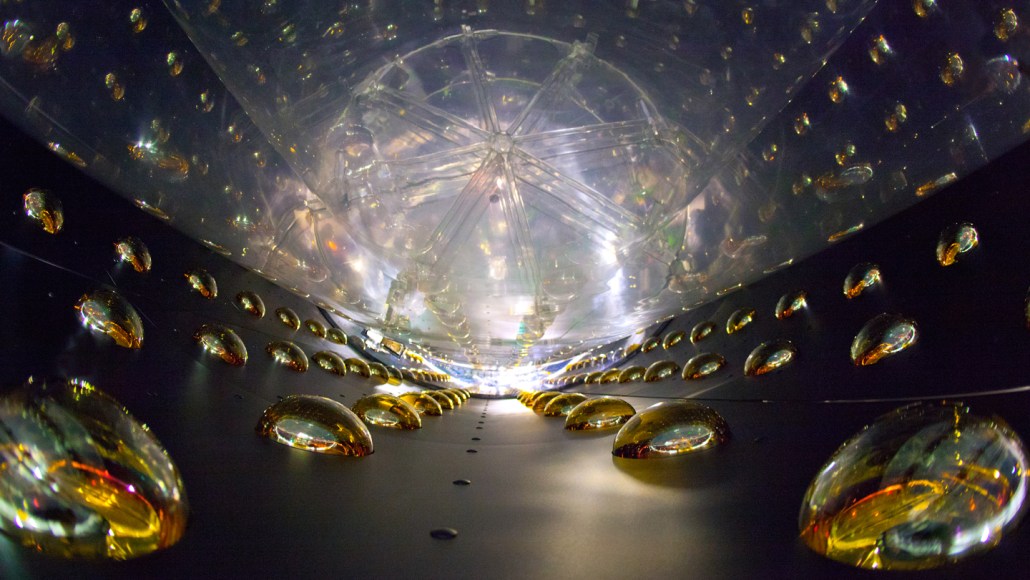
Neutrino detectors that are part of the Daya Bay Experiment.

Scientists once doubted that neutrinos could ever be observed. Today, detectors around the world, including at the Daya Bay experiment in China, pick up signals of these ghostly particles.

Brookhaven National Laboratory/Flickr (CC BY-NC-ND 2.0)

Neutrinos have been with us since the beginning. They existed alongside prehistoric humans, dinosaurs and the first scattered crumbs of life on Earth. The birth of the solar system, the formation of the cosmic scaffolding of the universe, the moments after the Big Bang — all were awash with the lightweight subatomic particles that we gave the name neutrino.

But only in the last 70 years have we known for certain they were there. In 1956, physicists Clyde Cowan and Frederick Reines unveiled the particles’ existence.

And exist they do. Not in meek scarcity, either. They are the most abundant massive particle in the universe, outnumbering protons about a billion to one. Scientists are still grappling with what these particles are all about. And neutrinos are not just one type of particle, either, but a trio of particles — electron neutrinos, muon neutrinos, and tau neutrinos — and their corresponding antimatter particles, all of which physicists refer to collectively as neutrinos.

Other particles have their unknowns, but “for neutrinos, the list of questions is deeper and more fundamental than for anything else,” says neutrino physicist Diana Parno of Carnegie Mellon University in Pittsburgh. We don’t know whether the particles are their own antiparticles, or whether additional types of neutrinos are in hiding. Some scientists wonder if neutrinos may explain why the universe is filled with matter and has just a smatter of antimatter.

Perhaps most glaringly, we don’t know the particles’ masses. We know that their masses must be incredibly tiny, but not zero. That makes them deviously hard to measure.

To make matters more complicated, neutrinos have no electric charge and interact with other matter through a wimpy effect called the weak interaction. That forced Reines and Cowan to concoct inventive techniques to spot them. Their work set a precedent: To study the neutrino, ingenuity is indispensable.

How the neutrino hunters succeeded

In 1930, physicist Wolfgang Pauli proposed the existence of neutrinos to explain the energies of electrons emitted in radioactive decays. In those decays, called beta decays, one nucleus converts into another, emitting an electron. The conversion releases a fixed amount of energy. If only the electron were emitted, you’d expect a given decay to produce electrons with one specific energy. Instead, the electrons were observed with a range of energies. The situation was so desperate that some physicists considered dropping the concept of conservation of energy, a foundational pillar of physics. Instead, Pauli proposed that a particle with no electric charge was also released, that carried some varying amount of the energy. He reportedly said, “I have done a terrible thing, I have postulated a particle that cannot be detected.”

Pauli was wrong, but the particles did elude detection for a respectable 25 years. The Reines-Cowan experiment took place at a nuclear reactor. Because many radioactive decays happen at nuclear reactors, they would be a potent source of neutrinos if the particles existed. (More specifically, these particles would be antineutrinos.) The experiment, performed at the Savannah River Plant in South Carolina, was much more practical than the original plan: dropping a detector down an underground shaft cushioned with feathers and foam rubber while simultaneously setting off an atomic bomb nearby.

The trick to doing the experiment at a reactor was to measure two back-to-back signals. When an antineutrino interacted with a proton in the detector, it would produce a neutron and a positron — the antimatter counterpart to an electron. The positron would quickly annihilate with an electron, releasing high-energy light called gamma rays that could be detected in a liquid called a scintillator, which lights up in response to radiation. The neutron would loiter around for a bit before being captured by a nucleus, which released more gamma rays and caused a delayed flash in the scintillator.

Two men monitor controls at a nuclear reactor.
Physicists Frederick Reines and Clyde Cowan monitor an experiment at a nuclear reactor in South Carolina in 1956. The experiment confirmed the existence of ghostly subatomic particles called neutrinos.

Cowan and Reines’ detector was constructed like a club sandwich, with three layers of liquid scintillator detectors separated by two layers of target material. The target contained water and cadmium chloride, with the latter chosen for its ability to capture the loitering neutrons. A double flash, produced in adjacent detector layers, was an antineutrino hallmark, the conclusive lub-dub of its figurative heartbeat.

Without that heartbeat to filter out spurious events, Reines and Cowan wouldn’t have been able to detect antineutrinos at a reactor. This creative solution, to a problem once thought unsolvable, won Reines the 1995 Nobel Prize in physics (Cowan died in 1974.)

Since then, scientists have detected neutrinos using the Antarctic ice sheet, the Mediterranean Sea and experiments deep underground. Scientists have spotted neutrinos produced in the sun, deep inside Earth, in the atmosphere and in space — including from an exploding star in a nearby galaxy. Experiments revealed that the particles oscillate, or morph from one type to another. That phenomenon can happen only if neutrinos have mass, but it doesn’t reveal how massive they are.

New techniques aim to unveil the neutrino

The discovery that neutrinos have mass means they clash with physicists’ theory of particle physics, the standard model. The basic theory assumes that neutrinos have no mass. So neutrinos are a muddle.

“There is something else, outside of the standard model, that neutrinos bring to the table, and we’re trying to figure out what that is,” says physicist Enectali Figueroa-Feliciano of Northwestern University. “We want to measure neutrinos in every way we can, because they don’t always do what we expect them to do.”

So physicists keep pushing detectors further. In 2017, scientists spotted neutrinos interacting with an entire nucleus at once, rather than an individual proton or neutron, for the first time. Such reactions are more common than interactions with protons or neutrons, but detecting neutrinos’ gentle nucleus-nudging demands highly sensitive sensors. The detectors sense flashes of light generated as nuclei recoil in crystals. Those detections involved laboratory sources of neutrinos, but scientists also spotted this process initiated by the lower energy antineutrinos from nuclear reactors, researchers reported last summer in Nature. That opens up possibilities to use the detector technology to monitor nuclear reactors for weapons development.

To measure neutrino-nucleus interactions even more precisely, Figueroa-Feliciano aims to use a transition edge sensor — essentially an extremely sensitive thermometer — to detect the heat that recoiling nuclei generate. If successful, the approach would allow scientists to test the standard model in a new way.

Another team is using transition edge sensors to try to get at neutrino masses. The HOLMES experiment in Italy uses transition edge sensors embedded with the radioactive element holmium-163. When the holmium decays, it converts into another element and emits a neutrino. The escaping neutrino causes the nucleus to recoil. Measuring those recoils can give insight into neutrinos’ masses. This technique set a ceiling on the neutrino mass, HOLMES researchers reported last autumn in Physical Review Letters, though it doesn’t yet outperform other methods of constraining neutrino masses.

Yale physicist David Moore has another plan for how to measure recoils, with nanospheres that are festooned with radioactive elements and levitated using a laser beam. Observing the nanoparticles’ motion as they recoil after radioactive decay could reveal whether there are any heavier neutrinos that are hiding out, and perhaps one day determine the masses of the known neutrinos. In 2024, Moore and colleagues demonstrated proof of principle by measuring the recoil produced by a radioactive decay that emits an alpha particle, the nucleus of a helium atom. Neutrinos are the next step, Moore says.

Neutrino mass is not just of theoretical interest. “it’s important to know the mass for the sake of it but it’s also important because neutrino mass is important for cosmology,” says physicist Matteo Borghesi of the University of Milano-Bicocca, who works on HOLMES. Neutrinos’ masses helped shape the structure of galaxies. Scientists can use that fact to try to determine the maximum possible mass of the neutrino from observing galaxies in space. But questions are swirling about those numbers, too. There seems to be a tension between what experiments on the ground are finding and what scientists are estimating based on the cosmos.

Wiliness might seem to be part of neutrinos’ nature. But the difficulty in understanding them mostly comes back to their tiny masses and weak interactions. “It’s not like the neutrino is sitting there thinking, ‘Okay, what can I do next to these physicists?’” Parno says, steepling her hands and wiggling her fingers in mock nefariousness.

But the particles do feel somehow destined to get under physicists’ skin. They’re a bit like one of the Mad Hatter’s riddles. What’s something that is crucial to the structure of the universe but also imperceptible? How can you know a particle has mass without knowing its mass?

How can you detect an undetectable particle?

At least Reines and Cowan bested the Mad Hatter on that one.

Senior physics writer Emily Conover has a Ph.D. in physics from the University of Chicago. She is a two-time winner of the D.C. Science Writers’ Association Newsbrief award and a winner of the Acoustical Society of America’s Science Communication Award.