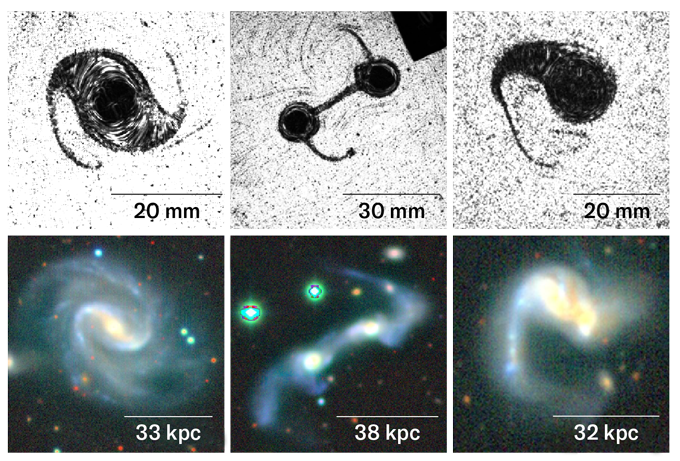
Like colliding galaxies, water droplets (dark circles) on a soap film orbit before coalescing.
J.-P. Martischang et al./PNAS Nexus, 2026
The physics of merging galaxies has popped up in an unexpected place: the stuff of soap bubbles.
Water droplets placed on a flat soap film act like galaxies that orbit one another before coalescing. As they merge, the water droplets take on shapes reminiscent of those that appear in astronomical images of colliding galaxies, physicist Jean-Paul Martischang and colleagues report in the April PNAS Nexus. The water droplets might eventually be useful for studying gravitational attraction in a laboratory, to better understand how galaxies collide and coalesce.
When plopped on a horizontal soap film — in the laboratory equivalent of a bubble wand — a water droplet takes on a hammocklike shape, about a centimeter wide. That disrupts the shape of the soap film, pulling it downward. That sagging causes drops to attract one another, orbit and coalesce.
To visualize the translucent water droplets, the researchers took advantage of the fact that each droplet acts like a lens that causes blurring. They placed a randomized pattern of dots below the film. Mapping out where that pattern was blurred revealed the drops’ locations and shapes.
The unexpected effect appeared while the researchers were studying other features of soap films, says Martischang, who performed the research at the University of Lille in France. “Once we tried putting water on it and we saw those lenses, we just thought ‘Let’s go with that.’”
Mathematical study of the effect revealed that the attraction of the two orbiting water drops was analogous to the attraction two objects experience due to gravity, but in two dimensions instead of three. The researchers don’t yet know if the merging of water droplets also follows gravity’s rules, but they did see structures in the merging drops that are commonly seen in colliding galaxies, such as bridges and spiral arms.
Once the math of merging droplets is fully understood, it could allow researchers to study phenomena that take eons in nature, but just moments in the lab. One second for the water droplets is equivalent to 460 million years in the lives of merging galaxies.