Exploding black holes could explain an antimatter mystery

Shock waves in the early universe may have helped matter reign supreme

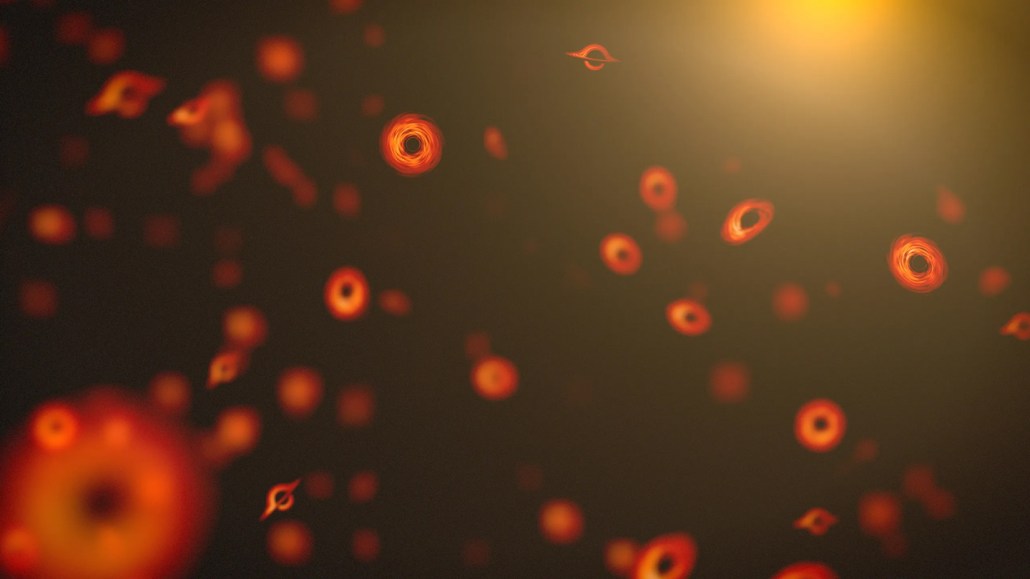
Many orange rings represent primordial black holes in an illustration

Primordial black holes (illustrated) could explain how the universe came to be formed predominantly from matter, while antimatter is rare.

NASA’s Goddard Space Flight Center

This is a human-written story voiced by AI. Got feedback? Take our survey . (See our AI policy here .)

DENVER — Tiny, exploding black holes might explain one of the biggest mysteries about how the universe, in its current form, came to be.

In the cosmos, matter is much more common than antimatter. But scientists don’t know how matter achieved its dominance. Now, a team of physicists reports that matter’s takeover may have involved tiny black holes, born in the first instants after the Big Bang. Those hypothetical primordial black holes would have quickly evaporated and exploded, sending shock waves careening outward. That could have set the stage for matter to take over, physicist Alexandra Klipfel reported in March at the American Physical Society’s Global Physics Summit.

Scientists believe that the universe formed with equal amounts of matter and antimatter. But matter and antimatter annihilate when they meet. Without something to tip the scales, the universe would have been featureless, containing pure energy. The tiny black holes could have shifted the balance to produce our matter-rich cosmos, enabling the formation of the stars, planets and galaxies within it.

If that’s true, it would give scientists a handle on black holes that would otherwise be very hard to study, says theoretical physicist Lucien Heurtier of King’s College London, who was not involved with the research. “It’s very difficult to detect their existence in cosmology because they are gone. They have been gone for a while.”

The black holes would have formed from fluctuations in the density of the early universe, with masses around a thousand kilograms each, about that of a small car. These relatively small black holes would have lived and died within the early-universe slurry called the quark-gluon plasma, the phase of matter that existed before protons and neutrons formed. They would have spewed out energetic particles — a phenomenon called Hawking radiation — thereby heating their surroundings.

A radiating black hole would have steadily lost mass before going out with a bang, within the first tenth of a billionth of a second of the universe’s existence. Such a blast would have launched a shock wave into the quark-gluon plasma, the researchers report in a related paper submitted March 16 to arXiv.org. The sudden explosion would have injected a large amount of energy into the plasma. “And that heats up a small sphere of our plasma, very, very hot,” Klipfel says. “It’s a really sharp wall,” with different conditions inside and outside the shock.

A sharp wall like that would provide conditions necessary to create an excess of matter, the researchers report in another paper submitted March 30 to arXiv.org. If everything in the universe were in a smooth, equilibrium distribution, any process that converted between matter and antimatter would work in both directions at once, resulting in no excess of either matter or antimatter. But conditions on one side of the shock wave would differ drastically from those on the other, in a way that could give matter a boost.

Inside a thin shell surrounding such a shock wave, temperatures would be so high that particles would not have mass. That’s because the Higgs mechanism, the phenomenon associated with the Higgs boson that gives mass to particles, kicks in only below a certain temperature.

Outside such a shock wave, particles would have mass. That means that when particles cross the border, their mass would change. That, in combination with other physics effects hypothesized to be present in the early universe, could have caused an excess of matter to build up at the boundary of a shock wave. That excess of matter could have then been locked in as the shock expanded.

For primordial black holes to be responsible for matter’s foothold, multitudes of them would have had to explode moments after the Big Bang. Instead of being a finale, those fireworks could have been just the beginning.

Senior physics writer Emily Conover has a Ph.D. in physics from the University of Chicago. She is a two-time winner of the D.C. Science Writers’ Association Newsbrief award and a winner of the Acoustical Society of America’s Science Communication Award.