Archaeology meets big tech
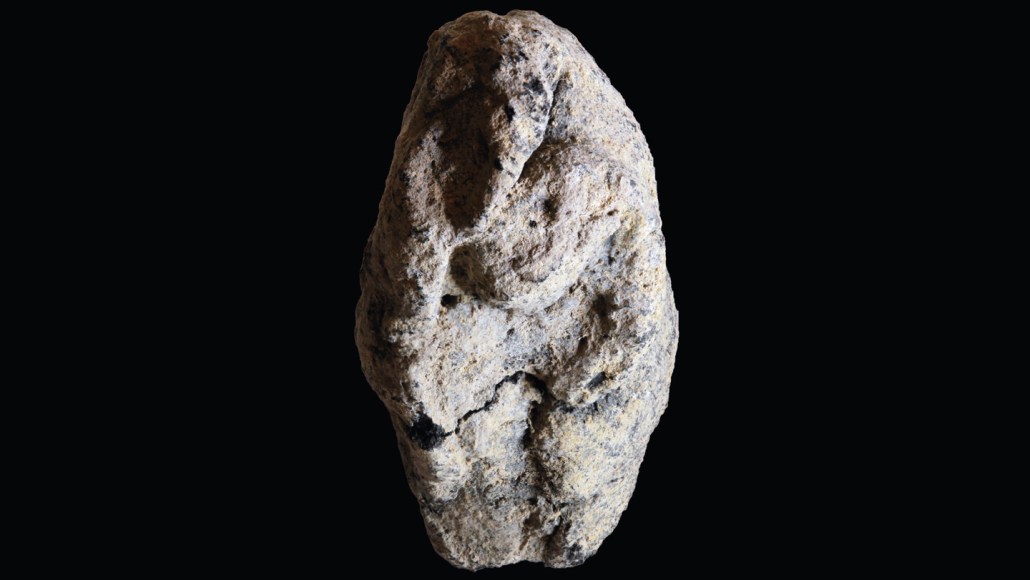
This newly discovered clay figurine shows a goose interacting with a woman. It points to a shift in spiritually inspired artwork and storytelling around 12,000 years ago in the Middle East.
© Laurent Davin
By Susanna Camp
📜 A 12,000-year-old story
A recent archaeological discovery suggests a major cultural milestone: the onset of naturalistic depictions of people with animals around 12,000 years ago, almost three thousand years earlier than previously estimated. Science News’s Bruce Bower has more on this ancient narrative shift.
🖌️ The original content creators
For millennia, Paleolithic art was dominated by animals. Think cave paintings of bison, carvings of horses and not many humans among them. A new finding, unearthed in modern-day Israel, marks a departure.Archaeologists studying an ancient figurine, timeworn and abstract to the naked eye, used “technological, archaeometric and dermatoglyphic analyses” to reconstruct a figure of a woman and a goose in a relationship of intimacy, or perhaps domestication.
Say what? Let’s parse these techniques one by one: 👇
Technological analysis refers to the scientific study of how an object was made, in order to reconstruct the sequence of actions, the knowledge and the tools used by ancient artisans. This could include microscopy (using high-powered optical or scanning electron microscopes), or radiography (using X-rays or CT scans), to see inside complex objects.
Archaeometry is the application of the physical and chemical sciences to determine composition, date and provenance of artifacts and environmental remains.
Dermatoglyphic analysis refers to identifying dermal ridges (fingerprints, palm prints and foot prints) to detect ancient prints left on soft materials.
The upshot: Scientists believe the discovery signals a profound psychological shift in human behavior, when myths and stories pivoted from nature worship to a time when humans began to place themselves in a spiritual narrative.
🗿Digitizing the dust: The business of computational archaeology
The contemporary field of archaeology is evolving to include industrial-grade 3-D scanning and photogrammetry (stitching 2-D images into hyper-realistic 3-D models. AI-driven pattern recognition can also analyze these 3-D datasets to classify fragments, identify toolmarks invisible to the naked eye and perform a sort of virtual restoration. This technology is creating a new asset class: digital heritage. Technology companies are getting in on educational licensing deals, consulting for immersive museum experiences and helping to create proprietary digital archives for augmented reality and spatial computing applications.
💽 Financing the digital replica
Archaeology is finding a convergence between heritage preservation and next-gen augmented reality infrastructure. Here are a few companies at the forefront of this field:
- CyArk, a pioneer in the digital preservation space, uses laser scanning to create precise 3-D blueprints of world heritage sites. While not a traditional VC target, they have secured over $400,000 in grants, with support from corporate partners like Google, Iron Mountain and Seagate, validating the commercial demand for high-fidelity reality capture data.
- Scaniverse, founded in 2020 and acquired in 2021 by augmented reality giant Niantic (creators of the viral game Pokémon GO), makes high-fidelity 3-D scanning technology that works with cell phones. It transforms physical objects into digital twins for applications like archaeology. In 2025, Niantic sold its games business and spun out a new startup, Niantic Spatial, with $250 million in funding. They are currently leveraging Scaniverse’s technology not just for scanning smaller locations such as statues, but to crowdsource a “Visual Positioning System” (VPS)—essentially a detailed 3-D map that allows augmented reality content (and potentially historical overlays) anywhere in the world, including places where GPS is denied or compromised.
The future of the spatial economy is quite literally being built on the dust of the past.
Disclaimer: The Science News Investors Lab newsletter is for informational purposes only and does not constitute investment advice. Society for Science and Science News Media Group assumes no liability for any financial decisions or losses resulting from the use of the content in this newsletter. Society for Science and Science News Media Group do not receive payments from, and do not have any ownership or investment interest in, the companies mentioned in this newsletter. Please consult a qualified financial advisor before making any investment decisions.