Who’s leading the herd on methane management?
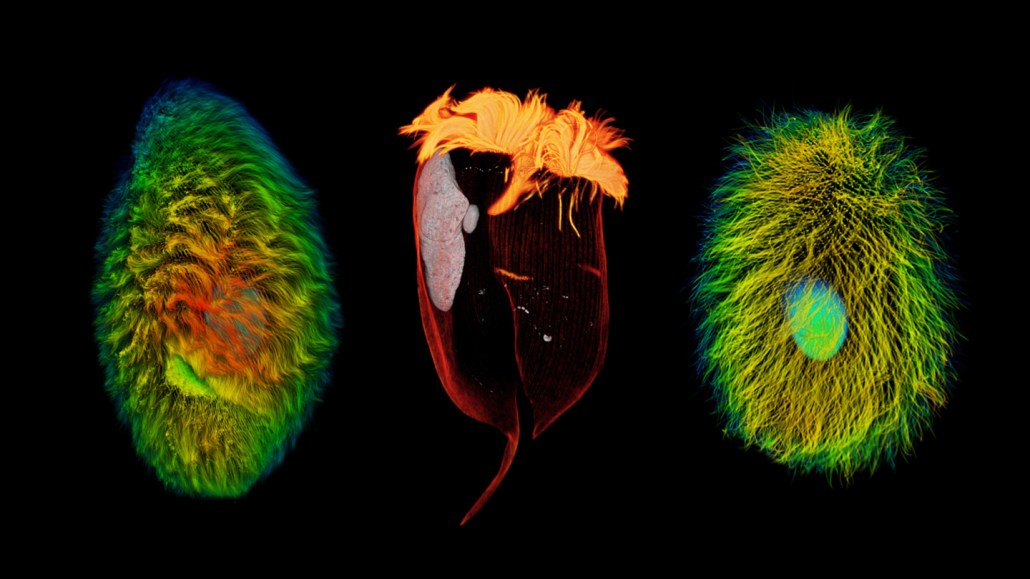
Fluorescent microscope images of three ciliate protozoa from the rumen (first stomach) of cattle. The one on the left is egg-shaped and covered in waves of green, yellow and red hairlike cilia. In the center a clear, red goblet-shaped organism is topped by a bright orange shock of cilia. On the right is a green and yellow microbe that resembles an oval Koosh ball with a blue-green oval in the center. The center oval is the nucleus. These organisms have a newly discovered organelle that makes hydrogen and spurs other microbes to produce methane.

Single-celled microbes called ciliates make up about a quarter of the organisms that help cud-chewing animals break down plants. Scientists have now cataloged 65 ciliate species, including Isotricha prostoma (left), Entodinium caudatum (center) and Dasytricha ruminantium (right) shown here in 3-D fluorescent microscope images.

Chuanqi Jiang, Jinying He, and Che Hu/Institute of Hydrobiology/Chinese Academy of Sciences

🫧 A bump for cow burps

Enteric methane — the polite term for burps from cows and other cud chewing animals — is a primary contributor to global greenhouse gas emissions, representing a significant climate liability. While the global livestock industry largely gets a free ride for this pollution (“burp taxes” and other methane-reduction strategies have been proposed and later rolled back in New Zealand and there’s been a debate about climate credits for cow poop in California), there’s still a problem waiting to be solved. For years, the sector has relied on inconsistently administered feed additives. However, a new era of gastrointestinal intelligence is arriving, thanks to a microscopic discovery that may allow farmers to target the problem at its biological source rather than just changing the menu. SN‘s Tina Hesman Saey reports from the field.

🏭 Factory in the field

The discovery is a newfound organelle (a specialized, tiny structure inside a cell that keeps the cell alive and functioning, acting like a miniature organ) within some fuzzy microbes that live in a cow’s first stomach — the rumen.

Not yet a subscriber?

Access to this content requires an Investors Lab subscription. Sign up for a free trial today to explore exclusive, data-backed insights into scientific breakthroughs set to disrupt industries.