Conversations with Maya: Lauren Williams
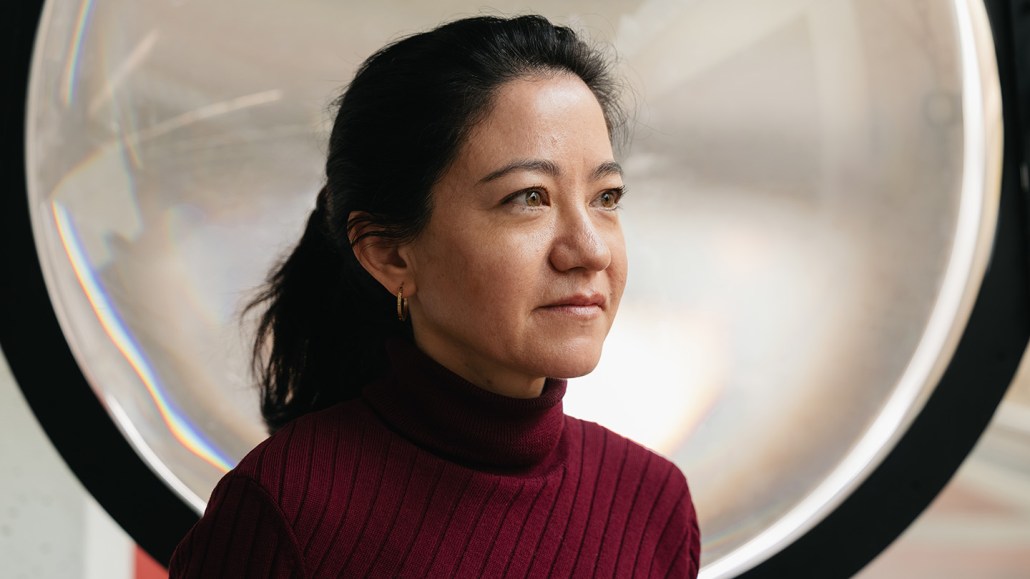
Lauren Williams is the Dwight Parker Robinson Professor of Mathematics at Harvard University and a recipient of a 2025 MacArthur Fellowship. She is a 1996 alumnus of the International Science and Engineering Fair (ISEF).
Photo Credit: Lucy Lu
Maya Ajmera, President & CEO of Society for Science and Executive Publisher of Science News, spoke with Lauren Williams, the Dwight Parker Robinson Professor of Mathematics at Harvard University and a recipient of a 2025 MacArthur Fellowship. She is a 1996 alumnus of the International Science and Engineering Fair (ISEF), a program of Society for Science.
What are your favorite memories from ISEF?
One of the things I really enjoyed about ISEF was talking to the judges about my work. It was great to talk to people who knew something about what I was doing, were enthusiastic and wanted to hear more.
Was your ISEF project a project in mathematics?
Yes. I participated in a summer program called the Research Science Institute (RSI) at MIT, which is where I began my research. After RSI concluded, my RSI mentor Satomi Okazaki connected me to Doug Jungreis, who was then a postdoc at UCLA near my home in Los Angeles, and he continued to mentor me. This enabled me to continue working on the research that became my ISEF project.
How would you describe the central ideas that drive your research?
My research is in algebraic combinatorics. Algebra is the study of things like polynomials, and combinatorics is the study of finite or discrete structures; it often involves counting. As an example, if you give a combinatorialist a cube, they will probably observe that it has six two-dimensional faces, 12 one-dimensional edges, and eight zero-dimensional vertices.
In my Ph.D. thesis, I studied a mathematical object called the positive Grassmannian. There are actually infinitely many positive Grassmannians, and they can have arbitrarily high dimensions, but just like a cube, each one can be decomposed into pieces of different dimensions. My first graduate school theorem was an explicit formula for the number of pieces of each dimension in each positive Grassmannian.
Your work lies at the intersection of algebra, combinatorics and geometry. What happens when those fields collide?
One thing that is useful about being at the intersection of several mathematical fields is that you’ve got a larger set of tools to draw from and a larger set of problems. My work has had unexpected connections to fields even outside of math. A year after I wrote my first paper on the positive Grassmannian, another mathematician named Sylvie Corteel wrote a paper proving that my formulas enumerating could be interpreted as probabilities explaining what happens in a model called the asymmetric simple exclusion process. This model was introduced by biologists to study translation in protein synthesis, and it has also been used as a model for traffic on a one-way street.
At that point I had never heard of the asymmetric simple exclusion process, but all of a sudden I was learning that my polynomials were computing probabilities related to traffic flow and protein synthesis. It was extremely intriguing.
Congratulations on being named a 2025 MacArthur Fellow. How did you feel when you learned you received the award?
I’ll preface my answer by saying that in May 2025, essentially all of the federal science grants at Harvard were canceled by the government. I had an individual National Science Foundation (NSF) grant for my research, and two NSF conference grants. The grants were all canceled in May — and I was supposed to use one of them to organize a conference at Harvard in June! It was an incredibly disruptive, stressful and discouraging experience. Since last spring, it has felt like higher education, and the field of science, was having an existential crisis.
Then in the fall I got a phone call from the MacArthur Foundation telling me I had won one of their awards. This was quite a wonderful shock. It was a real gift to be told that somebody still cares about my research and to be given the resources I needed. The award couldn’t have come at a better time.
Who inspired you when you were younger and who inspires you today?
When I was younger, I had many wonderful teachers who encouraged me in writing, math and music. I also grew up with three younger sisters, who like me loved math and science. Then when I was a senior in college at Harvard, I met Maryam Mirzakhani, who had just started graduate school at Harvard. We took a class together, and while she was quiet and a bit shy, she was clearly very intelligent and asked penetrating questions. She went on to become the first woman to win a Fields Medal, though tragically she passed away from cancer a few years later.
Today, I have a number of friends who inspire me, many of whom are women. Many are juggling careers with parenting. It’s inspiring to see women doing amazing work while juggling whatever else is going on in their lives.
What were your favorite books growing up and what are you reading today?
In elementary school my favorite books were the Narnia chronicles, starting with The Lion, the Witch and the Wardrobe, as well as the Lord of the Rings trilogy.
More recently, I’ve read several inspiring memoirs by female scientists. I read Sara Seager’s memoir The Smallest Lights in the Universe, about her work as an astrophysicist as well as her life. I also enjoyed Hope Jahren’s memoir Lab Girl, which discusses her life and work as a geochemist.
You recently coauthored a paper called First Proof, which examined the ability of large language models to solve complex mathematical questions. What prompted this investigation? What did you learn?
We initiated this project in part because the media surrounding AI and math is so extreme. There are articles saying AI is going to “solve math,” as well as articles saying that AI is useless. We wanted to develop an objective test to see how good AI is at proving mathematical statements.
We had to design this test very carefully because if you ask an AI model a math question, and the answer is on the internet somewhere, the model is going to find that solution. We had to identify problems that did not have solutions online. We also didn’t want to use famous unsolved conjectures, because that wouldn’t tell us anything. We needed to develop solvable open questions whose solutions were not on the internet: We concluded that we should use research questions from our own work that we had recently solved but not yet published. Our initial paper First Proof consisted of 10 problems from different areas of math. We made this paper public on February 6, and revealed the solutions on February 14, to allow for a “community experiment” during the eight days in between. During this time many companies and individuals took on the challenge and tried to solve our problems.
What did you learn from this experiment?
In our testing of a few publicly available AI models, before we publicly released the problems, we found that if we gave the model one shot to answer each question, as opposed to interacting with the model and giving feedback on intermediate solutions, the model could solve two of our 10 problems. During the community experiment, several companies shared more impressive results using their internal, but not publicly available, models. We didn’t specify any strict protocols for the community to follow, like the one shot rule, making it difficult to come to any definitive conclusions or compare the outcomes. We are now busy preparing to release a second more formal round of problems.
There are many challenges facing the world today. What keeps you up at night?
I would say one of the things keeping me up at night is worrying about the state of higher education and funding for science research in general. Recently, the government has been trying to cut as much funding as possible for basic scientific research, including graduate and postdoctoral fellowships.
Another thing I’m thinking about is how we, as mathematicians, can best use tools such as AI. While AI models can be very helpful, when it comes to math research, the models often output a wrong answer with a great deal of confidence. We need better tools for determining whether an AI-generated solution is correct.
What gives you hope for the future?
My students give me hope. I teach a freshman seminar every year, and it’s always a wonderful experience for me to get to know these very bright 18-year-olds who are arriving at Harvard full of hope and dreams. Their excitement and enthusiasm keep me feeling young and optimistic.