Astronomy
- Planetary Science
Sun may make most of the water on moon’s surface
A constant stream of particles from the sun bombarding the moon's surface may be the source of most lunar water.
- Planetary Science
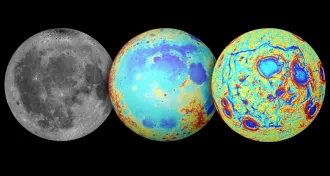
Asteroid impact did not form the moon’s largest plain
The moon's vast flatland — called Oceanus Procellarum — may have been formed through tectonic-like activity billions of years ago, scientists say.
- Chemistry
Interstellar chemical resembles building blocks of life
A molecule detected in the space between stars resembles amino acids, suggesting those building blocks of life share a similar origin.
- Astronomy
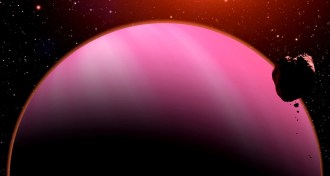
Water found on Neptune-sized world
Just four times as wide as Earth, HAT-P-11b is the smallest exoplanet known to store water in its atmosphere.
- Cosmology
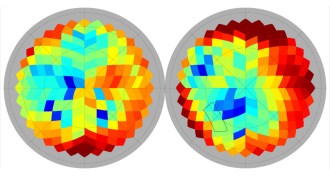
Gravitational wave discovery gives way to Milky Way dust
New polarization maps from the Planck satellite suggest that the BICEP2 announcement this year of primordial gravitational waves might be due entirely to dust in our galaxy.
- Astronomy
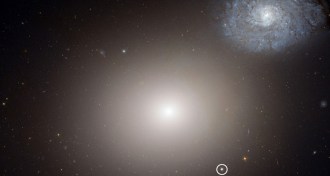
Enormous black hole resides at core of tiny galaxy
A small galaxy stores 15 percent of its mass in a black hole, suggesting compact galaxies might be shreds of once larger galaxies.
- Astronomy
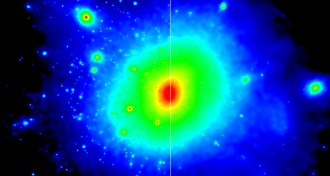
Tweak to dark matter may explain Milky Way mystery
Dark matter weakly interacting with light in the early universe might have prevented satellite galaxies from forming around Milky Way, astronomers propose.
- Astronomy
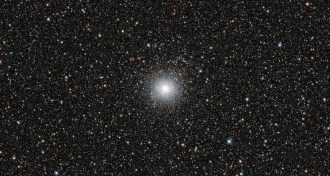
Mystery of missing lithium extends beyond Milky Way
Stars in cluster Messier 54, part of a nearby dwarf galaxy, have just as little lithium as stars in the Milky Way, suggesting that the mystery of the missing element is universal.
- Astronomy
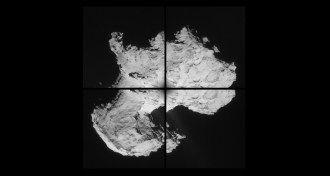
Rosetta’s comet shows few signs of surface ice
The first data sent back from one instrument aboard the Rosetta spacecraft suggests that comet 67P/Churyumov-Gerasimenko has little surface ice.
- Astronomy
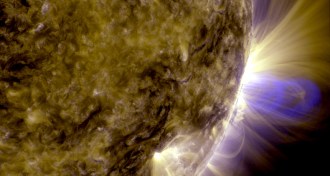
Plasma corkscrews form on sun during stellar eruption
Coronal mass ejection creates twisted loop in sun’s magnetic field.
- Astronomy
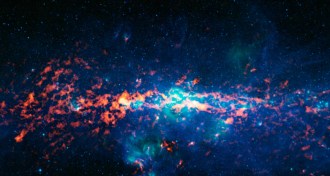
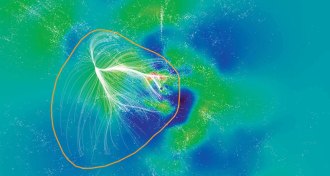
Milky Way connected to a vast network of galaxies
The Milky Way galaxy lives on the outer edge of a newly discovered supercluster of galaxies named Laniakea that is 520 million light-years across.
- Astronomy
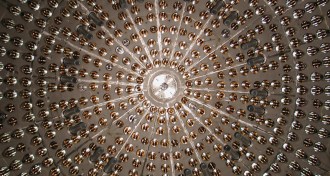
Subatomic particles give glimpse into sun’s core
For the first time, a subterranean detector has captured neutrinos generated in the main nuclear reactions that power the sun.