Physics
We summarize the week's scientific breakthroughs every Thursday.
- Physics
To get string theory, you need only four physics assumptions
Tenets of quantum mechanics and special relativity, among other theoretical ideas, lead inexorably to string theory.
- Particle Physics
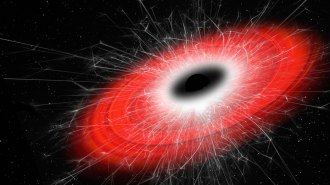
To understand black holes, physicists turn to a mathematical ‘Rosetta stone’
A link between particle physics and gravity equations, called the double copy, applies to Hawking radiation, creating a new way into black hole puzzles.
- Quantum Physics
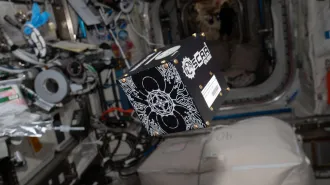
A grapefruit-sized quantum device mapped Earth’s magnetic field from space
On the International Space Station, a cube holding a diamond-based sensor revealed the potential for quantum magnetometers.
- Physics
The secret to perfect espresso? It’s physics
Inspired by gas and liquid flow in earth science, researchers brewed an equation to calculate the speed of water percolation through ground coffee.
- Particle Physics
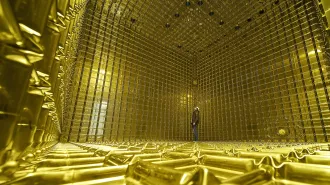
A strange ‘neutrino force’ helped heal a crack in particle physics
A neglected force produced by neutrinos and other particles helps atomic physics measurements align with predictions of the standard model.
- Physics
A new measurement reveals gravity is still hard to pin down
After a 10-year effort, physicists got a value for “Big G” that does not settle the debate over one of nature’s hardest numbers to nail down.
- Cosmology
Exploding black holes could explain an antimatter mystery
Shock waves from tiny black holes in the early universe could explain how antimatter became so rare while matter is common.
- Quantum Physics
Just 10,000 quantum bits might crack internet encryption schemes
Quantum computers based on atoms could provide access to encrypted data much sooner than scientists thought.
- Quantum Physics
Quantum physics can confirm where someone is located
The concept of entanglement links far-flung particles. That relationship can prove that someone is in the location they claim to be.
- Physics
Water has a newfound ‘critical point’ that may help explain its quirks
At cold temperatures, water has two different liquid phases, which become one at the critical point. The discovery could help explain water’s quirks.
- Particle Physics
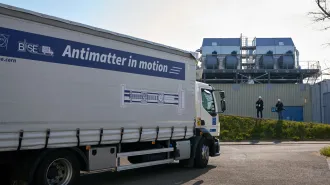
Antimatter traveled by truck for the first time
Scientists are envisioning an antimatter delivery program that could ferry antiprotons from CERN to other labs around Europe.
- Physics
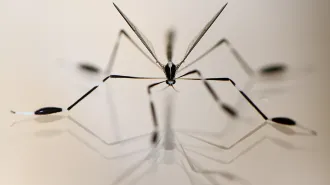
These insects fly with their legs. Physics explains how
Phantom crane flies change the angle of their splayed legs to increase or reduce drag, helping them navigate varying winds.