Space
We summarize the week's scientific breakthroughs every Thursday.
- Planetary Science
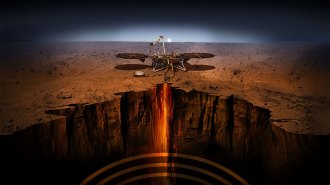
Marsquakes and meteorite hits show Mars has a dense liquid metal core
Mars’ dense liquid iron core is wrapped in a layer of molten rock, which threw off previous measurements of the Red Planet’s heart.
- Physics
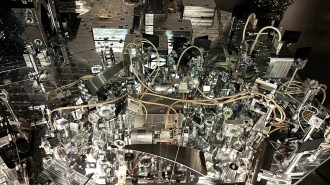
How quantum ‘squeezing’ will help LIGO detect more gravitational waves
An upgrade to LIGO that comes from exploiting a quantum rule known as the Heisenberg uncertainty principle makes it easier to detect spacetime ripples.
- Astronomy
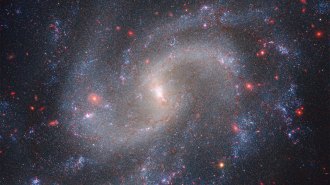
A rare glimpse at a relatively nearby supernova offers clues to how stars die
Thanks to its home in the Pinwheel galaxy, a favorite of amateur astronomers, researchers have monitored SN 2023ixf since shortly after it exploded.
- Planetary Science
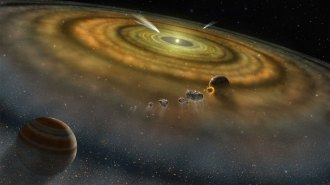
Giant planet ‘destabilization’ may have coincided with the birth of Earth’s moon
New meteorite data suggest the orbits of the giant planets abruptly changed about 60 million to 100 million years after the solar system started forming.
- Space
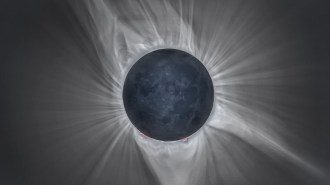
Here’s how citizen scientists can help during the 2024 solar eclipse
The sun will be near the peak of its activity cycle during the eclipse on April 8, 2024, making it a great time to crowdsource solar research.
- Planetary Science
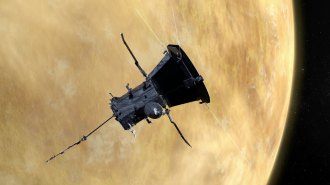
Here’s another strike against Venus having copious lightning
Past data and the Parker Solar Probe’s new discovery of weird whistler waves overturn the idea that Venus’ hellish atmosphere has a lot of lightning.
- Astronomy
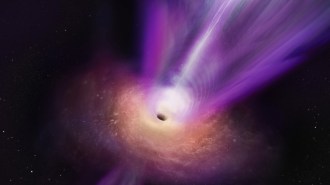
The black hole–powered jet in galaxy M87 is making stars explode
Hubble Space Telescope data show a surprising number of nova blasts along the jet of high-speed gas coming from the galaxy M87.
- Space
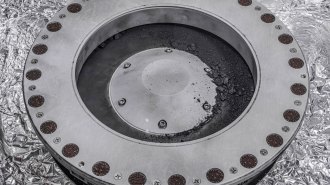
NASA’s first look at a sample from asteroid Bennu reveals life’s building blocks
Scientists have begun to analyze roughly 250 grams of Bennu, which could offer insight into solar system formation and life’s origins on Earth.
- Planetary Science
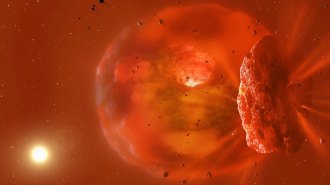
In a first, astronomers spot the afterglow of an exoplanet collision
A surge of infrared light from a remote star might have been a glow cast by the vaporized leftovers of an impact between Neptune-sized worlds.
- Physics
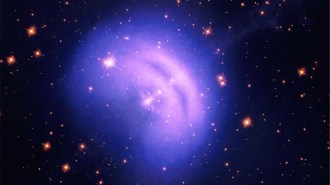
Vela’s exploded star is the highest-energy pulsar ever seen
A spinning dead star about 1,000 light-years away, in the constellation Vela, raises questions about how pulsars can emit such extreme radiation.
- Cosmology
New JWST images suggest our understanding of the cosmos is flawed
JWST data don’t resolve a disagreement over how fast the universe is expanding, suggesting we might need strange new physics to fix the tension.
- Astronomy
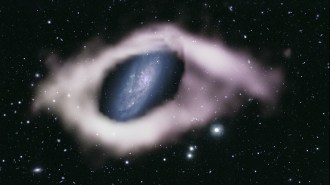
This ‘polar ring’ galaxy looks like an eye. Others might be hiding in plain sight
New images of two galaxies reveal what look like rarely seen rings of hydrogen gas nearly perpendicular to the galaxies’ starry disks.