All Stories
- Climate
Environmental change may spur growth of ‘rock snot’
A controversial new theory suggests alga that forms rock snot isn’t an invader, but a low-key species native to many rivers.
- Health & Medicine
Newer schizophrenia drug isn’t necessarily better
A newer antipsychotic medication may work no better than an older drug, results from a clinical trial show.
- Ecosystems
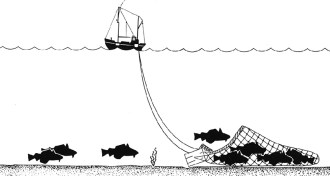
Deep-sea trawling threatens oceans’ health
Dragging large nets along the seafloor to catch fish cuts organic matter and biodiversity in half and may threaten all of the world's underwater ecosystems.
- Science & Society
Trust in gravity isn’t always the best astronomy policy
Historical episodes involving Neptune, Mercury and gravity have implications for today’s dark matter and dark energy mysteries.
- Planetary Science
Rosetta spacecraft’s comet develops dusty envelope
Comet 67P/Churyumov-Gerasimenko, the target of ESA’s Rosetta mission, has developed a dust coma.
- Animals
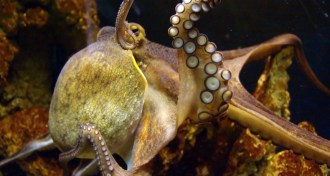
How an octopus keeps itself out of a tangle
The suckers on an octopus stick to just about anything, except the octopus itself. Scientists think they’ve figured out why.
- Health & Medicine
How Kawasaki disease may blow in with the wind
The origin of Kawasaki disease has been linked to farmlands in northeastern China.
- Climate
Forest fires may speed demise of Greenland’s ice sheet
Black carbon released by burning woodland darkens Greenland’s ice sheet, quickening its melt.
- Animals
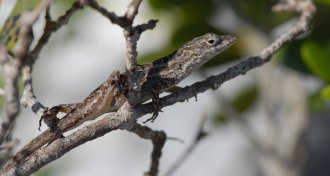
Lizards may scale back head bobbing to avoid predators
Brown anoles may scale back mating signals to avoid being eaten.
- Health & Medicine
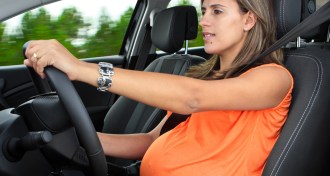
Study on pregnant women’s driving has some potholes
New study finds that pregnancy makes women get into more car accidents, but there could be a simpler explanation.
- Physics
‘The Sound Book’ explores echoes, bad acoustics and more
Acoustic engineer Trevor Cox provides an international tour of aural amazements.
- Particle Physics
Proposed experiment would create matter from light
Photon collider would convert light into electrons and positrons.