All Stories
- Astronomy
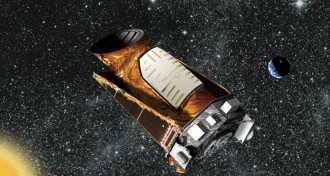
Billions and billions of Earth-sized planets call Milky Way home
Using Kepler data, astronomers estimate that a sizeable fraction of the galaxy’s sunlike stars have Earth-sized planets that could support liquid water.
- Psychology
Male version of eating disorder replaces purging with muscle enhancers
Physique concerns can drive young men to take banned substances.
- Earth
Greenhouse gas injections may unleash earthquakes
Plans to pump carbon dioxide into the ground to mitigate climate change could create other problems.
- Neuroscience
Brain enables sight without light
Sensory cross talk may underlie ability to see one’s own hand moving when it’s pitch black.
- Astronomy
Giant loner could shift idea of star formation
Observations of WR 102ka suggest it could have been born without any gaseous companions.
- Physics
New Atomic Accelerator
This excerpt from the December 14, 1963, issue of Science News Letter talks about how the atom smashers at Argonne National Lab have evolved.
- Materials Science
Qingsongite
This newly christened mineral has an atomic structure that’s similar to diamond and nearly as hard.
-
-
- Science & Society
U.S. science funding sends young people a mixed message
I think science, and more specifically scientific thinking, is the most powerful tool for understanding the world. Everyone should learn how to think like a scientist.
-
- Animals
Wag the dog: When left vs. right matters
Most of us see a wagging dog’s tail and automatically think it’s a good sign. But are some wags more friendly than others? A new study says yes.