All Stories
- Animals
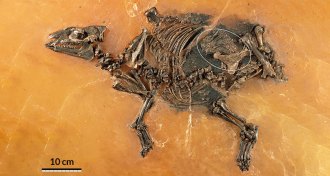
Oldest pregnant horselike fossil found
A 48-million-year-old fossil of an early horse and fetus is the oldest and best-preserved specimen of its kind.
- Science & Society
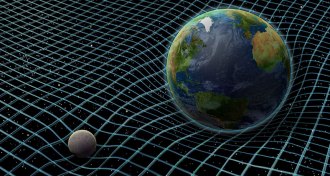
General relativity centennial celebrates Einstein’s genius
Science News uses the opportunity of the 100th anniversary of the general theory of relativity to take a deep dive into one — perhaps the most important — of Einstein’s scientific contributions.
- Science & Society
Special Report: Gravity’s Century
After years of pondering the interplay of space, time, matter and gravity, Einstein produced, in a single month, an utter transformation of science’s conception of the cosmos: the general theory of relativity.
- Quantum Physics
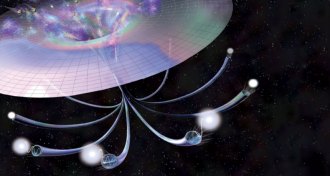
Entanglement: Gravity’s long-distance connection
The universe may be a vast quantum computer that safely encodes spacetime in an elaborate web of entanglement.
- Genetics
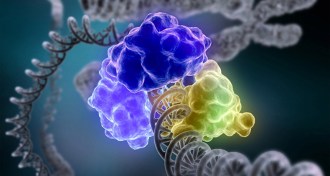
Chemistry Nobel honors studies of DNA repair mechanisms
Studies of DNA’s repair mechanisms have won Tomas Lindahl, Paul Modrich and Aziz Sancar the 2015 Nobel Prize in chemistry.
- Animals
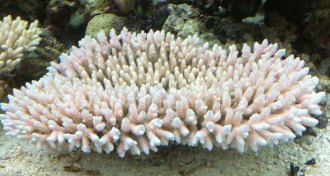
No eyes, no problem for color-sensing coral larvae
Switching colors of underwater light can switch preferences for where staghorn corals choose their forever homes.
- Particle Physics
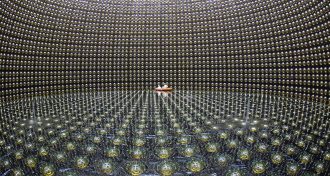
Top 10 subatomic surprises
Nobel Prize–winning neutrinos rank among science’s most unexpected discoveries.
- Particle Physics
Neutrinos’ identity shift snares physics Nobel
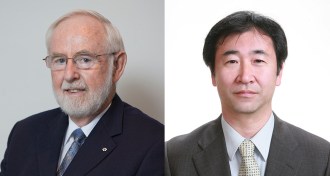
Arthur McDonald and Takaaki Kajita shared the 2015 Nobel Prize in physics for the discovery that neutrinos oscillate between different types, which demonstrates that the particles have mass.
- Science & Society
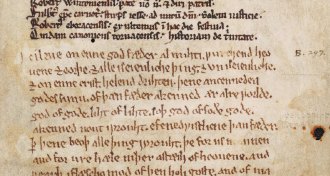
Neurological condition probably caused medieval scribe’s shaky handwriting
By scrutinizing a medieval scribe’s wiggly handwriting, scientists conclude that the writer suffered from essential tremor.
- Astronomy
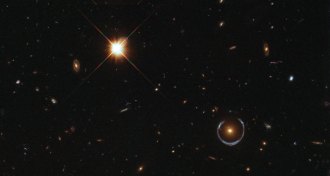
Using general relativity to magnify the cosmos
Astronomers have Einstein to thank for the tools that bring far-away galaxies and maybe even black hole collisions into view.
- Humans
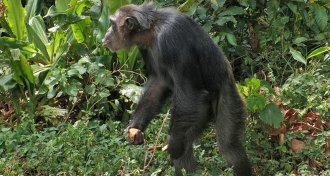
Chimpanzees show surprising flexibility on two feet
Chimpanzees’ upper-body flexibility while walking upright suggests ancient hominids walked effectively.
- Particle Physics
Discovery of neutrino mass earns 2015 physics Nobel
The discovery that subatomic particles called neutrinos have mass has won Takaaki Kajita of the University of Tokyo and Arthur McDonald of Queen’s University in Kingston, Canada, the 2015 Nobel Prize in physics.