It masquerades as malignant. But this bone-covered tumor is benign

Telling this mass apart from cancerous tumors could prevent unnecessary chemotherapy for patients
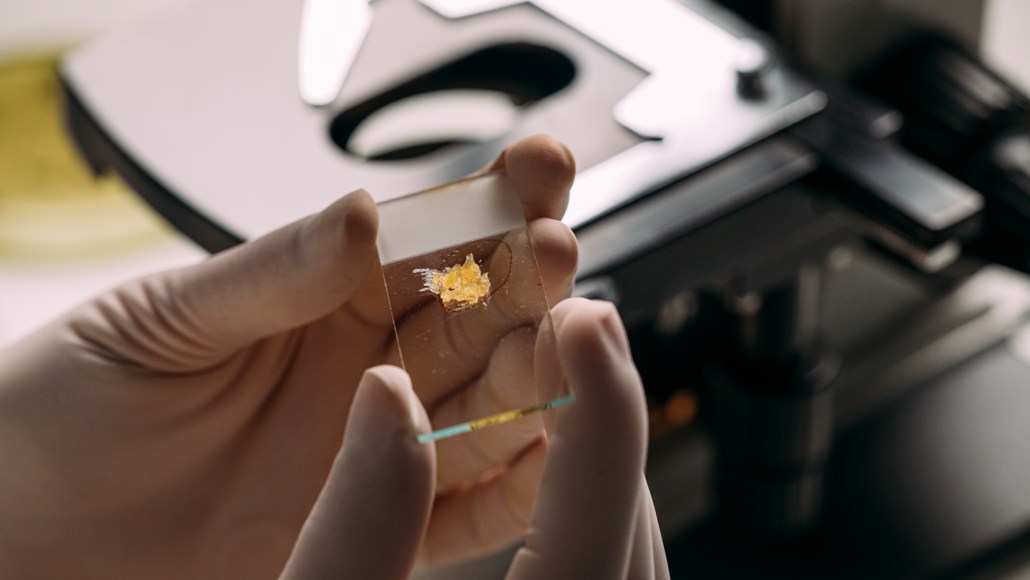
Gloved hands hold a microscope slide with a tissue sample on it

When examining a mass, a researcher found it had unusual characteristics. It’s bony shell and varied cells didn’t fit into any known tumor categories.

FreshSplash/Getty Images

It has traits that could easily be mistaken for cancerous tissue. But a new type of tumor with squishy insides cocooned in a hard, bone crust is actually benign.

Now, detailed guidelines will help doctors lump the mass in with benign growths instead of falling for a fatal-seeming façade, researchers report in the Dec. 3 issue of Modern Pathology. The classification may help patients avoid receiving unnecessary, and potentially damaging, chemotherapy treatment. 

“Imagine you feel something as hard as a baseball inside your muscles. You are always going to think about something bad,” says Fabrizio Remotti, a pathologist at Columbia University Irving Medical Center who was not involved in the study. “This paper is a big service to the general public because it actually gives a pathologist incredibly good tools to identify this lesion.”

To identify masses, pathologists examine samples from patients under a microscope, analyze their DNA and investigate underlying biochemistry for clues about where in the body the growth originated. 

A close-up cross-section photo of a tissue growth surrounded by bone
This benign cue ball-sized growth (shown in a photograph) looks deceptively cancerous. New, clear guidelines to help doctors identify it may help patients avoid damaging treatments. John Gross, Andrew Rosenberg, and Greg Charville

But in 2022, pathologist John Gross encountered an unusual bone-covered tumor from a patient’s limb. It resembled malignant sarcoma, a rare type of cancer that accounts for around 1 percent of adult cancers. There are established tumors known to have bony exteriors. But this mass didn’t fit into a known category. For instance, though it contained keratin, a protein generally found in certain cancer cells, the undefined entity didn’t have genes known to be indicators of cancer.

“It was really kind of a head-scratcher,” says Gross, of Johns Hopkins School of Medicine. Miffed, he logged the tumor as unclassified.

For years, he hunted for similar cases. By2025, he learned about 12 candidates at other institutions. Patients reported finding a hard mass in or near their legs and arms. While alarming, most patients found the cue-ball-sized growths painless.

Gross and his colleagues ran molecular tests on the growths. They used a tool that reads a tumor’s patterns of a chemical on-off switch in genes known as methylation. They also sequenced the tumors’ entire set of RNA. Commercial RNA sequencing panels scan for a small group of gene fusions known to cause cancer. The abnormal merges are often associated with cancer, and if similar, can provide clues to whether cases are related. The team hoped to find common gene fusions across the samples that standard panels may have missed. 

They found that the tumors had identical genetic “switches” — revealing a specific internal fingerprint. And they discovered a never-before-seen gene fusion that recurred in the majority of cases. The new findings, combined with previous descriptions of unusual characteristics, provided enough proof for a new category. 

The researchers named the tumor OSET (ossifying spindled and epithelioid tumor) after its appearance and two types of cells it contains — both of which are atypical in bone-covered tumors. The finding allowed doctors to carry out the correct treatment: Remove the tumor and avoid chemotherapy. No patients in the study have reported a resurgence of the growth since receiving the surgery.

“The next steps are to continue getting awareness to clinicians, patients and especially pathologists, so we can diagnose them correctly,” Gross says. “One of the biggest problems is overtreatment and giving chemotherapy or radiation for something that really just is benign.”

About Carly Kay

Carly Kay is the Fall 2025 science writing intern at Science News. She holds a bachelor’s degree in communication from the University of California, Santa Barbara and a master’s degree in science communication from the University of California, Santa Cruz.