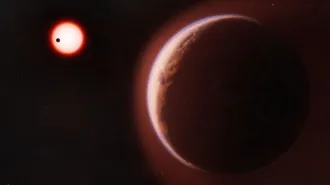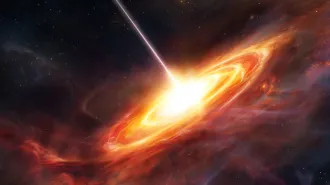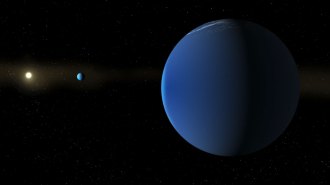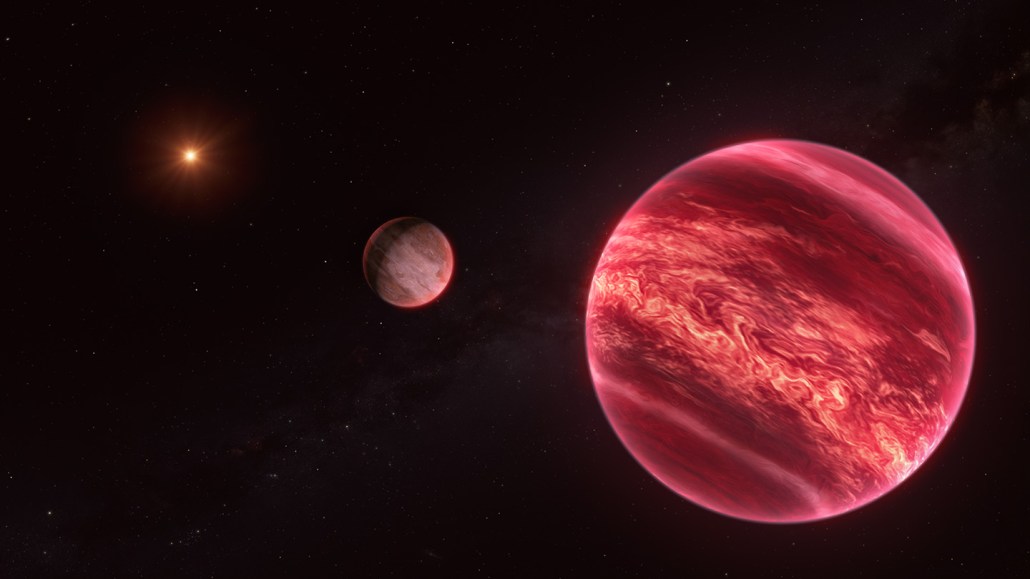
A newly spotted extrasolar object about the mass of Jupiter (illustrated in the foreground) orbits a brown dwarf (middle) which orbits a small star (bright point in the background). Astronomers aren’t sure what to call it.
M. Kornmesser/ESO
A newly discovered cosmic object is not a planet, not a moon — but a third thing we don’t have a name for yet.
The object is about as massive as Jupiter and orbits a brown dwarf — a body that fuses deuterium in its core but is too small to burn hydrogen and shine as a true star. The brown dwarf, in turn, loops around a small star. That hierarchy of orbits makes the system, called CD-35 2722, the first with a known “exosatellite”, astronomer Kevin Hoy and his colleagues report July 22 in Nature.
They coined that term because nothing else is quite right. It’s not exactly an “exomoon.” And “exoplanet” doesn’t feel right either, says Hoy, of the University Diego Portales in Santiago, Chile. “The structure of CD-35 is so different from the structure of the solar system that all the words we invented to describe the solar system just aren’t really working anymore.”
The find reignites a longstanding debate about what makes a planet a planet: an object’s intrinsic properties or its relationship to other bodies.
Hoy and his colleagues used the Very Large Telescope in Chile to observe the brown dwarf multiple times from October 2023 to February 2026. Periodic shifts in the wavelengths of the brown dwarf’s light revealed a massive companion tugging it to and fro — the same technique used to find the first exoplanets in the 1990s and hundreds since.
But this is the first time the technique has identified what Hoy calls a “moonish thingy”: something orbiting a bigger something orbiting a bigger something.
Does that nested arrangement make the object a moon? Hoy doubts it. “It feels so off,” he says. “We’re probably not going to get away with calling it an exomoon.”
The official definition of exoplanet also suggests not. Written in 2018 by the International Astronomical Union — the same body that redefined Pluto as a dwarf planet in 2006 — it unambiguously categorizes a planet-mass object orbiting a brown dwarf as an exoplanet. It doesn’t require the brown dwarf to be the biggest thing around.
“If you accept that this is a brown dwarf, that kind of forces the companion to be a planet,” says astronomer David Kipping of Columbia University, who has searched for exomoons with a different technique for more than a decade. “We can argue about if the IAU definition is wrong or right, but by the current IAU definition it’s a planet.”
That doesn’t sit right with Hoy either. “Because of the system hierarchy setup, it doesn’t feel the same as what normal planets are doing.” And this system isn’t the only oddball. In January, another group reported a tentative sign of a similar satellite around a brown dwarf in a different star system. If it holds up, that object is about half Jupiter’s mass.
Motion has defined planets since the ancient Greeks coined a word for “wandering star” to describe the points of light that move against the background of fixed stars. The Copernican revolution shifted the focus to movement around the sun, but motion was still key. A planet, the IAU authors wrote, is less a question of size or composition than of one body moving around another “in a hierarchical configuration.”
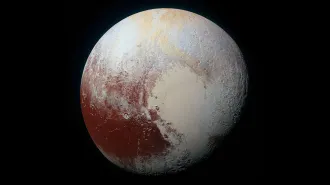
A look at the solar system supports this idea. The largest moons, Saturn’s Titan and Jupiter’s Ganymede, are roughly the same mass and size as the smallest planet, Mercury. “We’d be comfortable calling Mercury a moon if it orbited Jupiter and calling Ganymede a planet if it orbited a star,” Hoy says.
Ultimately, Kipping says, “nature doesn’t give a damn about how humans want to neatly bucket things.” But finding things that orbit other things that orbit other things suggests a discovery of true exomoons may not be far off.
“I think it’s exciting that we’re definitely entering the exomoon regime now,” Kipping says. “Even if this isn’t an exomoon.”