What to know about a rare hantavirus outbreak at sea
It’s unclear if it came from rodents on board or ones encountered on land

An outbreak of hantavirus aboard an expeditionary cruise ship, the MV Hondius, shown here off the coast of Cape Verde, has killed three passengers and sickened four other people.
AFP/Getty Images
Seven people aboard a cruise ship may have gotten hantavirus, a deadly illness more often associated with breathing in desert or other land dust. How could that happen?
When ship outbreaks make the news, the culprit tends to be norovirus or the virus that causes COVID-19. Now, though, the cruise ship MV Hondius is moored off the coast of Cape Verde in Africa with ill passengers and crew aboard. Hantavirus, a group of viruses that sometimes infects people who breathe in rodent excrement, may have killed three people and sickened four others.
Risk to the general public is low, Maria Van Kerkhove, the World Health Organization’s director of Epidemic and Pandemic Preparedness and Prevention, said in a news briefing May 4. Contact tracing, laboratory tests and other work is ongoing, she said. “Our priority is to keep the passengers and the crew safe and healthy while limiting the spread of this virus.”
Hantavirus has been confirmed in two passengers. One, a British citizen who was evacuated to South Africa, was the first to test positive for hantavirus, according to Oceanwide Expeditions, the company that runs the cruise line. On May 5, WHO confirmed that one of the dead passengers, a 69-year-old Dutch woman whose husband died on board first, was also infected. Another person had a mild fever but now has no symptoms, Van Kerkhove said in a news briefing May 5. That person is being considered a suspected case, bringing the count to seven.
WHO is working with several countries to investigate the situation and to evacuate sick passengers and crew members for treatment. The ship will continue to Spain’s Canary Islands where health officials will conduct a thorough investigation and disinfect the ship.
Hantaviruses infect thousands of people around the world each year, sometimes with deadly consequences. Most cases go under the radar, but some, such as the death of actor Gene Hackman’s wife, Betsy Arakawa, and this cruise ship incident garner attention.
“When these viruses make waves, they make big ones,” says Sabra Klein, a viral immunologist at Johns Hopkins Bloomberg School of Public Health. The reason hantaviruses “grab headlines isn’t because there are incredible numbers of cases,” she says. “It’s still very rare, but we do not have a vaccine, we do not have a cure.” And fatality rates can be high.
Many questions still remain about how cruise ship passengers fell victim to a virus that usually infects people on land. Science News contacted experts to help answer some of them.
What is hantavirus?
Hantavirus is not just one thing. There are more than 50 different types of hantaviruses, Klein says. Some can infect people, though humans are not the viruses’ usual hosts.
Hantaviruses infect rodents, moles and some bats, says Kartik Chandran, a virologist at Albert Einstein College of Medicine in New York City. The type of hantavirus aboard the cruise ship may be the Andes strain, one type of hantavirus found in Argentina where the ship began its Atlantic cruise.
A type of hantavirus known as Seoul virus has spread around the world because it infects Norway rats, which despite their name are everywhere. Clusters of hantavirus infections in the United States have been linked to the exotic pet trade. But, Chandran says, “most hantaviruses are just going about their business and not infecting people.”
Most hantaviruses have evolved to infect only specific host species, he says. Often animals infected with the viruses don’t get sick. And many people may be exposed to the viruses but fight them off without getting ill.
How do people catch hantavirus?
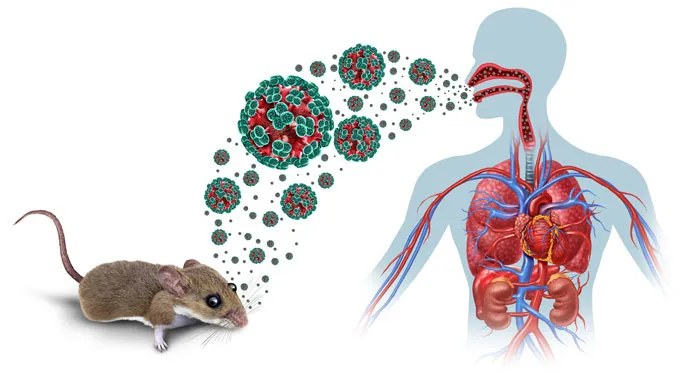
Urine, feces and saliva from infected animals contain hantavirus. Though people could get it from saliva, more commonly people contract hantavirus when they breathe in aerosolized particles of rodent pee or poop, Chandran says. “These are accidental, or zoonotic, infections, meaning that the virus is jumping from across the species barrier into people.”
Hantavirus particles can be stirred up by “sweeping, vacuuming, all the things that we think of when we see rodent excrement,” Klein says. Crew members are “probably vacuuming every nook and cranny on a ship,” but that could release even more virus into the air. Use bleach or alcohol-based solutions to clean up rodent droppings and prevent aerosolization of the virus, she recommends.
How does hantavirus infect cells?
Hantaviruses are a group of viruses that contain RNA as their genetic material. They are envelope viruses: A hard protein shell surrounds the RNA. That shell, in turn, is encased in a membrane studded with glycoproteins — proteins that have specific sugars attached to them. Those glycoproteins cluster in groups of four, giving the appearance of a virus covered in flowers, Chandran says.
When a person breathes in hantavirus, these flowerlike complexes act as a machine to grab a protein on human cells called protocadherin-1, or PCDH1. Once attached, the cell engulfs the virus, taking it into a stomachlike compartment called the endosome. Just like when people eat food, a cell that has swallowed a virus has a rush of acid to its “stomach.” Acidification is the virus’s signal to let its flowers bloom in a very dramatic way, Chandran says.
The glycoprotein is a multifunctional machine, much like a Swiss army knife, he says. Until acidification happens, the knife is closed. But then, “like a Swiss army knife, it exposes the blade, and it sticks into the membrane of the cell. And then, just like a Swiss army knife, it exposes another blade.” Finally, he says, “this glycoprotein essentially makes the membrane of the virus fuse with the membrane of the cell, kind of like two soap bubbles coming together.”
That fusion releases the virus’s genetic material into the cell. The virus’s RNA acts “like malicious code being inserted into computer that basically redirects the cell to stop doing what it’s doing and basically turn it into a zombie that just makes new viruses.”
Can people give hantavirus infections to each other?
Yes, but very rarely, and only with the Andes virus version of hantavirus, says Michelle Haby, an epidemiologist at the University of Sonora in Mexico.
Haby and colleagues reviewed reports in which people supposedly infected each other and found strong evidence in only a few cases from Chile and Argentina. “It’s very difficult to prove human-to-human transmission, because you also have to rule out having the same environmental exposure to the rodents,” she says.
One study in Chile found that of 476 household contacts of patients who caught hantavirus, only 16 developed hantavirus pulmonary syndrome — a severe form of the disease — and had antibodies against the virus. In most of those cases, the people were probably exposed to the same source of the virus. Only three cases fit the bill for person-to-person spread. And those weren’t just people merely living in the same house, Haby says.
“It was only with very, very close contact,” she says. “Kissing [and] sexual contact was the most likely.”
Person-to-person spread aboard ship is unlikely, Haby says. “Obviously, if it is extremely infectious, if there was person-to-person transmission easily, you would expect a heck of a lot more people sick at the moment, and that’s clearly not the case.”
Passengers are isolating in their cabins and people aboard are wearing masks and other protective equipment to prevent infection, Van Kerkhove said.
What happens when someone gets infected with hantavirus?
Initial symptoms of infection can include fever, chills, headache, nausea, stomach pain, vomiting and diarrhea.
Once in the lungs, the virus can cause serious illness, partly because of its own action and partly because immune system reactions to the infection may harm delicate lung tissue, Chandran says. “These viruses are sort of like a burglar trying to burglarize a mansion that they’re not familiar with, and they cut the wire to disable the alarm system, and instead, the whole house blows up.”
New World hantaviruses in the Americas can cause hantavirus pulmonary syndrome, a severe respiratory disease. Symptoms include fever, cough and shortness of breath and can lead to respiratory failure and death. Up to 35 percent of people who develop the severe lung disease die.
Old World hantaviruses in Europe and Asia can cause hemorrhagic fever with renal syndrome, which can produce internal bleeding, low blood pressure and kidney failure. Fatality rates for the hemorrhagic fever range from less than 1 percent to 12 percent, depending on the virus.
Not everyone who is exposed to hantavirus will get sick and many people who get ill will recover with treatment of symptoms, Klein says. “Anyone can get exposed. Anyone can get sick, but when you look at patterns of case fatality, it’s typically that it’s people who are older, who have other comorbidities that we know are associated with more severe respiratory illness.”
How did hantavirus get on a cruise ship?
Rats. Or other rodents.
There are two probable scenarios. In one, “there are probably infected rats on the ship, and the excrement is on the ship, and the virus gets aerosolized from the excrement,” Klein says. This wouldn’t be the first time infected rodents have carried a disease aboard a ship, she says. “They go where the food is.”
In the other, rodents were almost certainly involved, but the cases may not have been contracted while on the ship, Chandran says. It takes one to eight weeks after exposure for people to become ill from hantavirus. That’s within the window from the time the ship left Argentina about three weeks ago. “There were probably people exposed on land in Argentina, where these viruses are endemic, and then got on board with it already,” he says. “There’s a lot of detective work to be done to really understand what happened.”
Haby also wonders about predeparture exposure. “I would want to know where they had visited in Argentina prior to boarding the cruise ship, because it’s quite possible it’s still consistent with infection from on land,” she says. “We can’t even say yet that … the rats are on the ship.”
Van Kerkhove said that WHO is operating under the assumption that the Dutch couple who died may have contracted the virus while on a wildlife excursion in Argentina before joining the cruise. Other people may have come in contact with rodents on other islands or perhaps on board.
“However, we do believe that there may be some human-to-human transmission that’s happening among the really, really close contacts; the husband and wife, people who shared cabins, etcetera.… Our assumption is that has happened.”